Mega Doctor News
The Texas Department of State Health Services is reporting the end of this year’s measles outbreak centered in West Texas. It has been more than 42 days since a new case was reported in any of the counties that previously showed evidence of ongoing transmission. DSHS will continue to monitor for new cases but will cease updating the interactive outbreak dashboard.
As of Aug. 18, 762 cases of measles have been confirmed in the outbreak since late January. More than two-thirds of the cases were in children. Ninety-nine people were hospitalized over the course of the outbreak, and there were two fatalities in school-aged children.
“I want to highlight the tireless work of the public health professionals across the state who contributed to the containment of one of the most contagious viruses. We arrived at this point through a comprehensive outbreak response that included testing, vaccination, disease monitoring and educating the public about measles through awareness campaigns,” said DSHS Commissioner Jennifer A. Shuford, MD, MPH. “I also want to recognize the many health care professionals who identified and treated cases of a virus that most providers had never seen in person before this outbreak.”

Public health professionals consider a measles outbreak over after 42 days with no new cases because that is double the disease’s maximum incubation period, the longest time it can take between when a person is exposed to the virus and when they get sick.
The end of this outbreak does not mean the threat of measles is over. Since there are ongoing outbreaks of measles in North America and around the world, it is likely that there will be additional cases of measles this year in Texas. Health care providers should continue to be vigilant and test for measles if their patient has symptoms compatible with the virus.
Measles is a highly contagious respiratory illness, which can cause life-threatening illness to anyone who is not protected against the virus. During a measles outbreak, about one in five children who get sick will need hospital care and one in 20 will develop pneumonia. Rarely, measles can lead to swelling of the brain and death. It can also cause pregnancy complications, such as premature birth and babies with low birth weight.
Background:
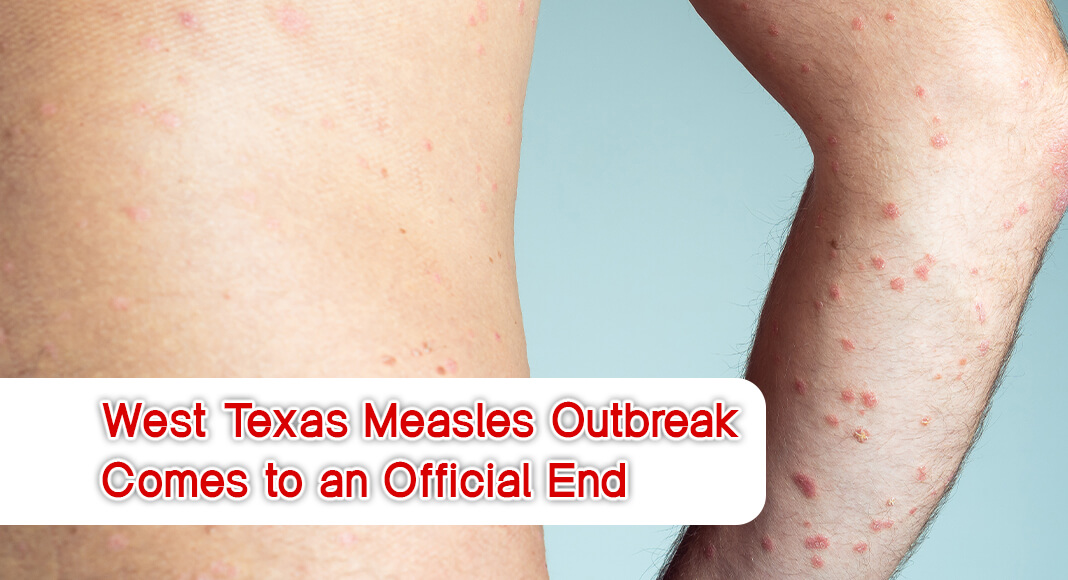
Measles can be transmitted by direct contact with infectious droplets or by airborne spread when an infected person breathes, coughs, or sneezes. People who are infected usually begin to have symptoms within a week or two after being exposed. Early symptoms include high fever, cough, runny nose, and red, watery eyes. A few days later, the telltale rash breaks out as flat, red spots on the face and then spreads down the neck and trunk to the rest of the body. A person is contagious about four days before the rash appears to four days after. People who could have measles should stay home during that period.
People who think they have measles or may have been exposed to measles should isolate themselves and call their health care provider before arriving to be tested. It is important to let the provider know that the patient may have measles and to get instructions on how to come to the office for diagnosis without exposing other people to the virus.
The best way to prevent getting sick is to be immunized with two doses of a measles-containing vaccine, which is primarily administered as the combination measles-mumps-rubella or MMR vaccine. Two doses of the MMR vaccine prevent more than 97 percent of measles infections. A small number of vaccinated people can occasionally develop measles. In these cases, the symptoms are generally milder, and they are less likely to spread the disease to other people. DSHS and the Centers for Disease Control and Prevention recommend children receive one dose of MMR at 12 to 15 months of age and another at 4 to 6 years. Children too young to be vaccinated are more likely to have severe complications if they get infected with the measles virus. However, each MMR dose lowers the risk of infection and the severity of illness if infected.
Health care providers can find recommendations for infection control and diagnostic testing in DSHS health alerts. Providers should report any suspected cases to their local health department immediately, preferably while the patient is still with the provider.
Information source: Texas Health and Human Services