









Mega Doctor News
MD Anderson Research News
- Aggressive prostate cancers often lose expression of traditional markers after treatment, making it hard to diagnose the tumor’s origin and complicating treatment decisions
- Researchers sought new sensitive markers for these cancers using The Cancer Genome Atlas
- FOXA1 was found in 80% of primary cases and 57% of metastatic cases of small cell carcinoma of the prostate
- Study suggests FOXA1 may be a highly sensitive diagnostic marker for prostate cancer, especially in cases that are challenging to diagnose due to loss of traditional markers

The FOXA1 protein is a potentially highly sensitive diagnostic marker for small cell carcinoma of the prostate and possibly other aggressive prostate cancer subtypes that are difficult to diagnose due to a loss of traditional prostate markers, according to researchers at The University of Texas MD Anderson Cancer Center.
The study, published in Histopathology, was led by Jianping Zhao, M.D., Ph.D., assistant professor of Anatomic Pathology

“The detectable expression of FOXA1 in most small cell carcinomas of the prostate makes it a potentially viable option for diagnosing aggressive subtypes that lose conventional markers,” Zhao said. “While further study is needed to understand the specific molecular mechanisms, we are encouraged by these results, which could help pathologists make prognostic and therapeutic decisions to improve patient care.”
Why is it hard to diagnose some aggressive prostate cancer subtypes?
Standard treatment for prostate cancer includes androgen deprivation therapy, but some aggressive forms of prostate cancer develop resistance independently from androgens, leading to a poorer prognosis for these patients.
In particular, small cell carcinoma of the prostate is a common, aggressive form that usually is hard to diagnose because it often loses expression of standard markers, such as NKX3.1. This makes it difficult to determine whether a metastatic tumor is the result of progression from a known tumor in the prostate or a new primary tumor from a different site.
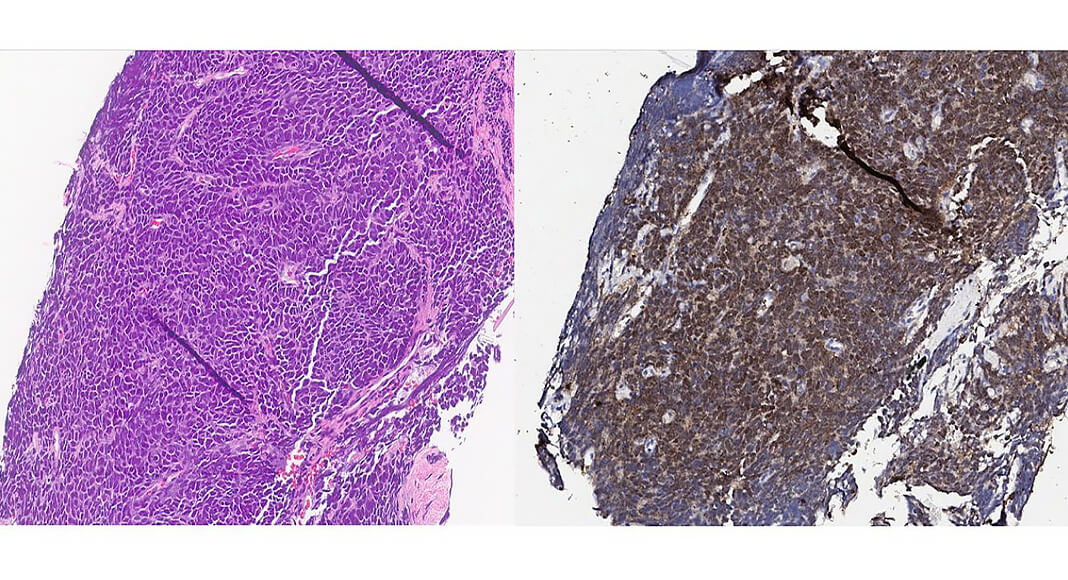
How did the researchers find an alternative marker for aggressive prostate cancer?
To find a novel marker for prostatic cancer, the researchers used The Cancer Genome Atlas database and found FOXA1 as a potential candidate. They then studied FOXA1 expression in tissue samples from primary and metastatic prostate tumors as well as other cancer types.
FOXA1 expression was notably higher in prostate cancer and showed expression levels similar to NKX3.1. Interestingly, they detected FOXA1 expression in 80% of primary and 57% of metastatic small cell carcinomas of the prostate, meaning it was still expressed in a significant proportion of tumors that commonly lost NKX3.1 expression, making it a valuable addition to aid in diagnosis.
Further evaluation is needed to understand FOXA1 expression in other aggressive subtypes of prostate cancer and comprehend its molecular mechanisms. Prospective clinical studies will also be needed to validate the use of this biomarker.
***
This work was funded by the University Cancer Foundation and the Andrew Sabin Family Fellowships. A full list of collaborating authors and their disclosures can be found with the full paper in Histopathology.


