







Mega Doctor News

By UT Southwestern Medical Center
Newswise — DALLAS – Robotic surgery offers significant benefits over laparoscopic procedures for many patients undergoing colectomies for colon cancer, according to a study by UT Southwestern Medical Center.
The findings, published in the World Journal of Surgical Oncology, show that patients undergoing robotic surgery in the vast majority of colectomies – the surgical removal of a portion of the large intestine – experienced shorter hospital stays and lower rates of complications. Additionally, they had more lymph nodes harvested and, as a result, had a more accurate determination of what stage the cancer was in.


They also had fewer conversions to open surgery necessitated by anatomical challenges and fewer instances of postoperative ileus – the inability of the intestine to contract naturally, which can lead to a life-threatening blockage.
“Colorectal cancer is one of the most common types of cancer with more than 150,000 new cases in the U.S. every year,” said study leader Patricio M. Polanco, M.D., Associate Professor of Surgery in the Division of Surgical Oncology and a member of the Harold C. Simmons Comprehensive Cancer Center. He is also Director of UTSW’s Robotic Surgery Training Program and co-Director of the Pancreatic Cancer Program.
“Robotic surgery for colectomies is quickly becoming the preferred approach due to its multiple benefits for the surgeon, which include better 3D visualization and a stable camera, improved dexterity and instrument control, and reduced fatigue and hand tremor,” he said. “Prior to this study, however, there was little real-world evidence demonstrating its efficacy compared to laparoscopic techniques.”
While both laparoscopic and robotic surgery are considered minimally invasive and use small incisions and a camera to view the procedure, there are important differences. Surgeons performing laparoscopy manipulate the tools by hand and use a thin, telescopic rod outfitted with a tiny 2D camera – called a laparoscope – to view the surgical site.
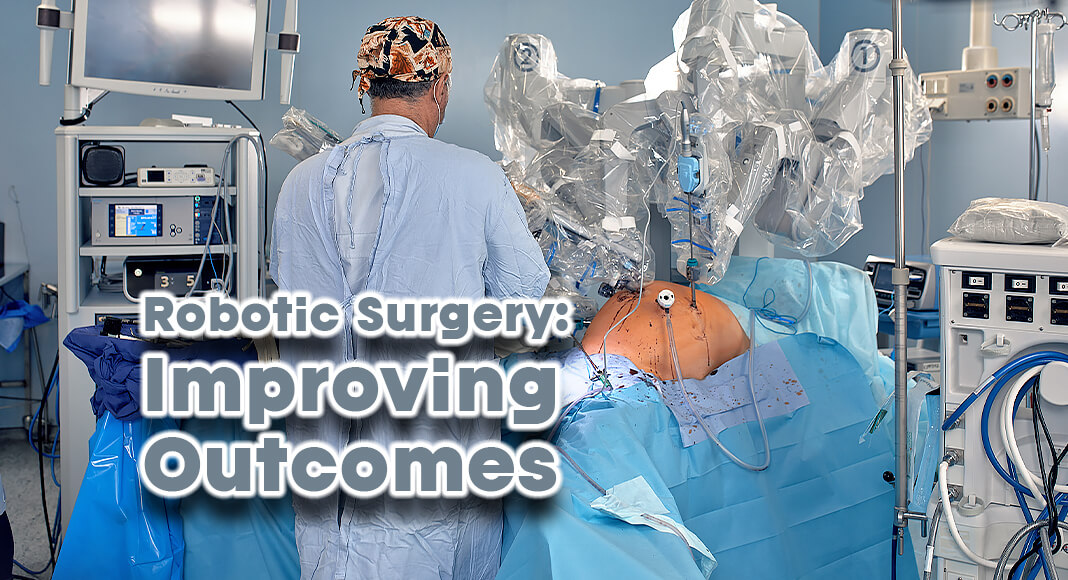
Robotic surgery has a control console that the surgeon uses to maneuver the robotic arms outfitted with surgical tools. This more advanced technology not only creates a higher-quality 3D view of the procedure, but it also offers better precision and range of motion and eliminates any hand tremors from the surgeon.
To compare the outcomes achieved by the two forms of surgery, UTSW researchers conducted a retrospective cohort study using the American College of Surgeons National Surgical Quality Improvement Program database from 2015-2020. A total of 53,209 colectomy cases from across the U.S. were included.
Colorectal procedures were identified by location – right and left colectomies, which comprise the majority of colorectal cancer surgeries, and low anterior resections, which involve the rectum. Textbook outcome was defined as the absence of 30-day complications, readmission, and mortality, and a postoperative length of stay of fewer than five days.
The study found that 71% of the robotic procedures for right colectomies resulted in textbook outcomes compared with 64% for laparoscopic treatments. The results were similar for left colectomies at 75% versus 68%.
Only low anterior resection procedures fared better with laparoscopy, with the study showing that the use of robotic surgery in those cases led to higher rates of postoperative ileus (11.9% versus 10.5%), hospital readmission (10.4% versus 9.1%), and major morbidity (7.1% versus 5.8%), with comparable rates of textbook outcomes (68% versus 67%). While the exact reason for the discrepancy can’t be determined with current data, Dr. Polanco said he believes that these small differences favoring the laparoscopic approach correspond to the higher complexity of rectal resections and surgeons’ longer experience with the procedure.
“The growth in robotic surgery and the alarming increase in colorectal cancer in younger adults are two of the most significant trends we have seen in recent years, both of which highlight the importance of optimizing surgical treatment strategies,” Dr. Polanco said. “These findings are critical because they give us a deeper understanding of the benefits and drawbacks of robotic surgery and can help patients and their surgical teams make informed decisions regarding their treatment.”
The study builds on earlier research at UTSW on the benefits of robotic surgery in the treatment of pancreas and liver cancer. Dr. Polanco’s work is supported by the Eugene P. Frenkel, M.D. Scholar Award from Simmons Cancer Center.
Other UTSW researchers from Surgery who contributed to this study are Herbert J. Zeh III, M.D., Chair and Professor of Surgery; Javier Salgado, M.D., Associate Professor and Section Chief of Colorectal Surgery; Emile Farah, M.D., Postdoctoral Research Fellow; Andres A. Abreu, M.D., Postdoctoral Research Fellow; and Benjamin Rail, B.S. Dr. Zeh holds the Hall and Mary Lucile Shannon Distinguished University Chair in Surgery.


