








By David Diaz
Mega Doctor News
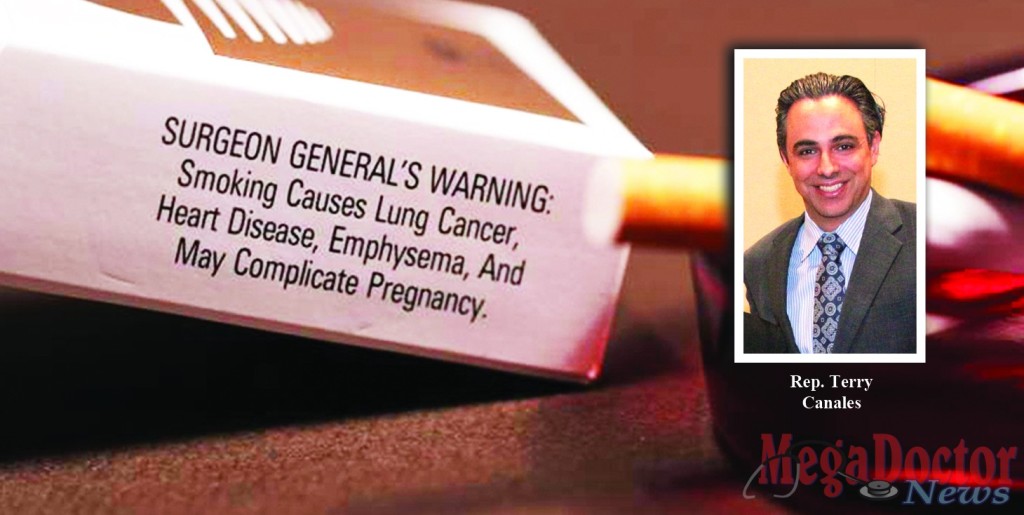
A driver smoking a cigarette who has a child younger than 8 in their vehicle could be pulled over by police and face up to a $500 fine in Texas under legislation by Rep. Terry Canales, D-Edinburg, who wants to help protect such children from the proven dangers of second hand smoke.

Smoking harms nearly every organ of the body, causing many diseases and affecting the health of smokers in general, as well as those inhaling second hand smoke.
The measure, House Bill 461, was pre-filed at the Texas Capitol on Friday, December 5. HB 461 bans smoking tobacco in a vehicle if there is a child in a car seat present.
Currently, Transportation Code Section 545.412 requires children younger than age 8 be seated in a car seat unless the child is taller than four feet, nine inches. This legislation makes this offense a Class C misdemeanor. If passed, HB 461 would take effect on September 1, 2015.
According to the Office of the U.S. Surgeon General, second hand smoke occurs when someone smokes a cigarette, and people nearby breathe that smoke.
Second hand smoke is the combination of smoke from the burning end of the cigarette and the smoke breathed out by smokers. “The effects of second hand smoke are well known. It has been shown to cause many health problems. Second hand smoke has more than 7,000 chemicals, hundreds which are toxic, and about 70 are known to be a carcinogenic (cause cancer),” said Canales. “In infants and young children, the statistics are more startling.”
Americans for Nonsmokers’ Rights, a leading national lobbying organization dedicated to nonsmokers’ rights, contends passenger vehicles increase the health hazards of second hand smoke.
“When someone smokes in the small enclosed space of a car, people are exposed to toxic air that is many times higher than what the EPA (U.S. Environmental Protection Agency) considers hazardous air quality, even when a window is down,” ANR explains. “Additionally, the gaseous and particulate components of tobacco smoke absorb into the upholstery and other surfaces inside a car, and then off-gas back into the air over the course of many days, exposing passengers to toxins long after anyone actually smoked in the car.” Photograph By Debora Cartagena
Centers For Disease Control And Prevention MDN


