Mega Doctor News

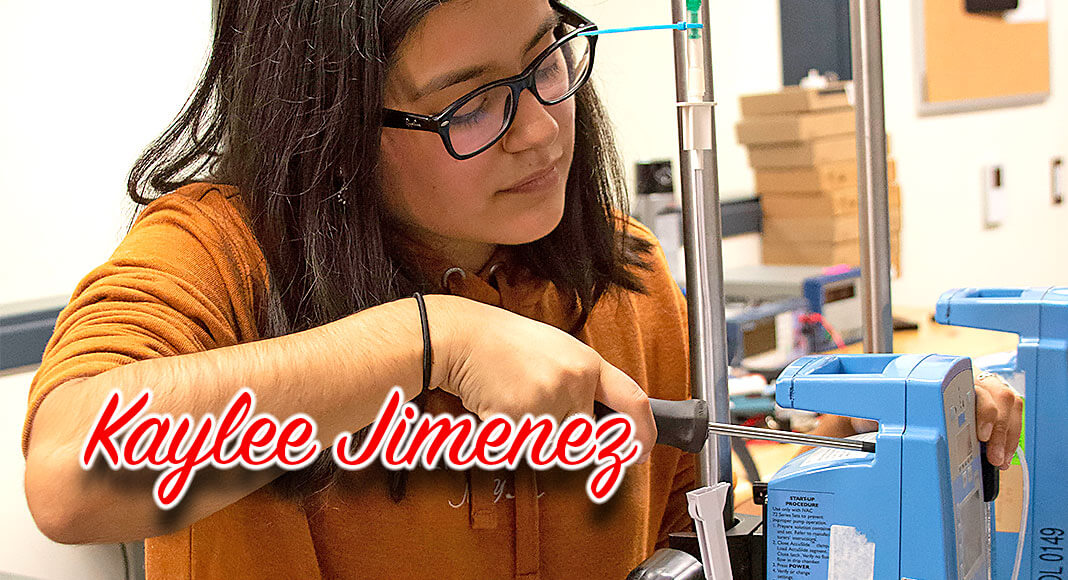
HARLINGEN, Texas – Kaylee Jimenez, of Rio Hondo, hopes to have a career in the medical field with a connection to engineering in a hospital setting.
Her choice to pursue the Biomedical Equipment Technology program at Texas State Technical College’s Harlingen campus has been a rewarding one.
The program teaches students how to inspect, calibrate, maintain and repair high-technological medical devices.

In lab sessions, students work on activities such as building circuits and rectifiers. A rectifier is an electrical device used to convert alternating current into direct current by allowing a current to flow through the device in only one direction.
“We have to find a rectifier, de-solder it and place it on an oscilloscope,” Jimenez said. “An oscilloscope is used to locate waveforms.”
She added that an interest in engineering was sparked when she noticed her father working on vehicles at home.
“It inspired me to want to learn and fix things on my own and help my community,” she said.
The students perform maintenance on medical equipment at other Allied Health programs at the Harlingen campus, according to David Sanchez, an instructor in TSTC’s Biomedical Equipment Technology program.
“They have worked on X-ray machines in the Dental Hygiene program,” he said. “It is a steppingstone before they visit other businesses.”
Many students who enter the program have minimal medical knowledge.
Jimenez noted that at the beginning she felt like a baby deer taking its first steps. Then she adapted, and a hunger for knowledge evolved.
“When we work on equipment, I like to analyze the schematics,” she said. “If I do not understand it, I research. Then I explain the information to my classmates so we can all be on the same page.”
She credits Oziel Capetillo and Ray Longoria, TSTC Biomedical Equipment Technology instructors, for their in-depth explanations regarding the equipment.
Now in her final semester, Jimenez would like to pursue an internship with an upstate company or locally with Valley Baptist Medical Center.
Medical equipment repairers can earn an average annual salary of $49,050 in Texas, according to the U.S. Bureau of Labor Statistics. This allied health career has a 12% projected job growth rate in Texas, onetonline.org shows.
TSTC offers an Associate of Applied Science degree in Biomedical Equipment Technology.
For more information about TSTC, visit tstc.edu.