







Texas Border Business Welcomes New Medical School Dean, Dr. Francisco Fernandez

Translate to Spanish or other 102 languages!

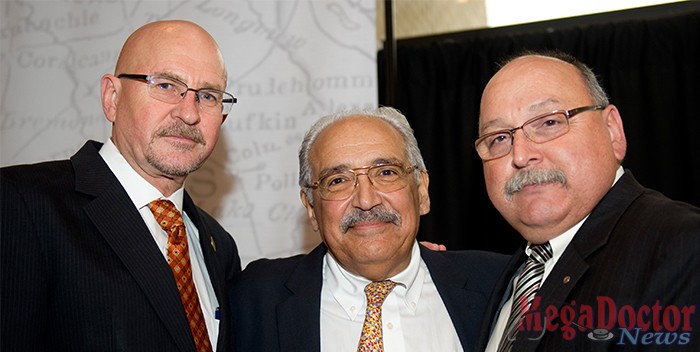
Psychiatrist Francisco Fernandez, MD, (center) who has been selected to assume the historic position of founding dean for The University of Texas Rio Grande Valley’s much-anticipated School of Medicine has assumed his position. He posed with outgoing UTPA President Dr. Robert Nelsen (left) and Eduardo Olivarez Chief Administrative Officer for the Hidalgo County Health and Human Services on the right. Photo courtesy UTPA
Psychiatrist Francisco Fernandez, MD, (center) who has been selected to assume the historic position of founding dean for The University of Texas Rio Grande Valley’s much-anticipated School of Medicine has assumed his position.
He posed with outgoing UTPA President Dr. Robert Nelsen (left) and Eduardo Olivarez Chief Administrative Officer for the Hidalgo County Health and Human Services on the right. Photo courtesy UTPA

Texas Border Business

- Advertisement -

Dr. Francisco Fernandez, a native of Havana, Cuba, Dr. Fernandez is no stranger to Texas, having served as a faculty member at both UT MD Anderson Cancer Center and the Baylor College of Medicine from 1984 to 1997.

Most recently, he has served as professor and chairman of psychiatry and neurosciences at the University of South Florida College of Medicine in Tampa.  Fernandez’s research interests focus on the brain’s relationship to behavior.

He is also active in the American College of Psychiatrists, where he currently serves as first vice president.  The new medical school, which will be part of The University of Texas Rio Grande Valley, will enroll its first class in Fall 2016.

- Advertisement -

“I am excited and humbled by this tremendous opportunity to build the UT Rio Grande Valley School of Medicine into a world-class educational center. The chance to build a medical school from the ground up in a region as richly diverse and wonderful as South Texas is a dream come true,” Fernandez said. “To be part of an initiative like this that will have so much impact, is a once-in-a-lifetime experience. I’m eager to get started and become part of the Valley community.”

Dr. Fernandez assumed his role as dean on April 28, 2014 and he will play a leading role in securing accreditation of the new medical school’s undergraduate medical education program and of its residency programs.

We continue to look toward the future of The University of Texas Rio Grande Valley and recently welcomed our new Dean of the UTRGV Medical School, Dr. Francisco Fernandez. UTRGV will open its doors Fall 2015 with the medical school to follow Fall 2016. UT System is continuing to collaborate with both Universities and the spirit around campus continues to grow as we near our first semester as UTRGV.


- Advertisement -
- Advertisement -

- Advertisement -

More Articles

McAllen Cancer Survivor Takes Her Fight for Patients to Washington

For breast cancer survivor Elvia Gibbs, traveling from McAllen to Washington, D.C., was about more than advocating for legislation. It was an opportunity to tell lawmakers firsthand that cancer research and access to clinical trials can mean more time, hope, and quality of life for patients.

Susie Wiles Announces She Is Cancer-Free Following Breast Cancer Treatment

White House Chief of Staff Susie Wiles announced Wednesday that she is cancer-free following months of treatment for early-stage breast cancer, sharing the news after receiving clear pathology results from the Mayo Clinic.

What You Need to Know About Aortic Dissection

An aortic dissection – a tear in the inner layer of the main artery – is a life-threatening emergency. It can happen with little warning, as apparently was the case with U.S. Sen. Lindsey Graham. His sudden death at age 71 was preliminarily attributed to an aortic dissection stemming from plaque buildup in his arteries.

DHR Health’s Free Seminar on Breakthrough Treatment for Stroke Survivors, Sept. 19th

DHR Health’s Neuroscience Institute will host a free seminar for stroke survivors who want improved hand and arm movement as many stroke survivors experience impaired mobility and loss of function in the arm which can significantly affect their ability to   perform everyday activities.
- Advertisement -
