








Mega Doctor News
Newswise — In the neonatal intensive care unit, the most fragile patients in medicine are often the most heavily wired. Premature babies, some weighing less than a pound, can be tethered to a tangle of cables, monitors, and sensors. Each blood draw to check sugar levels or electrolytes means another needle, another bandage, another moment of stress for an infant whose skin is still forming.
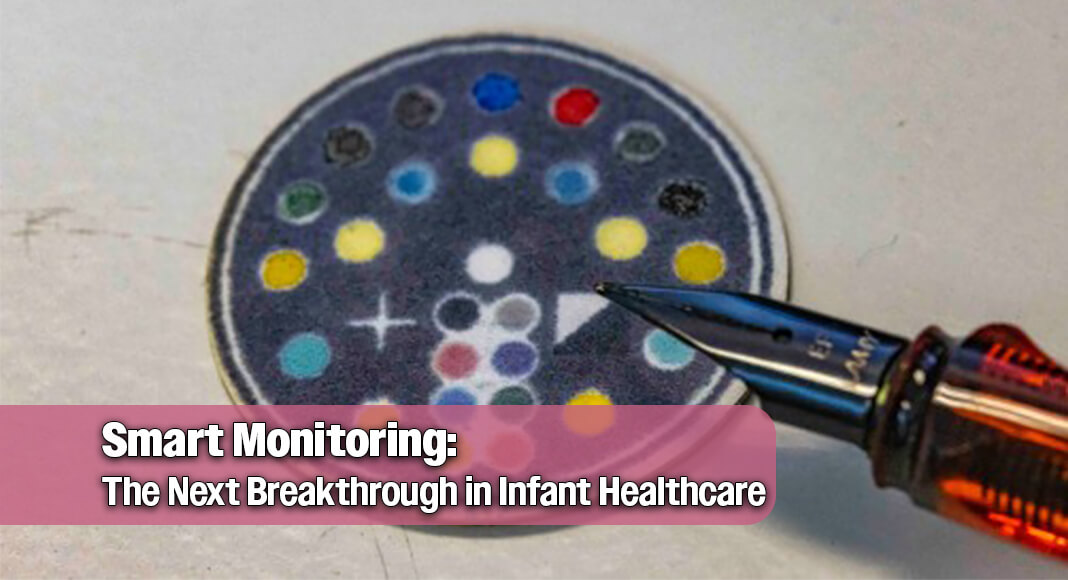
A team of researchers from Tufts University’s Silklab, Helmholtz Munich, Ludwig Maximilian University (LMU) Munich, and the Technical University of Munich, have developed a radically gentler alternative: a featherlight, silk-based sticker, smaller than a coin, that quietly reads four critical health signals at once just by changing color.

The work, published in ACS Sensors, describes a wearable patch that captures temperature, pH, sodium, and glucose from the wisps of fluid that pass naturally through a baby’s still-developing skin. An AI system reads the patch’s color shifts through any standard camera, even in the dim, humid, hard-to-photograph environment of an incubator, and translates them into precise numbers a clinician can act on.
The ability to track multiple critical health signals in one patch helps create a more accurate picture of the baby’s progress. “There is a lot more information in how multiple variables move relative to one another than in any single variable on its own,” said Fiorenzo Omenetto, Director of the Silklab at Tufts University. “If you only watch one number, you’re reading one line of a much longer story. We wanted to create a sensing interface that gives clinicians the whole paragraph.”
The patch also provides a safer monitoring environment for the baby. “The newborn is the most demanding patient we have,” said Anne Hilgendorff, a neonatologist and researcher at Helmholtz Munich, LMU Munich and the Carl von Ossietzky University Oldenburg. “What we’ve built is designed around that reality: no needles, no wires, nothing that pulls or irritates the skin. Just a small patch that listens to the body.”
“We’re not replacing the lab,” cautioned Benjamin Schubert, who leads computational health research at Helmholtz Munich. “We’re catching the things that happen between lab tests—the slow drift toward a problem that no one sees until it becomes an emergency. That’s where continuous, non-invasive monitoring saves lives.”
How It Works
The sensor is built in layers, each only fractions of a millimeter thick.
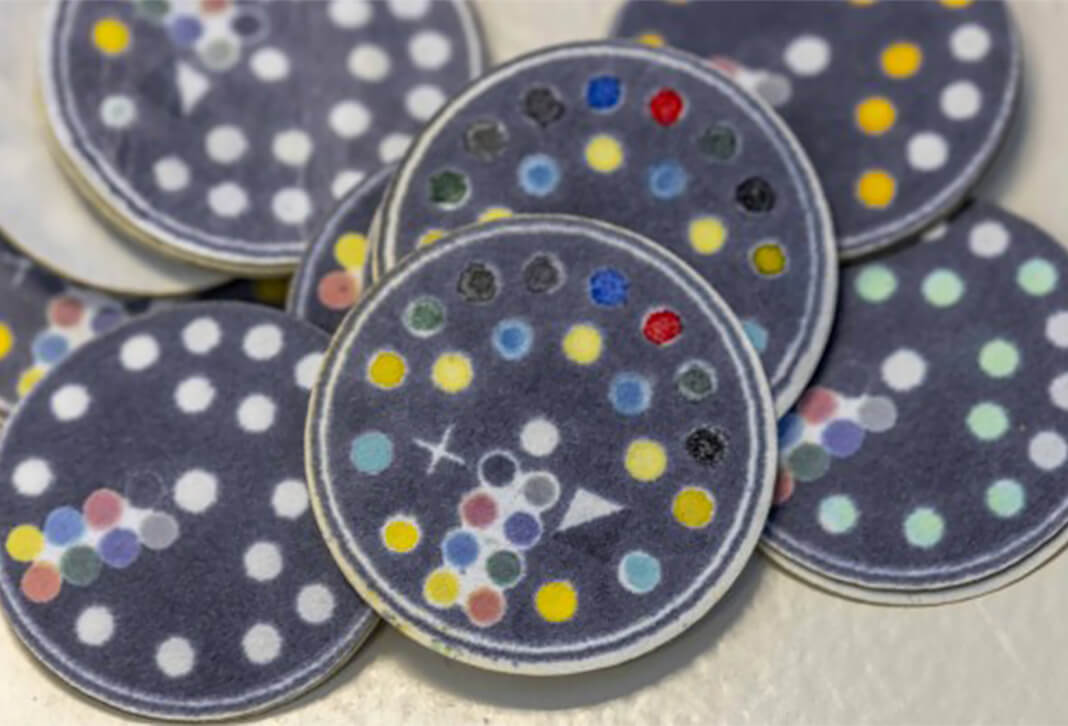
The first is a silk fibroin base, derived from silk moth cocoons, which stabilizes delicate biological molecules, including enzymes that normally need refrigeration, so the patch is shelf-stable and rugged. The second is a wax-printed paper layer, which acts as a tiny plumbing system, drawing in microscopic volumes of fluid and routing it to each sensing dot.
The third layer is a waterproof medical adhesive that seals the whole thing against the warm humidity of an incubator and lets the patch flex with a baby’s skin.
Crucially, the patch is designed around what preterm babies actually do—they lose interstitial fluid through their skin at high rates because their skin barrier hasn’t finished developing, turning a vulnerability into a diagnostic opportunity.
That same fluid loss provides a continuous, painless sample. When sweat or interstitial fluid reach the patch, each of the dye spots changes color. For example, yellow to deep red for glucose, or blue to purple for sodium.
Color changes are notoriously hard to read reliably under different lighting conditions in a hospital. To correct for lighting, angle, and movement, the research team built an AI deep-learning model that automatically corrects and converts the patch’s colors into precise measurements. Accuracy is above 91% for critical vital signs and over 98% for low blood sugar.
What Comes Next
The research team is careful to call the current work a proof-of-principle. The next steps include larger studies in real neonatal units, pairing patch readings with traditional blood samples to confirm how closely skin fluid mirrors what’s happening inside a baby’s bloodstream, and broadening the AI’s training data across different settings.
Longer term, the same platform could be extended to oxygen saturation, carbon dioxide, and other parameters and, given that the sensor itself costs cents to manufacture and needs no power, no wires, and no refrigeration, it is uniquely suited to low-resource settings such as remote rural communities or in developing countries, where neonatal mortality remains stubbornly high and high-end monitoring is often out of reach.
“A piece of paper, a drop of silk, and a smartphone camera,” Omenetto said. “If that were to become all it takes to keep a baby safer, then we should be putting one in every incubator on the planet.”


