








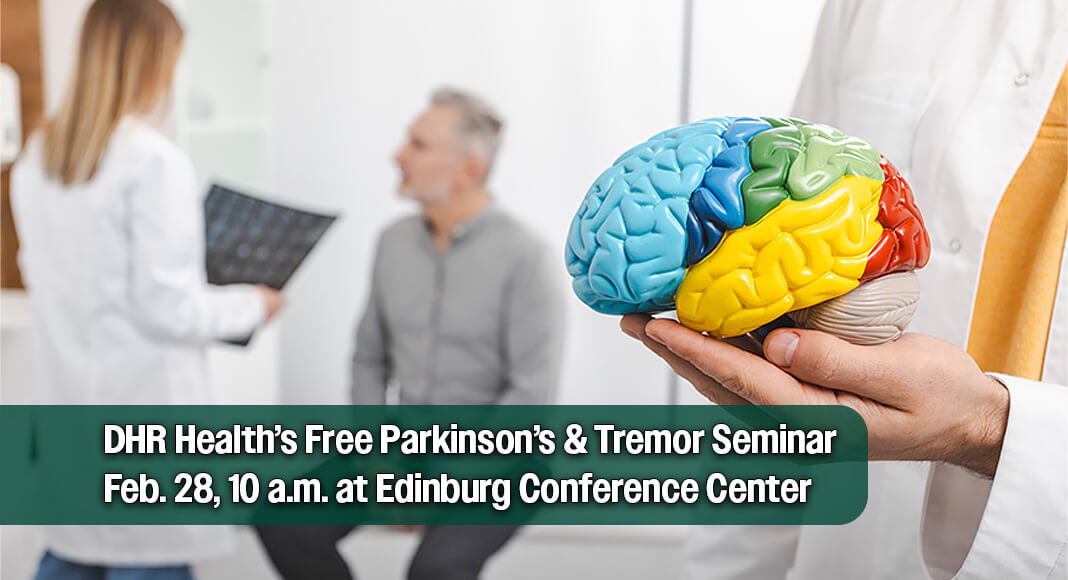
DHR Health’s Free Seminar on Groundbreaking Treatment Options for Parkinson’s Disease, Feb, 28th

Translate to Spanish or other 102 languages!

The seminar will take place on Saturday, February 28, 2026, from 10:00 to 11:45 a.m. at the Edinburg Conference Center at Renaissance, located at 118 Paseo del Prado in Edinburg. Doors open at 9:50 a.m. Image for illustration purposes
- Advertisement -

EDINBURG, Texas – DHR Health, in collaboration with Medtronic, will host a free community seminar to help community members learn about new and advanced treatment options for Parkinson’s disease and essential tremor. The seminar will take place on Saturday, February 28, 2026, from 10:00 to 11:45 a.m. at the Edinburg Conference Center at Renaissance, located at 118 Paseo del Prado in Edinburg. Doors open at 9:50 a.m.

The seminar will be led by Dr. Juan Torres-Reveron, neurosurgeon at DHR Health, who will discuss how deep brain stimulation (DBS) therapy is being used to help people better manage symptoms such as tremors, stiffness, and slowed movement. He will also share information about the latest advancements in DBS technology, including the Percept™ DBS system with BrainSense™ technology, which allows doctors to better personalize treatment for each patient.

“For people living with Parkinson’s disease or essential tremor, daily life can be unpredictable,” said Dr. Torres-Reveron. “This seminar is about giving our community education, hope, and a better understanding of the options that are available today. New technology is allowing us to tailor treatment in ways that may help patients maximize the time they feel their best.”

- Advertisement -

Deep brain stimulation therapy uses a small implanted device, similar to a pacemaker, to send gentle electrical signals to specific areas of the brain that control movement. This therapy may help reduce certain symptoms and improve quality of life, especially for patients who are no longer getting enough relief from medication alone.

The free seminar is open to community members who want to learn more for themselves or for a loved one. Registration is encouraged and can be completed by visiting http://tiny.cc/Feb282026.

- Advertisement -
- Advertisement -

- Advertisement -

More Articles

DHR Health Transplant Institute Earns Top State and National Rankings

The DHR Health Transplant Institute announced today that it has been recognized among the state’s and nation’s top performing kidney transplant centers, earning the no. 2 ranking in the State and no. 16 ranking in the Nation, according to the Scientific Registry of Transplant Recipients (SRTR).  

New Noninvasive Tech Tracks Infant Vital Signs Without Wires

In the neonatal intensive care unit, the most fragile patients in medicine are often the most heavily wired. Premature babies, some weighing less than a pound, can be tethered to a tangle of cables, monitors, and sensors. Each blood draw to check sugar levels or electrolytes means another needle, another bandage, another moment of stress for an infant whose skin is still forming.

STHS McAllen Receives National Award for Advancing Cardiac Arrest Care & Improving Patient Survival

In the moments following cardiac arrest, every second counts. Rapid intervention, seamless teamwork and evidence-based care can make the difference between life and death.

The Truth About Hot Dogs and Your Health

July is National Hot Dog Month. Reports show Americans eat roughly 20 billion hot dogs every year. While they’re okay to have on occasion, they shouldn’t be a regular part of your diet.
- Advertisement -

