








By Vicky Brito and Amanda Taylor
Mega Doctor News
Rio Grande Valley, Texas – The University of Texas Rio Grande Valley is now home to the UTRGV Center for Vector-Borne Disease (CVBD), a collaborative effort to develop a self-sustaining, research-focused center in South Texas.
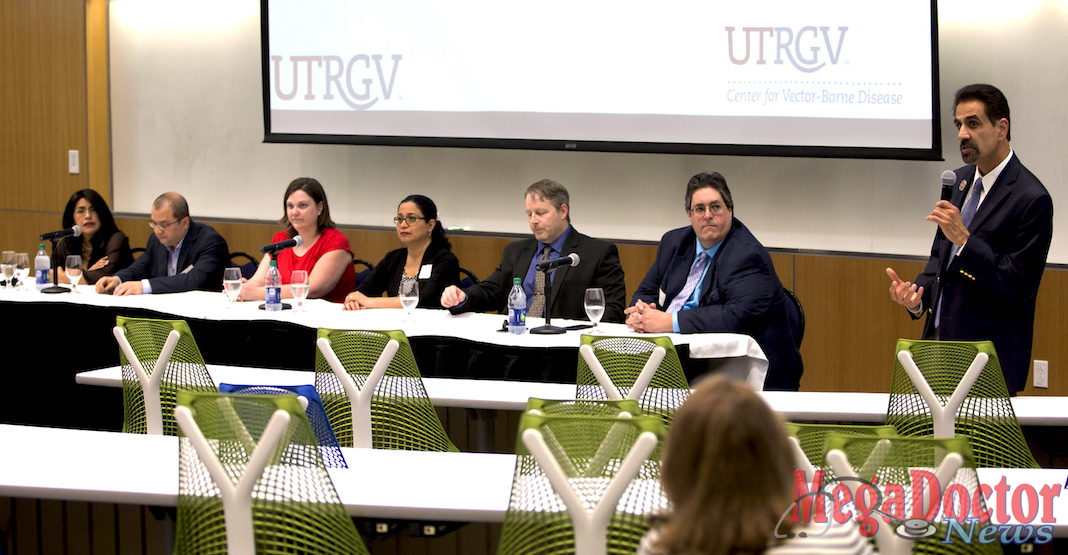
On April 9, the university held an event in Edinburg to formally announce and launch the center, which will be housed in Edinburg though an official physical space has not yet been determined.

UTRGV President Guy Bailey, who attended the event, emphasized the importance of this center for South Texas.
“As we kick of our Center for Vector-Borne Disease here at UTRGV, we’re reminded that no place could be better for this center,” he said of the Valley. “If you remember, the Zika virus broke out here two years ago and our climate offers a prime area for these kinds of diseases. It’s especially important, what we’ll do here because we want to address the issues that directly affect the Rio Grande Valley. It’s crucial for us to educate students and it’s important for us to improve the lives within this community.”
Vector-borne diseases are human illnesses caused by parasites, viruses, and bacteria transmitted through insects such as mosquitos, ticks, and mites.
The center will have a multi-disciplinary focus to encourage research collaboration and cooperation between students, researchers, and departments at UTRGV and external partners.
The UTRGV founding members of the center include:
- Dr. Christopher Vitek, associate professor of biology.
- Dr. John Thomas, assistant professor of biology.
- Dr. Teresa Patricia Feria Arroyo, associate professor of biology.
- Dr. Beatriz Tapia, assistant dean for faculty development, UTRGV School of Medicine.
- Dr. Tamer Oraby, assistant professor of mathematical and statistical science.
- Dr. Erin Schuenzel, associate professor of biology.
Vitek said the idea to establish the center has been percolating since UTRGV was created in 2015.
“We thought this was an excellent way to incorporate research because of the location of UTRGV, along with the experts that we have in the field in different departments,” he said. “We thought it was very appropriate to develop a center that would be focusing on vector-borne disease.”
It was a slow start building things up, but in around 2016, we really started moving forward finding out how to establish the center.”
With the support of Dr. Parwinder Grewal, executive vice president of Research and Graduate Studies and former dean of the UTRGV College of Sciences, and Dr. Frederic Zaidan, professor, and chair of the Department of Biology, plans were expedited in earnest in 2016 with the Zika epidemic spreading throughout North and South America.
The center is not just focused on the Zika virus, but rather on a variety of diseases and pathogens that are becoming more globally known, such as cattle fever and dengue.
The center’s official goals are threefold.
- Conduct research to foster a collaborative partnership between UTRGV faculty and have partnerships outside of UTRGV with agencies like the USDA, CDC and state and local agencies.
- Provide educational opportunities for students with certificate courses, internships or research opportunities, to learn about vector-borne diseases and become interested in pursuing careers in the field or in related fields, such as medical entomology.
- Provide community outreach through engagement with the area by providing expertise to workshops, seminars and other entities hoping to be educated in vector-borne diseases.


