







Mega Doctor News

by American Cancer Society (ACS)
Newswise – The American Cancer Society (ACS) released updated guidelines for colorectal cancer screening. The new recommendations reaffirm that average-risk adults should begin colorectal cancer screening at age 45 and continue through age 75 for those with a life expectancy greater than 10 years. However, ACS is now adding guidelines for a blood-based screening test taken in a doctor’s office, as well as one updated and one new at-home screening option that looks for hidden blood and molecular markers in stool samples. The move reflects advances in disease detection and a critical shift in public health strategy to expand screening options and lower barriers to access. The update is published in a report in CA: A Cancer Journal for Clinicians, the flagship journal of ACS.
“We need to increase our emphasis on colorectal cancer as a highly preventable disease as much as a treatable one,” said Dr. Robert Smith, senior vice president, early cancer detection science at the American Cancer Society and senior author of the report. “By offering more screening tools in our guideline update, more eligible adults will be able to participate in lifesaving colorectal cancer testing, helping to close the screening gap and catch more cancers at an earlier, treatable stage.”

Colorectal cancer screening dramatically improves survival, with studies showing early-stage detection yielding five-year survival rates of more than 90% in the United States. Despite the benefits, there are more than 20 million Americans eligible for colorectal cancer screening who have not been tested as recommended – about 1 in 3 adults. With recent ACS research showing colorectal cancer is now the top cancer killer of adults under the age of 50, getting individuals screened is even more critical.
What’s new in ACS colorectal cancer screening guidelines
Consistent with prior ACS guidelines, the authors emphasize that the most effective screening test is the one that the patient completes. A colonoscopy (a highly effective medical procedure used to visually examine the rectum and colon) remains the gold standard for colorectal cancer screening. However, to provide options, the updated screening guideline includes these tests:
Multitarget stool testing (mt-s)
- The next generation-ng-mt-sDNA test (brand name Cologuard), which is an updated version of an already-recommended at-home mt-sDNA test analyzing stool samples for specific DNA markers and hemoglobin.
- A mt-sRNA test (brand name ColoSense) is a new at-home multi-target test that analyzes stool samples for specific RNA markers and hemoglobin.
These tests demonstrate high sensitivity for colorectal cancer and moderate sensitivity for advanced precancerous lesions and are recommended for screening every 3 years.
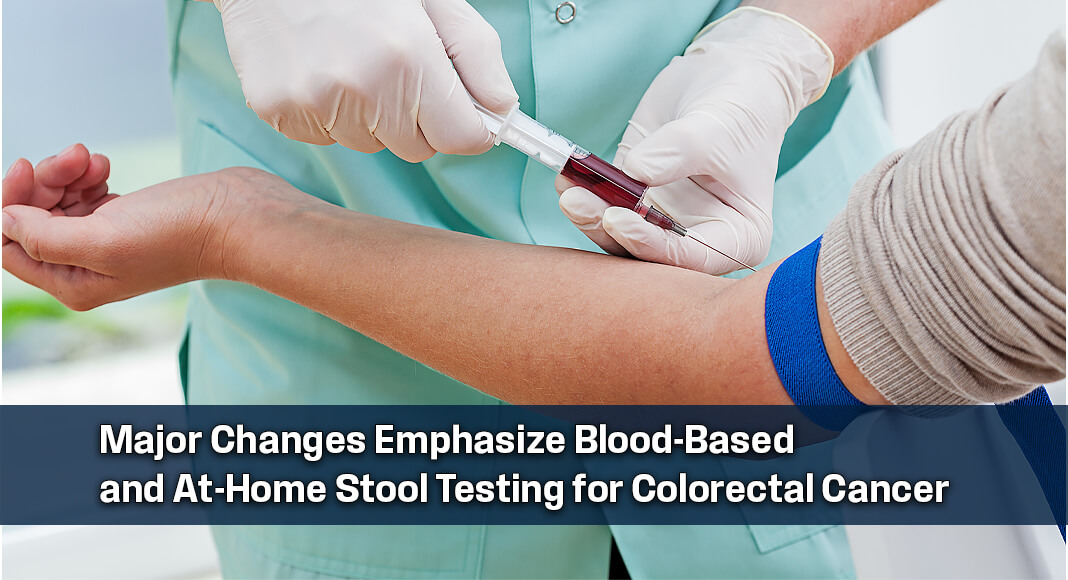
Blood-based tests
- These screening tests detect tumor DNA in the blood.
- Blood-based tests (brand name Shield) are only recommended for individuals who decline or do not complete preferred screening tests. Compared with established stool-based tests, blood-based tests demonstrated lower sensitivity for both advanced precancerous lesions and stage I cancers, with studies predicting less effectiveness in reducing colorectal cancer incidence and mortality.
For any stool or blood-based screening test to be effective, a positive result requires timely follow-up with a colonoscopy, preferably within 6 months, to complete the screening process.
What has not changed
Individuals are still offered a choice between a stool test and a direct visual exam for colorectal cancer screening.
Home-based Stool tests
- High-sensitivity guaiac-based tests (gFOBT), every year
- High-sensitivity fecal immunochemical tests (FIT ) tests, every year
- Multi-target, stool DNA (mt-sDNA) tests, every 3 years
- Multi-target, stool RNA (mt-sRNA) tests, every 3 years
Visual Exams
- Colonoscopy (testing every 10 years)
- Flexible sigmoidoscopy. A procedure similar to a colonoscopy but only examines the lower third of the colon (sigmoid colon). (testing every 5 years)
- Computed tomography (CT) colonography. A test that creates 3D images of the colon and rectum to detect polyps or cancer. (testing every 5 years)
People at increased or high risk of colorectal cancer might need to start colorectal cancer screening before age 45, be screened more often, and/or get specific tests.
People over age 85 should no longer get colorectal cancer screening.
Why these changes
The updated report is led by the ACS Guideline Development Group. The group continuously monitors medical and scientific literature for new evidence that may support a change in current guidelines or the development of new guidelines, and for information about colorectal cancer screening that should be conveyed to clinicians and target populations. Ongoing evaluation of adherence, real-world implementation, and clinical outcomes will inform future updates for these new targeted-based screening tests.
“No matter which test you choose, what’s most important is to get screened, and that includes underserved, rural, and minority populations,” said Dr. William Dahut, chief scientific officer at the American Cancer Society. “These changes were developed to add to the colorectal cancer screening arsenal and help ensure preventive cancer care is available to all.”
The American Cancer Society’s advocacy affiliate, the American Cancer Society Cancer Action Network (ACS CAN), continues to work at all levels of government to advance equitable colorectal cancer screening.
“Expanding screening options only matters if people can actually access them,” said Lisa A. Lacasse, president of ACS CAN. “Coverage and affordability remain among the biggest factors in whether eligible individuals get screened for colorectal cancer. ACS CAN will continue pressing for policies that eliminate out-of-pocket costs and other barriers, so everyone has a fair opportunity to get the evidence-based screening they need.”
Today’s published guideline report also includes a patient page supporting the new guideline. CA journal Patient Pages provide highly relevant, evidence-based medical content in a structured, concise format that addresses typical patient questions about diseases, their related symptoms, prevention, and treatment. This tool helps patients understand specific conditions and treatment options.
ACS researchers Dr. Deana Baptiste and Tyler Kratzer, MPH, are contributing authors of the report.
Additional ACS Resources:
- Studies Report Surge in Colorectal Cancer Screening and Early Diagnosis in U.S. Adults 45-49
- Colorectal Cancer Information
- CRC Statistics Report 2026
- ACS CancerRisk360


