








A Mother’s Legacy Built with Love and Strength

Translate to Spanish or other 102 languages!

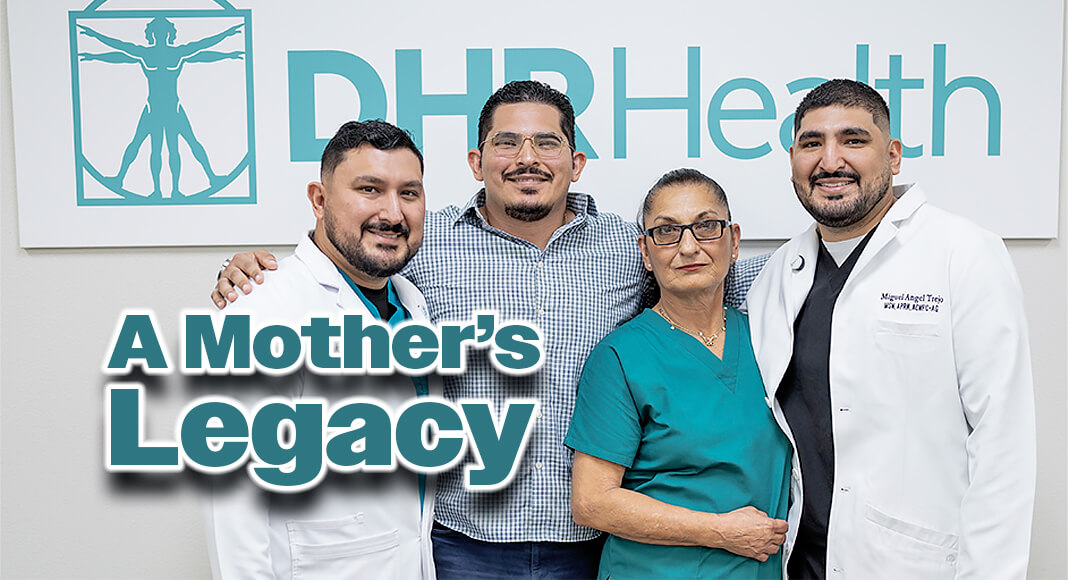
Margarita Trejo stands alongside her three sons—Miguel (right), Samuel (left), and Hector (middle)—all of whom have followed her example of dedication and now work in healthcare at DHR Health. Her journey is a testament to the power of love, resilience, and a mother’s unwavering support. Image courtesy of DHR Health
- Advertisement -

DHR Health

Mother’s Day is a time to celebrate the quiet strength and sacrifices of the women who hold families together. For Margarita Trejo, that strength has shaped every part of her journey—not just as a mother, but as the heart of a family built on love, hard work, and faith.

For the past ten years, Margarita has worked as a housekeeper in the Environmental Services department at DHR Health. She’s the proud mom of three sons—all of whom followed her example of compassion and dedication by going into healthcare. Miguel, her oldest, is a nurse practitioner in palliative care. Samuel is the Director of the Progressive Critical Care Unit. And Hector, the youngest, will graduate from UTRGV’s School of Medicine this May and begin his internal medicine residency at DHR Health this summer.

- Advertisement -

As a single mom, Margarita raised her three sons on her own—with confidence, determination, and an open heart. “I wasn’t afraid,” she said. “I had a job and I knew I could take care of them.”

When her sister passed away, Margarita opened her arms even wider, raising her niece and nephew alongside her boys. “My family got bigger, but I didn’t mind,” she said. “I’m thankful for what it became.”

There were hard moments—long days, no backup—but she stayed focused on giving her children a stable home and a strong foundation. Even without formal education at the time, she worked hard, saved up, and eventually built their family home in San Carlos. She also earned her GED, determined to keep growing for herself and her kids.

“Sometimes I don’t know how she did it,” said Hector. “But I think it was her unconditional love. She’s stronger than anyone I know.”

- Advertisement -

What her sons admire most is her constant kindness. “No matter what was going on, she reminded us to keep going and always be kind,” Hector said.

Today, Margarita still works at DHR Health, surrounded by the family she built. “I didn’t have much,” she said, “but I gave them everything I had. And now I look at them—and I couldn’t be prouder.”


- Advertisement -
- Advertisement -

- Advertisement -

More Articles

Exploring Facial Processing Differences in Autism

Some of the hallmark characteristics of autism are the tendencies to avoid looking at other’s faces and making less eye contact.

STHS’ Freestanding ERs Earn National Recognition for High-Quality Resuscitation Care

Sudden cardiac arrest is a life-threatening medical emergency that occurs when the heart unexpectedly stops beating, abruptly cutting off blood flow to the brain and other vital organs. It can strike anyone, at any age, often without warning.

New Lancet Commission Outlines Roadmap to Close the Gender Gap in Blood Disorders

A new report in The Lancet Haematology, led by Cleveland Clinic hematologist Bethany Samuelson Bannow, M.D., outlines practical strategies to improve diagnosis, care and outcomes globally for women and girls with hematological conditions, such as bleeding disorders, heavy menstrual bleeding, postpartum hemorrhage, thrombosis and maternal hematologic complications.

DHR Health Neuroscience Institute Nationally Recognized for Commitment to Excellence in Stroke Care

DHR Health Neuroscience Institute received the American Heart Association’s Get With The Guidelines® - Stroke Gold Plus quality achievement award for its commitment to ensuring people experiencing a stroke receive timely, appropriate treatment based on nationally recognized, research-based guidelines, ultimately helping to save lives and reduce disability.
- Advertisement -
