
Mega Doctor News


By American Heart Association News
To understand why you should know how to help someone who is choking, and why that has been given new prominence in the latest American Heart Association CPR guidelines, you could look at statistics showing that blocked airways often lead to cardiac arrest.
Or you could listen to what happened to one of the writers of those guidelines, Dr. Benny Joyner Jr.

Not long before the new guidelines for CPR and emergency cardiovascular care were published in October, Joyner was hosting a family get-together at his house when his wife shouted his name from the kitchen. “We need you in here!” she cried.
An adult relative was choking, and Joyner had to do what the guidelines spell out: repeat cycles of five back blows and five chest thrusts. His relative expelled the obstruction and was fine.
Joyner is the A. Conger Goodyear Professor and Chair of the Department of Pediatrics at the University at Buffalo Jacobs School of Medicine and Biomedical Sciences, in New York. But as he told his relatives, “there’s no rocket science” to what he did. “Everybody should know this.”
The guidance on choking is part of a broad update of the CPR guidelines, which were jointly published in the American Heart Association journal Circulation and the American Academy of Pediatrics journal Pediatrics. The revisions represent the latest science and an effort to streamline information, Joyner said, but the basic message is simple.
“Early recognition and early intervention saves lives,” he said.
Dr. Katie Dainty, a social scientist who studies bystander CPR and also helped write the guidelines, said the advice on how people should respond is designed to be easy to remember.
“It’s something that we all need to be prepared to do,” said Dainty, research chair of patient-centered outcomes at Toronto’s North York General Hospital and an associate professor at the University of Toronto’s Institute of Health Policy Management and Evaluation. “Otherwise, the alternative is pretty devastating.”
What does choking have to do with CPR?
If you can’t breathe, eventually your heart is going to stop. “It’s no more complicated than that,” Joyner said.
According to American Heart Association statistics, each year approximately 350,000 people in the U.S. have an out-of-hospital cardiac arrest, a sudden stopping of the heart. The CARES cardiac arrest registry estimates that respiratory emergencies or asphyxia cause more than 9% of the cardiac arrests in adults and 39% of those in children in the U.S.
The technical term for choking is foreign-body airway obstruction, Joyner said. It means exactly what it sounds like – somebody can’t breathe because “the big pipe that brings the air in is blocked.”
That’s distinct from somebody who either can’t summon the effort to breathe or is ill and has mucus clogging the lungs that prevents oxygen from being exchanged. With choking, if the obstruction – such as a grape or a small toy – is cleared, the person can start breathing normally. If not, the heart is eventually starved of oxygen and goes into arrest.
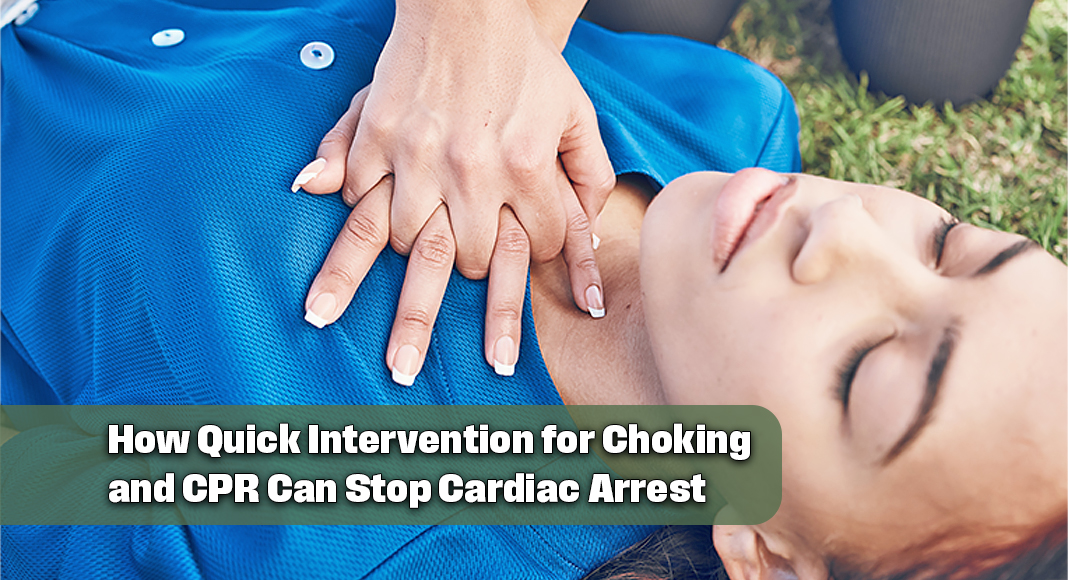
Cardiac arrest requires an immediate response – by calling 911, beginning hands-only CPR and asking someone to quickly fetch an automated external defibrillator, or AED.
What do the CPR guidelines say about choking?
The guidelines say that adults can often expel an obstruction by coughing. If not, intervention is needed.
Don’t hesitate, Dainty said. A blocked airway is an emergency. Call 911. “If you can, and if you’re willing, you should respond immediately and do everything you can to try and get that foreign body out of the way.”
The revised CPR and ECC guidelines say:
- For conscious adults and children, alternate five back blows (or slaps) followed by five abdominal thrusts (what has been called the Heimlich maneuver), until the object is expelled or the person becomes unresponsive. If the choking person becomes unresponsive, start CPR.
- In infants, alternate between five back blows and five chest thrusts using the heel of one hand, until the foreign object is expelled or the infant becomes unresponsive. Abdominal thrusts are not recommended in infants. If the choking infant becomes unresponsive, start Infant CPR.
- Don’t use your fingers to search the choking person’s mouth for an obstruction. The risk of worsening the problem outweighs the benefits.
The guidelines make a major change in the approach to infant CPR as well, Joyner said. In the past, people were taught to use two fingers on an infant’s sternum. “We are actually no longer recommending two fingers because of ineffectiveness of achieving the proper depth for compressions,” he said. The guidelines now recommend a one-hand or two thumb-encircling hands technique.
Who should be trained on the new guidelines?
It’s “imperative” for parents and caregivers of small children to be able to recognize what choking looks like and know how to respond, Joyner said.
“Kids are more apt to explore with their hands, explore with their mouth and put things in their mouth that they shouldn’t put in their mouth,” Joyner said, and they don’t always have the force or presence of mind to expel something.
Warning signs include a child who is turning blue and not coughing or making sounds, Joyner said.
Overall, the guideline changes highlight the need to update your CPR training periodically, Dainty said. “It’s always good to get a refresher.”
Aside from teaching the latest techniques, training helps you feel ready to act when the time comes. “It’s easy to panic, but if you have training and if you understand what’s recommended, then you’ll feel more confident and be able to respond and save that person’s life,” Dainty said.
Joyner emphasized that while training is helpful, in an emergency, perfect technique is not what matters most. “You don’t need to be a doctor to do an assessment and do all the things,” he said. “You just need to be able to jump into action.”
Find details about American Heart Association classes, as well as videos about hands-only CPR, at heart.org/nation.
Watch and download videos demonstrating how to respond to infants, children and adults who are choking.