








Mega Doctor News
By Roberto Hugo González / Mega Doctor News
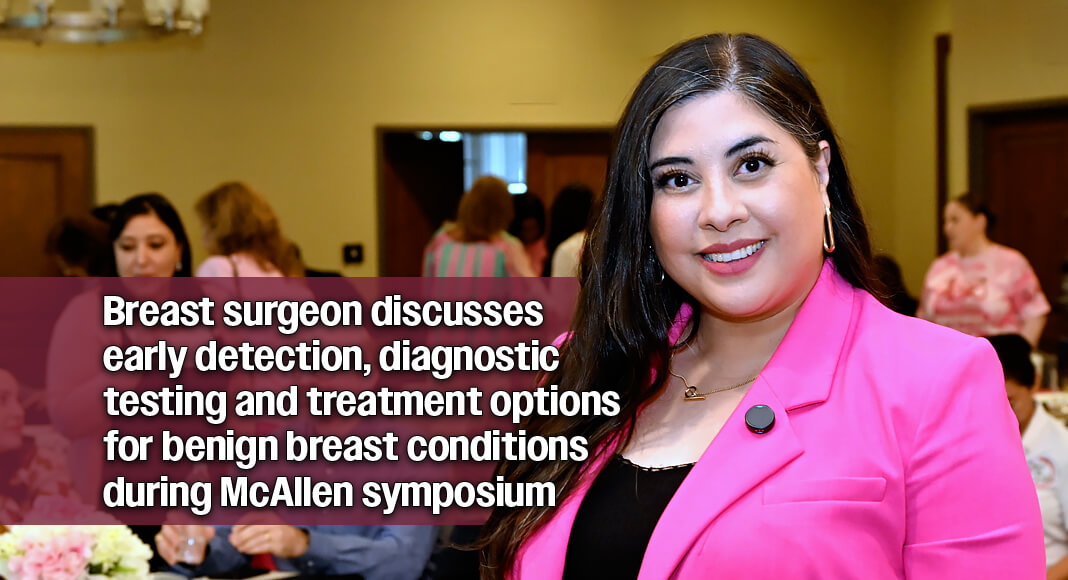
McALLEN, Texas — Discovering a lump in the breast can cause immediate concern, but many breast abnormalities are not cancerous, according to Dr. Lisa Chapa, a breast surgeon who explained how physicians distinguish benign conditions from breast cancer.
Chapa presented “Benign Breast Disease: Work Up, Diagnosis, & Treatment” on October 16, 2026, during the symposium “Breast Cancer 2026: Early Detection, Modern Care, and Survivorship Through Community Partnership.”

“Benign breast disease is way more common than cancer is,” Chapa told attendees, emphasizing that a physical examination alone cannot reliably distinguish a harmless lump from a cancerous one.
“If you feel a lump or if you feel a mass in your breast, one, don’t panic, but two, get it checked out,” she said.
Chapa explained that mammograms, ultrasounds and biopsies help physicians determine whether an abnormality requires treatment.
She discussed breast cancer screening recommendations from the American Society of Breast Surgeons, including formal risk assessments beginning at age 25 and annual mammograms starting at age 40 for women at average risk.
Women with higher risk may need earlier screening and additional imaging, she said.
Chapa also explained the Breast Imaging Reporting and Data System, known as BI-RADS, which radiologists use to classify findings.
Categories 1 and 2 generally indicate negative or benign findings. Category 3 means an abnormality is probably benign and typically requires follow-up imaging after six months. Categories 4 and 5 indicate suspicious findings that generally require a biopsy.
One common benign condition is fibroadenoma, a solid breast lump frequently diagnosed in women younger than 30.
Chapa said fibroadenomas usually do not require surgery unless they grow rapidly, become unusually large or cause visible changes to the breast.
However, some noncancerous abnormalities require closer attention.
She discussed atypical ductal hyperplasia, a condition involving abnormal cell growth inside breast ducts.
Although it is not cancer, Chapa said surgical removal may reveal cancer in approximately 30% of cases initially diagnosed through needle biopsy.
She also discussed intraductal papillomas, growths inside breast ducts that may cause nipple discharge.
Papillomas without atypical cells can often be monitored, while those containing atypical cells may require surgery because of their association with cancer.
Another condition, lobular carcinoma in situ, is not considered invasive breast cancer but indicates an increased lifetime risk of developing the disease, Chapa explained.
Chapa addressed breast infections, including mastitis, and warned that inflammatory breast cancer can resemble an infection.
She advised further evaluation when breast redness, swelling, and other symptoms do not improve with antibiotic treatment.
The surgeon also stressed the importance of reviewing imaging and biopsy results together.
A benign biopsy does not always settle the diagnosis if the pathology findings fail to explain a suspicious mammogram.
“If it’s discordant, you gotta go to surgery,” Chapa said, referring to cases in which imaging and pathology findings do not agree.
Her central message was that benign breast conditions are common, but accurate diagnosis and appropriate follow-up remain essential.
See related stories: