








Mega Doctor News

Ticks can carry germs that cause serious and sometimes deadly diseases like tularemia, ehrlichiosis, Rocky Mountain spotted fever, and Lyme disease. While most tickborne infections occur during the summer, ticks may still be active into the fall, or even year-round on warm winter days. Ticks live in grassy, brushy, or wooded areas, and on animals themselves, so hunting will bring you in close contact with ticks. Take the proper precautions this hunting season to keep you and your pets healthy.
Another reason to prevent tick bites is the tick bite associated allergy called alpha-gal syndrome, or AGS. AGS is a serious, potentially life-threatening allergic condition. AGS is also called alpha-gal allergy, red meat allergy, or tick bite meat allergy. AGS is not caused by an infection. AGS symptoms occur after people eat red meat or are exposed to other products containing alpha-gal. Evidence suggests that AGS is primarily associated with the bite of a lone star tick in the United States, but other kinds of tick have not been ruled out.
Prevent Tick Bites

Currently no vaccines are available to prevent tickborne disease in the United States, so avoiding tick bites is the best way to protect yourself, your family, and your pets.
Before the Hunt
- Treat gear and clothing with products containing 0.5% permethrin. Products containing permethrin kill ticks. Permethrin can be used to treat boots, clothing and camping gear and remain protective through several washings.
- Use Environmental Protection Agency (EPA)-registered insect repellentscontaining DEET, picaridin, IR3535, oil of lemon eucalyptus (OLE), para-menthane-diol (PMD), or 2-undecanone. EPA’s helpful search tool can help you find the product that best suits your needs. Always follow product instructions.
- Treat dogs for ticks. Dogs are very susceptible to tick bites and tickborne disease. Treat dogs regularly with tick prevention products. Talk to your veterinarian about the best product for your dog.
- Tuck your pants into your boots or socks and tuck your shirt into your pants to prevent ticks from crawling inside clothing.
During the Hunt
- Walk in the center of trails, when possible, to avoid brushing up against ticks.
- Wear gloves when dressing or butchering game and wash hands thoroughly afterwards. Animals can carry diseases like brucellosis, tularemia, and rabies. People can become exposed while handling infected animal tissue.
After the Hunt
- Shower soon after being outdoors. Showering may help wash off unattached ticks.
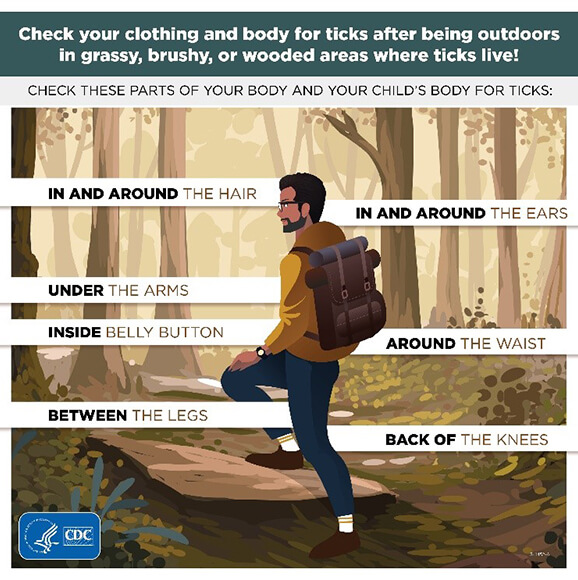
- Check your body for ticks. Conduct a full body check to look for ticks. Use a hand-held or full-length mirror to view all parts of your body.
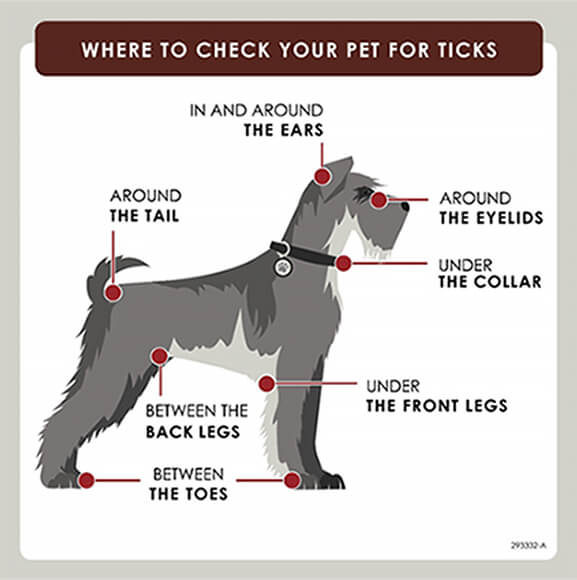
- Check your dogs for ticks daily, especially after they spend time outdoors. Check the ears, around the eyelids, between the legs, around the tail, and between the toes.
- Remove attached ticks from people or pets as soon as possible.
- To remove a tick, grasp it with fine-tipped tweezers, as close to the skin’s surface as possible. Pull upward with steady, even pressure. Do not twist or jerk the tick.
- See Tick Removal for detailed information or use the Tick Bite Bot to assist you with removing attached ticks and determining when to seek health care.
- Watch for fever, rash, or flu-like illness in people and pets in the weeks following tick exposure, even if you don’t remember being bitten by a tick.
Tickborne Diseases in the United States
Ticks can carry a wide range of germs that can make you or your pet sick. Thousands of cases of tickborne disease occur every year in the United States. Illnesses can range from very mild to deadly. See your healthcare provider right away if you develop a fever, rash, or flu-like illness following exposure to or contact with ticks. Remember, many tickborne diseases can be effectively treated if recognized early. Be sure to mention to your doctor any history of tick bites or outdoor activities where you might have been exposed to ticks.
Visit CDC’s Ticks website for more information about tickborne diseases, areas where ticks live, and more.
Information Source: CDC


