







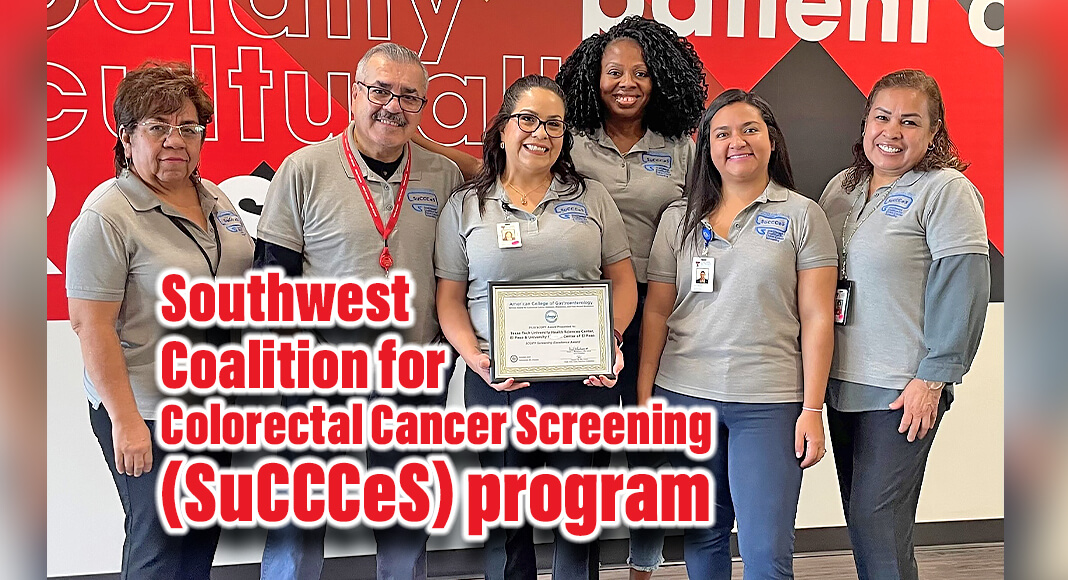

Grand Prize Winner: The Southwest Coalition for Colorectal Cancer Screening (SuCCCeS) program

Translate to Spanish or other 102 languages!

The SuCCCeS program is designed to reduce the rates of colorectal cancer (CRC) in El Paso, Texas, and the surrounding 56 counties. Based at Texas Tech University Health Sciences Center El Paso, SuCCCeS works in partnership with multiple community organizations and is supported by funding from the Cancer Prevention and Research Institute of Texas (CPRIT). Courtesy Image
- Advertisement -

According to the American Cancer Society, the number of colorectal cancers in the US for 2024 are estimated to be about 106,590 new cases of colon cancer (54,210 in men and 52,380 in women) and about 46,220  new cases of rectal cancer (27,330 in men and 18,890 in women). 

The American Cancer Society National Colorectal Cancer Roundtable (ACS NCCRT), honored five organizations for their extraordinary work to increase colorectal cancer screening rates across the U.S. with the 2024 80% In Every Community National Achievement Award. 

Texas Tech University Health Sciences Center El Paso is proud to recognize and spotlight the Grand Prize Winner: The Southwest Coalition for Colorectal Cancer Screening (SuCCCeS) program. 

- Advertisement -

The SuCCCeS program is designed to reduce the rates of colorectal cancer (CRC) in El Paso, Texas, and the surrounding 56 counties. Based at Texas Tech University Health Sciences Center El Paso, SuCCCeS works in partnership with multiple community organizations and is supported by funding from the Cancer Prevention and Research Institute of Texas (CPRIT). 

The program serves a population of 2.56 million people who are primarily medically underserved, ethnically diverse, and located in rural and border communities. 

SuCCCeS focuses on sustainably engaging health care systems and community organizations to address barriers to reducing CRC disparities and funding screening. To date, SuCCCeS has distributed over 31,000 fecal immunochemical test (FIT) kits, with a return rate of 71%. 

SuCCCeS has scheduled over 800 high-risk screening and over 1100 diagnostic colonoscopies for patients with positive or abnormal FIT results, with a completion rate of 74%. SuCCCeS credits their high FIT return and follow-up colonoscopy completion rates to working within and listening to their community and being a resource for other partners. 

- Advertisement -

The program is most proud of the cancers they have prevented or caught early with their work, which, as of January 2024, stands at 34 cancers diagnosed and over 1000 individuals with adenomatous polyps removed.  

- Advertisement -
- Advertisement -

- Advertisement -

More Articles

STC Makes History as First Nursing Apprenticeship Cohort Achieves 100% Pass Rate

Just months after making history as graduates of the nation’s first federally-recognized registered nursing apprenticeship, all 10 recent South Texas College graduates have passed the National Council Licensure Examination (NCLEX-RN) on their first attempt, achieving a 100% pass rate and becoming licensed registered nurses

How an STC Dual Credit Alumna Is Guarding Hidalgo County

From investigating outbreaks and identifying health threats to educating the community, South Texas College alumna Amy Gonzalez has dedicated her career to serving others and making a meaningful difference in the community she calls home.

Texas Grants $5.6 Million to Expand Nursing Education and Workforce Capacity

Governor Greg Abbott announced more than $5.6 million in grants to eight Texas colleges and universities. The Nursing Innovation Grant Program (NIGP) supports new and expanded projects that improve or extend nursing programs.

How Energy Drinks Can Mask the Dangers of Alcohol

As students prepare for the start of the fall semester, experts with the New Jersey Poison Control Center are warning about the dangers of mixing energy drinks with alcohol.
- Advertisement -

