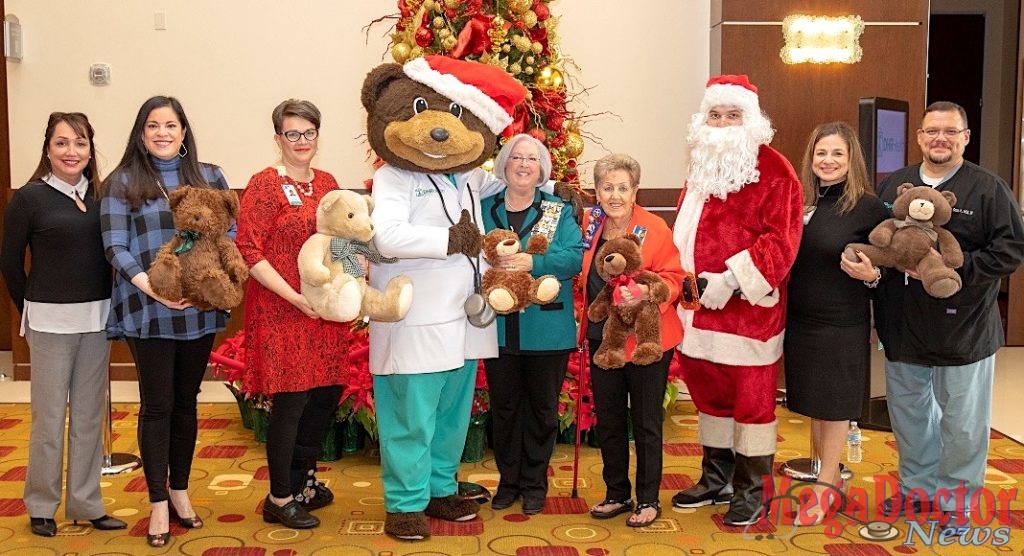
Pictured above: DHR Health receives a donation of teddy bears from Paula Owen and Irene Quail, representing the Rio Grande Chapter National Society Daughters of the American Revolution. Pictured from left to right: Norma Teran, DNP, MBA, RN, Chief Nursing Officer, DHR Health; Elizabeth Adamson, DNP-HI, MSN, RN, BC, Chief Nursing Information Officer, DHR Health; Lesley Anne Durant, JD, CHC, CHPC, Chief Compliance and Privacy Officer, DHR Health; Dr. Ted E. Bear; Paula Owen; Irene Quail; Lisa R. Treviño, PhD, Vice President for Research and Development; Mario Garza. Jr., MSN, RN, Vice President of Surgery and Procedural Services, DHR Health.
Mega Doctor News
- Advertisement -
Edinburg, TX—For young patients at DHR Health, a small act of kindness ensures that children are comfortable in what can be a very scary situation. In December 2018, DHR received a donation of more than 40 teddy bears to give to children in the emergency room and oncology unit.
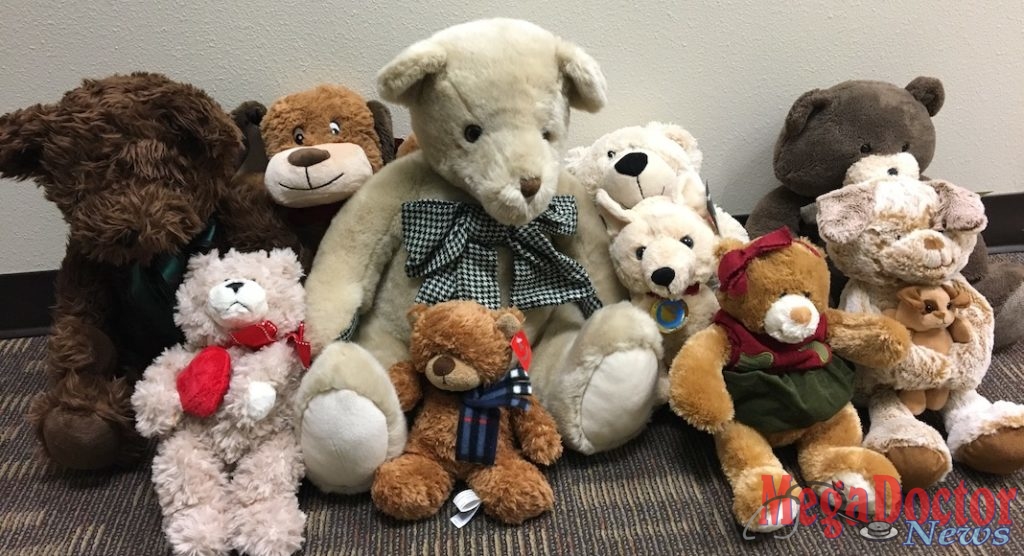
Teddy bears donated to children at DHR Health.
The bears provide comfort for a child whose family member is sick or injured, and help ease a little one’s fear and discomfort during what is usually an unhappy visit to the hospital. The donation program, started by Paula Owen of the Rio Grande Chapter National Society Daughters of the American Revolution in 2017, continues to provide stuffed animals for children in the hospital throughout the year.
The free event will feature educational seminars in English and Spanish led by STHS healthcare professionals, covering stroke prevention, risk factors, treatment options and the recovery process.
DHR Health is pleased to announce the launch of DHR Health Talks, a new podcast series designed to connect all Rio Grande Valley residents with trusted DHR Health physicians, nurses, and other healthcare professionals who provide listeners with valuable information on a variety of health-related topics. You can start listening to a podcast segment of your choice by going to YouTube and searching for “DHR Health Talks.”
Governor Greg Abbott announced that the Texas Health and Human Services Commission (HHSC) plans to award $78 million in Rural Texas Strong grants to 216 rural healthcare providers throughout the state.