
Mega Doctor News
By Roberto Hugo González / Mega Doctor News
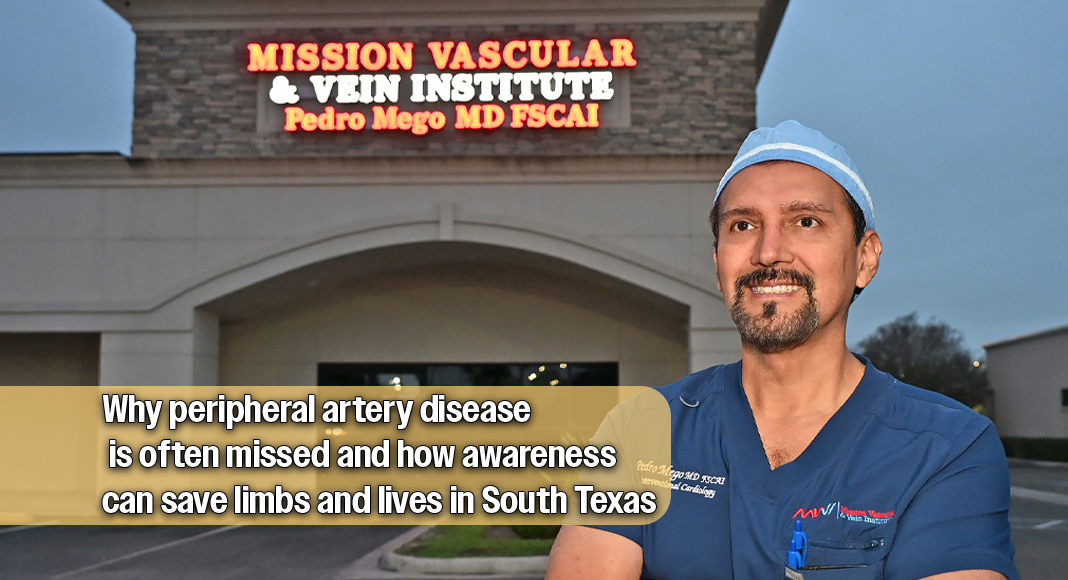
Dr. Pedro Mego, FSCAI, is a board-certified Interventional Cardiologist. He said his decision to dedicate his medical practice entirely to peripheral artery and venous disease was shaped by what he encountered after arriving in South Texas. While he expected to see high rates of obesity, diabetes, heart attacks, and strokes, he said he “was not prepared for the number of patients with amputation or at risk for amputation.” Because of that need, he gradually shifted his focus until he was “dedicating 100 percent of my practice to leg circulation, which includes peripheral artery disease and venous disease.”
He stressed that peripheral artery disease, commonly known as PAD, should never be viewed as an isolated leg problem. “It is important to remember that peripheral artery disease is part of a systemic condition called atherosclerosis,” he said. Over time, cholesterol and inflammatory material build up inside arteries, narrowing blood flow and sometimes completely blocking it. When that happens, “the territory that is supposed to receive that blood will not receive blood,” placing patients at risk for serious complications.

The consequences depend on where the blockage occurs. Disease in the neck increases stroke risk, disease in the heart can lead to a heart attack, and disease in the leg arteries causes PAD, which in advanced stages can result in ulcers that do not heal or amputation. “The brain, the heart, and the legs are the organs most commonly affected, and they are very important for daily living,” he said.
Dr. Mego noted that vascular disease rarely affects only one area. “If there is evidence of severe narrowing in the heart or the neck, there is about a 33 percent chance there are severe blockages in the legs,” he said. In patients with both coronary artery disease and stroke or transient ischemic attack, “there is easily a 50 percent chance the patient has severe PAD as well.” Treating only the leg, he said, is not enough. “If we treat only the leg circulation and do not treat the systemic condition, that repair is only temporary. The artery can re-narrow.”
PAD remains widely underdiagnosed because many patients have no symptoms early on. “Thirty to forty percent of patients we test already have abnormal circulation and are completely asymptomatic,” he said. Despite the lack of symptoms, the risk remains high. “Patients with asymptomatic PAD have a significantly higher risk of stroke, non-fatal heart attack, and higher mortality compared to patients with no PAD.”
Although outcomes for heart disease have improved over the past decade, Dr. Mego said Texas has not seen similar progress in limb preservation. “We did not see a plateau or reduction in amputations in Texas. The numbers have remained trending up,” he said, attributing this to the high prevalence of obesity, diabetes, and metabolic syndrome in the state.
As PAD progresses, symptoms can range from none at all to leg pain with walking, known as claudication. “Patients notice they cannot walk the same distance as before,” he said. In advanced disease, patients develop critical limb ischemia, characterized by rest pain, nonhealing ulcers, or blackened tissue (known as “gangrene”). Nighttime leg pain is a key warning sign. “When patients lie flat, gravity no longer helps blood reach the feet,” he said. “The quantity of blood getting to the feet becomes significantly lower.” Some patients wake up in the middle of the night with cold feet, cramps, or pain in their legs; they experience temporary relief while sitting at the bedside or standing briefly. These are signs of severe PAD.
For screening, Dr. Mego emphasized evaluating high-risk patients, including those with diabetes, high blood pressure, high cholesterol, smoking history, kidney disease, older than 55 years old, or poor pulses. He described the ankle-brachial index as the standard test. “We compare blood pressure in the ankle to blood pressure in the arm,” he said. Values below 0.9 indicate PAD, and values below 0.5 suggest severe disease.
Because PAD is systemic, treatment must address the whole patient. Dr. Mego emphasized controlling risk factors, encouraging physical activity, and using medications such as antiplatelet therapy. “Patients with PAD already have narrowed arteries, and a small clot can easily close them,” he said. Medication choices depend on risk and bleeding concerns.
When disease becomes limb-threatening, restoring blood flow is critical. “Whenever possible, we attempt endovascular revascularization first,” he said. These minimally invasive procedures often allow patients to walk within hours and go home the same day. Surgical bypass is reserved for more complex cases.
Dr. Mego also addressed confusion between artery and vein disease. “Arteries bring blood from the heart to the legs. Veins bring blood back to the heart,” he said. Venous disease causes blood to pool in the legs, leading to swelling, skin changes, and ulcers near the ankle. Modern vein treatments, he noted, are now minimally invasive and allow faster recovery.
He cautioned that many patients mistake a short ultrasound for a full vein evaluation. “An ultrasound to rule out DVT usually takes 10 to 15 minutes,” he said. A comprehensive venous insufficiency study takes much longer and evaluates how well blood returns to the heart.
Looking ahead, Dr. Mego said awareness is the most important factor in reducing amputations. “Many patients have this disease and do not know it, so they do not receive treatment,” he said. He emphasized regular foot exams for people with diabetes and early referral. “Improving blood flow allows wounds to heal, improves quality of life, and reduces the risk of amputation.”
He added that his practice continues to expand across the Rio Grande Valley, with plans to open in Rio Grande City in the near future. The goal, he said, remains early detection, comprehensive care, and minimally invasive procedures when revascularization is required to improve quality of life and prevent amputations.
Since beginning his vascular practice in the Valley in 2005, Dr. Mego has remained firmly focused on prevention. In past interviews, he has stressed the importance of seeking second opinions, noting that many amputations can be avoided. He continues to promote regular walking, balanced nutrition, and timely screenings as central elements of patient education.
See related story: