Mega Doctor News

Newswise — LOS ANGELES — Liver disease is usually caused by one of three factors: alcohol consumption, fat buildup in the liver linked to obesity, diabetes and high cholesterol, or hepatitis B and C.
Now, a new study published in Liver International from Keck Medicine of USC reveals that tetrachloroethylene (PCE), a chemical used in dry cleaning and found in consumer products such as adhesives for arts and crafts, spot cleaners and stainless steel polish, may also be harmful to the liver.

Exposure to PCE was shown to triple the risk of significant liver fibrosis, an excessive amount of scar tissue in the liver that can lead to liver cancer, liver failure or death.
Additionally, the more exposure people had to the chemical, the more likely they were to develop significant liver fibrosis.

“This study, the first to examine the association between PCE levels in humans and significant liver fibrosis, underscores the underreported role environmental factors may play in liver health,” said Brian P. Lee, MD, MAS, a hepatologist and liver transplant specialist with Keck Medicine and lead author of the study. “The findings suggest that exposure to PCE may be the reason why one person develops liver disease while someone with the exact same health and demographic profile does not.”
Where PCE can be found
PCE is a human-made, colorless liquid used in dry cleaning, household goods and industrial settings to remove grease and for other purposes.
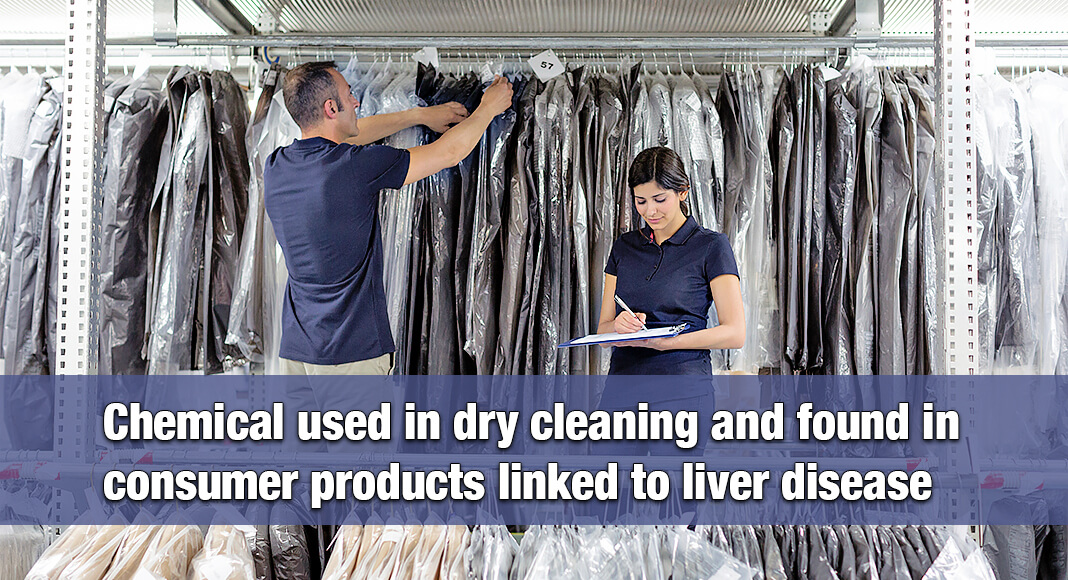
People are typically exposed to PCE through the air — for example, the chemical can be slowly released into the air over time from clothes that have been dry cleaned. PCE can also be present in drinking water from contaminated sites due to spills and improper disposal of PCE that can seep into the soil and then into the groundwater.
The International Agency for Research on Cancer has classified PCE as a probable carcinogen and linked it to bladder cancer, multiple myeloma and non-Hodgkin lymphoma. Other studies showed that exposure to PCE increased the risk of liver cancer, said Lee.
Due to its toxicity, the United States Environmental Protection Agency has launched a 10-year phaseout for the use of PCE in dry cleaning as well as banned or placed workplace controls on other uses of PCE. However, the chemical may remain present in some applications and in countries without similar regulations.
The more PCE exposure, the greater the risk of liver disease
Lee and his fellow researchers used data from the National Health and Nutrition Examination Survey (NHANES), a nationally representative survey of the United States population, to reach their conclusions. They tracked PCE exposure through the concentration of the chemical in individuals’ blood in people 20 and older from the years 2017-2020, the most recent years for which information is available, finding that some 7% of the population had detectable PCE.
They then examined which individuals with PCE in their blood had significant liver fibrosis and found that people exposed to PCE were three times more likely to have significant liver fibrosis than those without exposure.
These results held steady independent of factors such as age, sex, race, ethnicity and education level.
The study did show that those most at risk of PCE exposure were from higher-income households. “People with higher incomes may be more likely to use dry cleaning services, which could increase their exposure to PCE,” said Lee. “However, people who work in dry cleaning facilities may also face elevated risk due to prolonged, direct exposure to PCE at work.”
The researchers also found that for every one nanogram per milliliter increase in PCE concentration in the blood (one nanogram is one-billionth of a gram), the individual’s odds of having significant liver fibrosis increased five-fold.
Of particular note, alcohol use and fat buildup in the liver linked with obesity and other health factors did not appear to play a role in significant liver fibrosis when PCE was present. “Patients will ask, how can I have liver disease if I don’t drink and I don’t have any of the health conditions typically associated with liver disease, and the answer may be PCE exposure,” said Lee.
Future research needed
Lee would like to see future research in the field of environmental toxins and how they affect liver disease. “No doubt there are other toxins in our environment besides PCE that are dangerous to the liver,” he said.
He also thinks the study may lead to improved outcomes for patients. “We hope our research will help both the public and physicians understand the connection between PCE exposure and significant liver fibrosis,” he said. “If more people with PCE exposure are screened for liver fibrosis, the disease can be caught earlier and patients may have a better chance of recovering their liver function,” said Lee.