Mega Doctor News –
Harlingen – Alfonso Soto Jr. of Weslaco was driving, running an errand, when his brother-in-law, who was in the passenger seat, noticed that Mr. Soto suddenly just “didn’t look good”.
Mr. Soto, age 65, was slurring his speech and his face was drooping. Mr. Soto pulled over at a gas station, and his brother-in-law called 911. Soon, an ambulance arrived, and the Emergency Medical Services technicians saw that Mr. Soto was having a stroke – similar to a heart attack but to the brain.
Mr. Soto previously had been treated for heart attacks at a McAllen hospital, and his family asked that he be taken to that same hospital. But the Weslaco Fire Department EMS personnel advised them that since it appeared it was Mr. Soto’s brain that was being affected, they should instead take him immediately to Valley Baptist Medical Center in Harlingen — since Valley Baptist is the only hospital in the Valley capable of performing specialized “endovascular” procedures to open the blood vessels to the brain during a stroke.

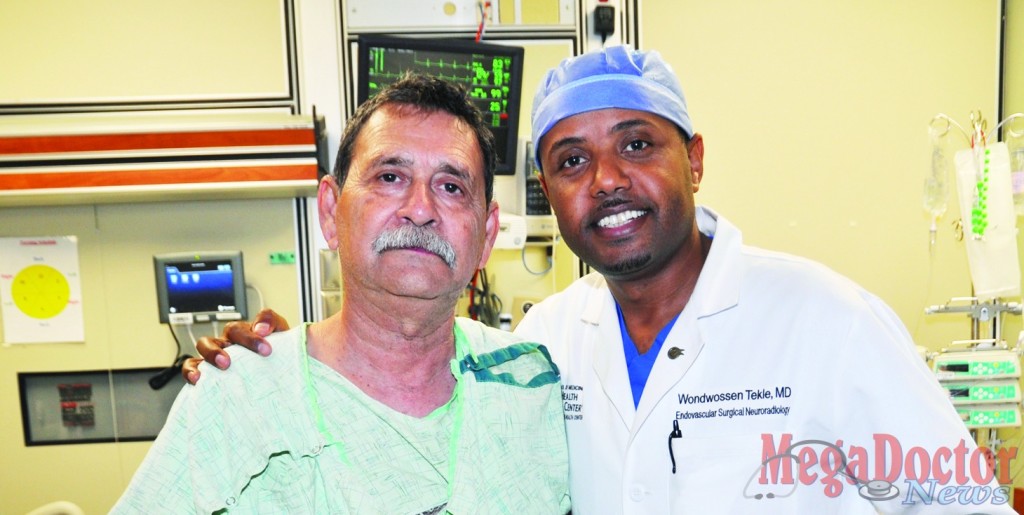
The EMS crew promptly notified Valley Baptist of the incoming patient. Upon Mr. Soto’s arrival at the hospital, he was greeted by a specialized “Stroke Team” which included specialized emergency room nurses, radiology technicians, phlebotomists who drew blood samples, and Dr. Wondwossen Tekle, one of only two specialized “endovascular neurologists in the Valley (the other being Dr. Ameer Hassan, also of Valley Baptist).
Mr. Soto was quickly taken to a special room for a CT scan of the brain. Dr. Tekle saw from the CT scan that there was no internal bleeding in Mr. Soto’s brain – but instead there was a blood clot, which was blocking one of the blood vessels supplying blood and oxygen to his brain.
Dr. Tekle immediately ordered an I.V. (intravenous) injection of a “clot-busting” medication to reverse the stroke. The medication was infused into Mr. Soto while he was still laying on the CT scanner table — in a record-breaking “door to needle” time of 12 minutes from the time he first came into the hospital.
While Mr. Soto received extremely fast treatment, it turned out that because the blood clot was so large in his case, there was not much improvement as a result of the clot-busting medication injected through the I.V. So, Valley Baptist staff took Mr. Soto to a specialized “bi-plane neuro-angiography suite” in Valley Baptist’s catheterization laboratory, where Dr. Tekle used a mechanical device to pull the large blood clot out of Mr. Soto’s brain. Once the clot was out, blood was able to again flow to Mr. Soto’s brain — and Dr. Tekle and the hospital staff noticed an almost immediate improvement.
“Mr. Soto went from having a severe stroke – measured by a very high stroke score of 20 – and then immediately after the endovascular stroke procedure – his (National Institutes of Health Stroke Scale) score fell to zero (0), which is basically a normal level,” Dr. Tekle said. “He started moving his left side again while he was still on the table in the cath lab – this after being completely paralyzed just a few moments before.”
Amazingly, Mr. Soto – who hadn’t remembered anything since he was first brought to the hospital – began speaking clearly. Later that evening and the next day, he was not only talking and eating, but also walking again, with help from physical therapists in Valley Baptist’s Neurological Intensive Care Unit.
Dr. Tekle said the earlier the patient gets to Valley Baptist, the better. “We can open up a blood vessel with an endovascular stroke treatment as long as six to eight or more hours after stroke symptoms start. But the ‘golden hour’ is the first two to three hours, when you can make the maximum impact in saving lives and preventing disabilities.” MDN