








Mega Doctor News

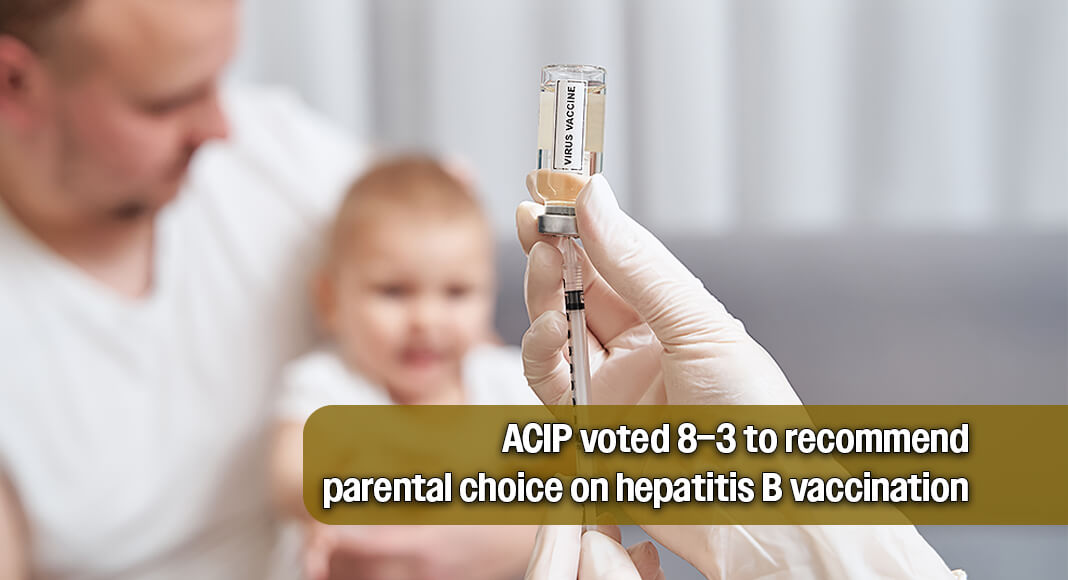
CDC – ATLANTA — The Centers for Disease Control and Prevention’s (CDC) Advisory Committee on Immunization Practices (ACIP) today voted 8 to 3 to recommend individual-based decision-making for parents deciding whether to give the hepatitis B vaccine, including the birth dose, to infants born to women who test negative for the virus. For those infants not receiving the birth dose, ACIP suggested in its recommendation that the initial dose be administered no earlier than two months of age.
Individual-based decision-making, known on the CDC immunization schedules as shared clinical decision-making, means that parents and health care providers should consider vaccine benefits, vaccine risks, and infection risks, and that parents consult with their health care provider and decide when or if their child will begin the hepatitis B vaccine series. The committee said parents and health care providers should consider whether there are infection risks such as a household member who has hepatitis B or frequent contact with persons who have emigrated from areas where hepatitis B is common.
ACIP also voted to recommend that when evaluating the need for a subsequent hepatitis B vaccine dose in children, parents should consult with health care providers to decide whether to test antibody levels to hepatitis surface antigen to evaluate adequacy of protection through serology results.


These recommendations on hepatitis B immunization maintain consistency of coverage for all payment mechanisms, including entitlement programs such as the Vaccines for Children Program, Children’s Health Insurance Program, Medicaid, and Medicare, as well as insurance plans through the federal Health Insurance Marketplace. ACIP on September 19, 2025, voted to recommend that all pregnant women be tested for the hepatitis B virus, a test that is covered across all insurance programs.
Today’s votes were preceded yesterday by presentations to ACIP on the hepatitis B disease burden, vaccine safety, and comparative nation immunization policies as well as briefings from representatives of the vaccine manufacturers.
A presentation from Cynthia Nevison, Ph.D., on the decline of the hepatitis B disease burden since 1985 concluded that the universal birth dose contribution to acute case decline is likely small. It identified sharp declines in post-transfusion hepatitis B transmission due to advanced blood screening, improved dialysis practices, and needle exchange programs. It also acknowledged a 2019 study that found 57.9% of estimated births to women who test positive for the hepatitis B surface antigen were attributable to non–US-born women, mainly from high-endemicity countries. The study reported that 0.5% of pregnancies in the U.S. are to women who test positive for the hepatitis B surface antigen, which is the most significant risk to newborns for being infected with the virus.
ACIP Childhood/Adolescent Schedule Workgroup Chair Vicky Pebsworth, Ph.D., RN, presented the policy context and historical and international comparison of the immunization schedule for hepatitis B. The United States’ universal recommendation of the hepatitis B vaccine birth dose is an outlier among developed countries with low hepatitis B prevalence.
“The American people have benefited from the committee’s well-informed, rigorous discussion about the appropriateness of a vaccination in the first few hours of life,” said Deputy Secretary of Health and Human Services and CDC Acting Director Jim O’Neill.
A recommendation from ACIP becomes part of the CDC immunization schedule once it is adopted by the CDC director.
Information source: CDC