







Mega Doctor News

National Eye Institute
Have you noticed that more children than ever are wearing glasses? Global research indicates 35% of children are affected by myopia, needing glasses to see clearly at a distance. If the trend continues, the number is expected to rise to 40%, or more than 740 million children, by 2050.
These are the kind of stats that prompted David Berntsen, O.D., Ph.D., chair of clinical sciences at the University of Houston College of Optometry, and his collaborators at Ohio State University, to seek effective methods to stem nearsightedness.

And they’ve been successful.
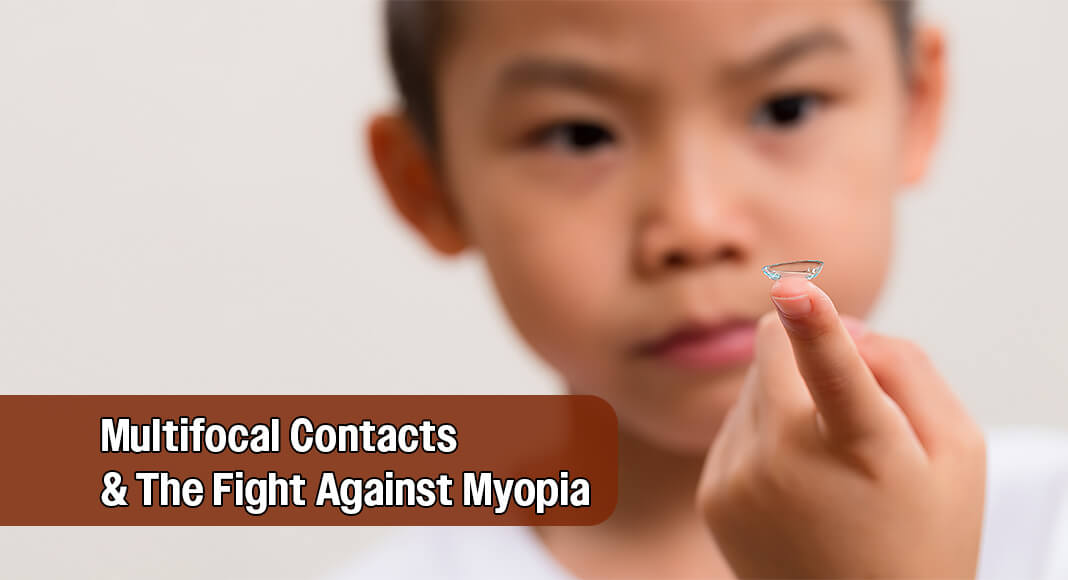
Funded by the National Eye Institute, Berntsen and the BLINK Study team (Bifocal Lenses In Nearsighted Kids) has shown that having children with myopia wear high-add power multifocal contact lenses slows its progression and that the treatment lasts even after older children stop wearing the lenses. He has led his team at UH through both the BLINK and BLINK2 Studies.
Now Berntsen is reporting the biological changes associated with slowing eye growth when wearing multifocal lenses. This slowdown is vital since children develop myopia mainly because their eyes grow too long, becoming too long from front to back, causing light to focus in front of the retina instead of directly on it. This results in blurred distance vision.
Focus on the choroid
The choroid is a layer of blood vessels that supply oxygen and nutrients to the retina, which is the part of the eye that detects light so we can see. . Importantly, the choroid slightly thickens in children wearing high-add multifocal contact lenses, the same children with slower eye growth in the BLINK Study. This finding suggests the choroid may be involved in regulating eye growth when children wear high-add multifocal contact lenses.
“We evaluated changes in subfoveal choroidal thickness and area in children wearing soft multifocal contact lenses for myopia control,” reports Berntsen in the journal Investigative Ophthalmology and Visual Science. “After initiating contact lens wear, subfoveal choroidal thickness and choroidal area increased in the group wearing high-add multifocal contact lenses compared to those in standard contact lenses, a difference that was maintained throughout the three-year study. Increased choroidal thickness and area after two weeks were associated with less axial elongation over three years.”
Information source: National Eye Institute


