Mega Doctor News

Measles, once thought to be eradicated in the U.S., is making a comeback. The number of U.S. measles cases continues to tick upward, caused by declining vaccination rates and vaccine hesitancy. Los Angeles recently reported its first confirmed case. Texas has confirmed 259 cases, one death and 30 hospitalizations.
Watch the Cedars Sinai Video Below:
The Cedars-Sinai Newsroom spoke to two infectious disease specialists—Jonathan Grein, MD, director of Hospital Epidemiology, and Priya Soni, MD, a pediatric infectious disease specialist at Cedars-Sinai Guerin Children’s—to get the facts about how to protect yourself and your family.

Why is measles so dangerous?

Priya Soni, MD: Many people think that measles is just a rash, but it can be life threatening. One in 5 children who develop measles end up in the hospital. One in 20 children develop pneumonia, and this is the leading cause of measles-related deaths. In addition, 1 in 1,000 children can develop a rare complication of brain swelling—encephalitis—that can cause permanent brain damage.
How does measles spread?
Jonathan Grein, MD: Measles is one of the most infectious diseases that we know of, and it’s spread very easily through the air, particularly for people who are not immune or have not received the vaccine. It’s so infectious that you don’t even need to be in the same room at the same time with someone who has measles to potentially get infected.
What are the telltale signs of measles?

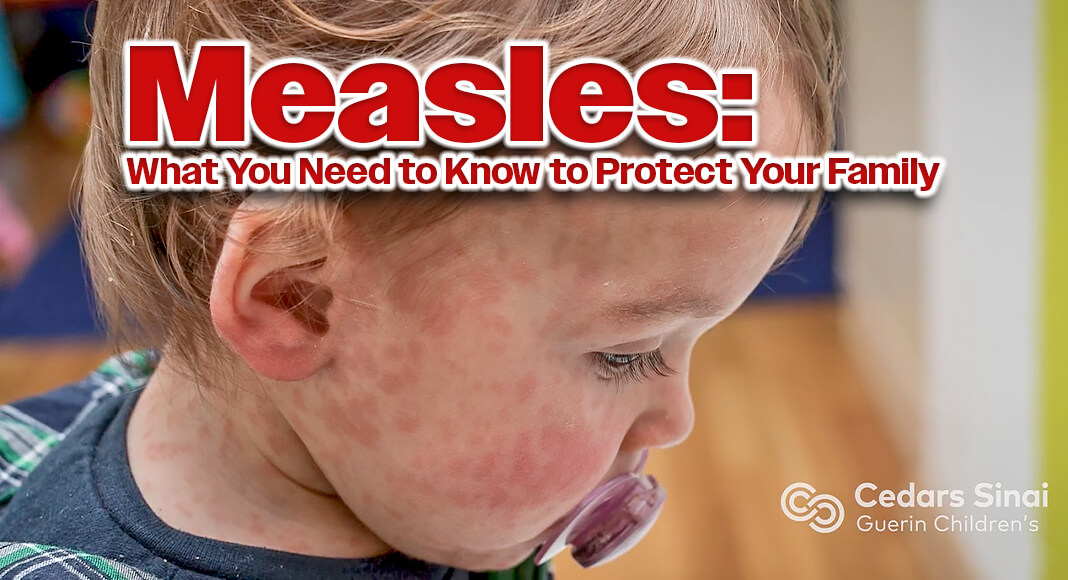
Grein: The symptoms of measles can begin like any other viral illness. You may feel feverish, have muscle aches, headaches, very nonspecific symptoms. Patients may then go on to develop cough, runny nose, sometimes redness of the eyes. That all precedes the classic rash that you may be familiar with that typically starts on the face and spreads throughout the body. I think it’s important to know that it is possible to be infectious several days before that rash begins, which is one of the real challenges with trying to control measles from being spread person to person.
What should you do if you think your child has measles?
Soni: If you think your child has measles, the first thing to do is call your pediatrician, but do not go directly to their offices or the Emergency Department without speaking to someone on the phone first. The virus is extremely contagious, so you want to call ahead to let the healthcare providers know what’s going on. Showing up without calling ahead can cause other children in the waiting room to be infected. In addition, you should immediately isolate your child from other children, especially infants who are less than a year of age, as they may not have protection from the virus. You should also isolate your child from any immunocompromised family members.
How is measles treated?
Grein: The treatment for measles is solely supportive. There is no specific measles treatment, but you want to try to control the fever and make sure the patient is hydrated and resting in isolation.
How do we protect against measles?
Soni: Vaccination is the best protection against measles. The MMR vaccine, which is inclusive of measles, mumps and rubella, is 97% effective after two doses. It’s one of the most effective vaccines that we have. And it protects children in outbreak situations and other vulnerable community members as well.
Typically, the first dose of the measles vaccine is given at 12-15 months of age. The second dose is given around 4-6 years of age.
If your child is 6-12 months old, they can receive an early dose of the measles vaccine if they’re in a high-risk situation such as an outbreak or if they’ve been exposed to the virus. This additional dose that’s given earlier than the recommended schedule does not count toward their two-dose series.
Do adults need to get vaccinated against measles?
Grein: Most adults will not need an additional booster dose if they were previously vaccinated. There is a small number of adults who may have received a different version of the measles vaccine between 1963 and 1967. This vaccine was later found to be less effective, and it doesn’t provide as long-lasting immunity as the current vaccine. So if you did receive that vaccine, it is recommended that you receive a booster dose with the current MMR vaccine to achieve appropriate immunity.
Read more on the Cedars-Sinai Blog: Why Some Vaccines Last A Lifetime and Others Don’t
Information Source: Cedars Sinai Newsroom