Mega Doctor News

Newswise — WASHINGTON — Without the prospect of herd immunity on the immediate horizon, speedy detection for COVID-19 remains imperative for helping to curb the pandemic. Point-of-care testing that can provide immediate results is an urgent need.
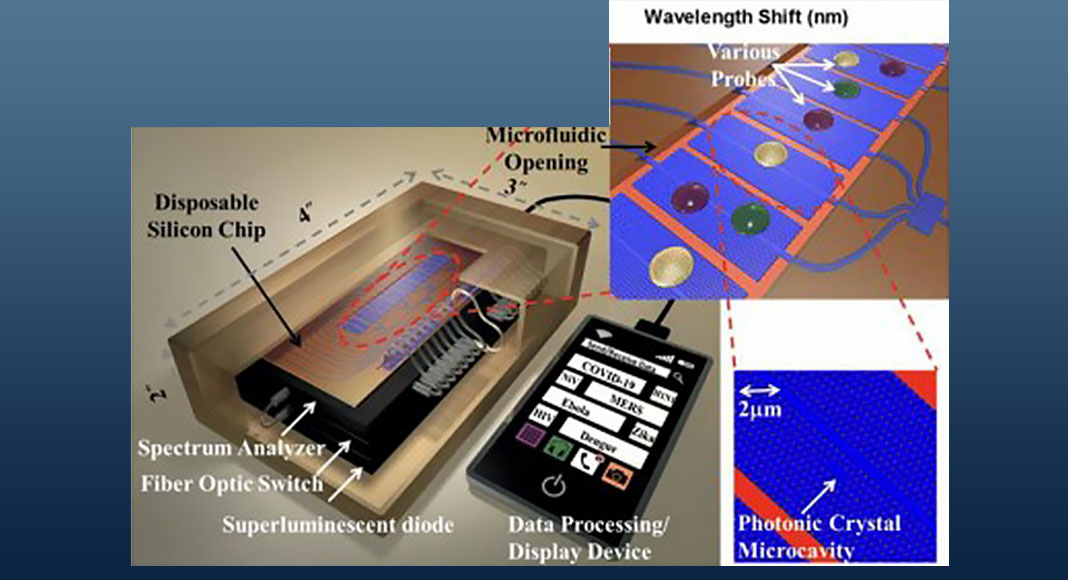
Researchers from the University of Texas at Austin and Omega Optics Inc. investigated the opportunities and challenges in developing rapid COVID-19 sensing techniques. They discuss the prospects of optical biosensors for point-of-care COVID-19 testing in the journal Applied Physics Reviews, from AIP Publishing.
“Due to growing cases resulting from more transmissible variants around the world and the need to prevent and control cases and outbreaks when they arise, we should be utilizing rapid testing more commonly to detect and stop the spread before hitting the transmission peak,” said Aref Asghari, one of the authors.

One of the most promising solutions to accurate rapid testing is using optical biosensors. When a virion is present on the surface of an optical sensor, its interaction with a light beam on the sensor affects the light’s properties, causing a measurable shift in the light signal. Even with only a very small viral dosage, the system can reliably detect the coronavirus in real time.
“In case of COVID-19, the viral load at the onset of infection can be low enough to not be detected by many commercially available methods,” Asghari said. “Therefore, viral detection, especially at earlier infection stage, can be very challenging.”
There are a number of different ways in which this interaction can be utilized and improved upon, such as integrating it with measurements of plasma oscillations or incorporating graphene into its fabrication process.
Each potential configuration uses a different mechanism to sense the virus and has its own set of advantages and drawbacks, but the primary takeaway remains the same. Even with the widespread availability of vaccines, the pandemic cannot be overcome without developing faster ways to determine infection, particularly as mutations and new variants of the virus continue to arise.
“The combination of vaccines and rapid tests will drive down community transmission to a point where we can effectively eliminate the virus,” Asghari said.