Mega Doctor News
2nd Dual-Camera Cath Lab at Valley Baptist-Harlingen includes advanced equipment for heart patients, stroke & brain aneurysm patients; two “bi-plane” rooms also increases treatment capability for Valley patients needing “electrophysiology studies” of the heart
HARLINGEN, 2014 – A new “bi-plane” Cardiac Catheterization Laboratory to treat Valley heart and stroke patients has opened at Valley Baptist Medical Center in Harlingen.
The new “G.E. Innova IGS 630” bi-plane lab, combined with Valley Baptist’s original bi-plane lab from 2012, will give the Valley increased capacity to treat heart patients, including those needing “electrophysiology studies” for problems with their heartbeat. The two bi-plane cath labs also enhance treatment for stroke patients; including through“3D road mapping”of the brain.

With the addition of the second bi-plane suite, the growing Harlingen area now has the ability to treat two heart or two stroke patients at the same time using advanced dual-camera technology (Valley Baptist has a total of four cath labs, and two of those labs are now “bi-plane” suites).
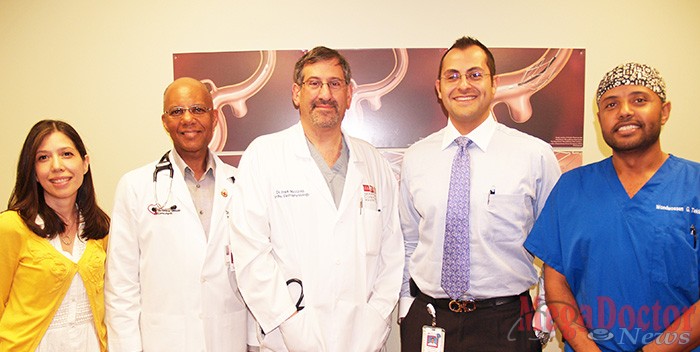
Dr. Frank Mazzola and Dr. Luis Eguia, Cardiac Electrophysiologists, will be conducting specialized electrophysiology studies – to help determine how to treat problems with the rhythm of the heart — in Valley Baptist’s first bi-plane lab. During these procedures, electrodes on the end of a flexible tube are threaded into the heart, to gather information on the electrical activity of the heart, and to treat abnormal heart rhythms.
“The new cath lab expands our capability to provide the most advanced specialized treatments to more of our patients,” Dr. Mazzola said.
Dr. Farley Neasman, Cardiologist, said the catheterization laboratory is able to better serve Valley patients not only because of advanced technology, but because of an experienced support staff of nurses and cardiovascular technicians at Valley Baptist. Dr. Neasman recently inserted the Valley’s first miniature heart monitoring device — about the size of a “triple-A” battery — into a heart patient, in Valley Baptist’s cath lab.
For stroke treatment, the Valley’s only two Endovascular Neurologists, Dr. Ameer Hassan and Dr. Wondwossen Tekle, have used Valley Baptist’s bi-plane lab to perform the Valley’s first and only treatments of stroke and brain aneurysm patients with stroke-reversing medications and tiny medical devices delivered through a catheter (thin tube inserted through blood vessels going to patient’s brain).
Valley patients will benefit from the new bi-plane lab through more precise treatment, as the technology allows physicians to see inside the blood vessels in a greater level of detail, through state-of-the-art, three-dimensional imaging. Unlike other cath labs, the new lab is equipped with two camera arms instead of one, allowing physicians to see tiny blood vessels from two angles or “planes”. This gives doctors more options to treat blockages and other problems in the blood vessels. For the patient, it means less radiation and less “contrast dye” has to be used during the procedure.
Parker MacDonald, RN, BSN, CCRN, Director of the Cardiac Catheterization Laboratories and Cardiac Rehabilitation Dept. at Valley Baptist, said the new bi-plane lab shows Valley Baptist’s commitment “to serving our community by keeping our services on the cutting edge of technology”.