



Mega Doctor News

By Christina Elston / Cedars-Sinai
L-glutamine, an amino acid that occurs naturally in the body and plays an important role in digestion, has been studied as a potential way to ease side effects in other cancers. But this was the first trial to evaluate it as an anti-cancer therapy in human patients, said Jun Gong, MD, associate professor of Medicine, medical director of Colorectal Cancer at Cedars-Sinai Cancer and first author of the study.
“Current treatment for stage 4 pancreatic cancer is a cocktail of chemotherapy, with overall survival ranging from eight to 13 months,” Gong said. “We found that by adding L-glutamine to this treatment, we increased overall survival to as much as 22 months—and these positive results merit larger clinical trials of this combination.”


In this Phase I clinical trial, investigators studied 16 patients with advanced pancreatic cancer. All patients were treated with a standard chemotherapy combination of gemcitabine and nab-paclitaxel, along with clinical-grade L-glutamine supplements.
“We began the trial in the hope of improving gut health in these patients,” said Neil Bhowmick, PhD, Mark Goodson Chair in Oncology Research, professor of Medicine and Biomedical Sciences, research scientist at Cedars-Sinai Cancer, and senior author of the study. “Patients with pancreatic cancer do not absorb nutrients well, and often develop a condition called cachexia—a loss of weight and muscle that can be fatal. Glutamine is known to help the gut heal.”
Half of the patients in the study maintained their weight, and investigators found a correlation between the way the bacteria in the gut responded to the glutamine and patient outcomes, Gong said.
“At the time of our paper’s publication, the life expectancy of these patients taking glutamine and chemotherapy was more than double the average life expectancy associated with the historical standard of care,” Gong said. “The study did not compare the two options head-to-head, but our result is striking enough for us to advance to a larger randomized trial where patients are given glutamine or not.”

In the lab, investigators also found that cancer cells exposed to high-dose glutamine were particularly vulnerable to chemotherapy, a result in line with the reduction in tumor size seen in patients.
“It is really satisfying to see science from the bench translated so well into patient outcomes,” Bhowmick said.
The supplements used in the study are approved by the Food and Drug Administration for treatment of sickle cell disease, meaning they are federally regulated, Bhowmick and Gong said.
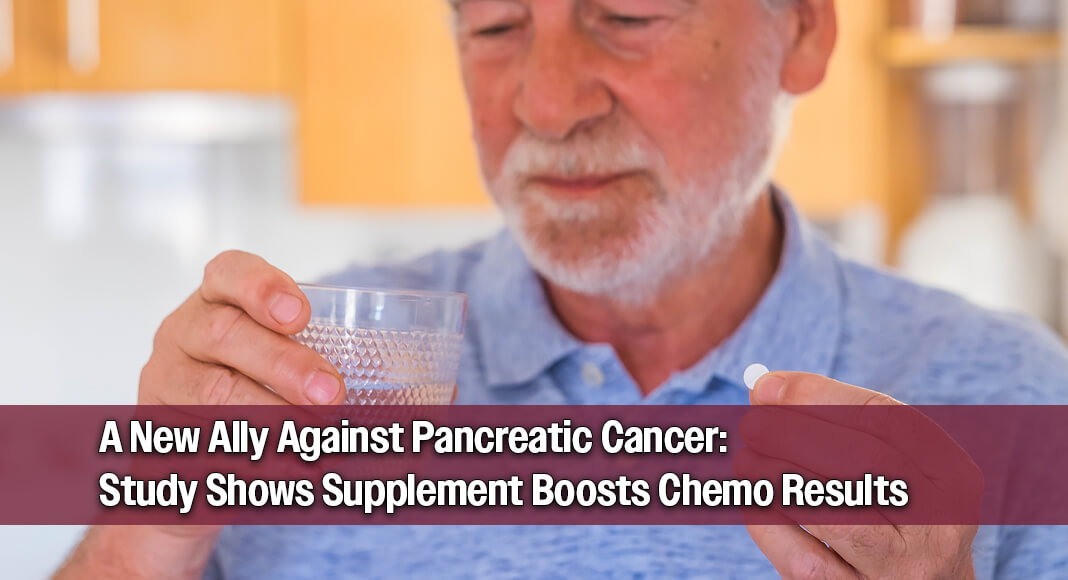
When added to standard chemotherapy, a clinical version of the dietary supplement L-glutamine improved survival in an early-phase trial of patients with advanced pancreatic cancer. The study, led by Cedars-Sinai Health Sciences University investigators, was published in Nature Cancer.
“The survival rate for advanced pancreatic cancer is poor,” said Robert Figlin, MD, interim director of Cedars-Sinai Cancer. “This trial points to a potential new option for optimizing first-line chemotherapy for patients while also opening up a number of new avenues for our physician-scientists to study.”
Additional Cedars-Sinai authors include Hayato Muranaka, So Yung Choi, Mourad Tighiouart, Aleksandr Stotland, Jennifer Van Eyk, Omer H.M. Elmadbouh, Mouad Edderkaoui, Sunao Tanaka, Hideki Furuya, Arsen Osipov, Jeremy Lorber, Sandrine Billet, Stephen J. Pandol, and Andrew Hendifar.
Other authors include Shrikant Bhute, Ezinne R. Aja, Jonathan P. Jacobs, Alexzandra Morris, Johanna ten Hoeve-Scott, and Thomas Graeber.
Funding: This project was funded by the 2019 Tower Cancer Research Foundation Experimental Therapeutics Endowed Fund/Cedars-Sinai Cancer 2019 Developmental Funds for Investigator-Initiated Trials (IITs; J.G.). This project was also supported in part by the NIH National Center for Advancing Translational Sciences (NCATS) UCLA CTSI (UL1 TR001881-01; M.T.) and NCI grants P01CA233452 (M.T., S.J.P., N.A.B.) and U01 grant CA232859-01 (M.T.).
Competing Interest Statement: H.M., N.A.B., J.G. and A.H. have a pending patent related to the work.
Cedars-Sinai Health Sciences University is advancing groundbreaking research and educating future leaders in medicine, biomedical sciences and allied health sciences. Learn more about the university.
Information source: Cedars-Sinai Newsroom