






Mega Doctor News

By University of North Carolina School of Medicine
Newswise –Melanoma, the deadliest form of skin cancer, can’t always be removed with a scalpel.
Patients with advanced stages of melanoma often need immunotherapy and chemotherapy to completely rid their body of cancer cells. But even then, the therapy is only successful in less than half of patients — and can come with side effects that dampen quality of life.

Researchers at the UNC School of Medicine and UNC Lineberger Comprehensive Cancer Center have identified a potential solution. In a new study published in the Journal of Clinical Investigation, researchers have found that by inhibiting a problematic protein, the immune system can better fight off melanoma, decreasing tumor growth and bolstering the body’s immune cells.
The first-of-its-kind study shows that adding a small molecule that blocks the problematic protein to existing cancer treatments—like immunotherapy and CAR T-cell therapy—could help these treatments work much better in patients with difficult-to-treat melanoma.

“For the first time, we were able to confirm that this specific protein contributes to the growth of melanoma,” said Pengda Liu, PhD, who is a biochemist and expert on cancer cell biology at UNC Lineberger Comprehensive Cancer Center. “We also showed that by manipulating this protein in melanoma models, we can bolster our immune cells’ ability to infiltrate solid tumors and enhance the efficacy of immunotherapies.”
As of this study, researchers did not know if SPOP played any type of role in melanoma.
SPOP Helps Cancer Avoid Detection by Immune System
The protein is called speckle-type POZ (SPOP) and belongs to a family of proteins called E3 ubiquitin ligases. Over the years, these proteins have been associated with genetic mutations that can both increase and decrease cancer growth in the prostate and kidneys, respectively.
In the first part of their study, Liu and Gianpietro Dotti, MD, professor of microbiology and immunology at the UNC School of Medicine, found that SPOP helps tumors avoid detection (and attacks) from the immune system.
They confirmed this in mouse models and saw that when SPOP was “knocked out” in tumors, tumors were more fiercely attacked by the immune system, causing the tumors to decrease in size.
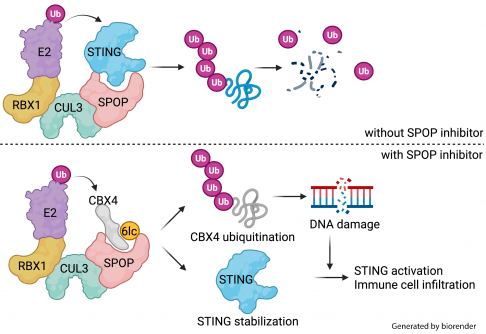
Liu and Dotti wanted to know more. Through studies on a deeper and more technical level, researchers found that SPOP helps tumors avoid immune detection by destabilizing an essential “immune sensor” called STING.
STING, a type of protein, can detect dangerous genetic materials—like viral infections and DNA damage—and can then alert the rest of the body to potential danger, much like a weapons defense system.
What Happens Without SPOP
When the Liu and Dotti labs tested a small molecule that inhibits SPOP, they made a surprising finding: the inhibitor not only re-stabilized STING, it also further activated STING by enhancing DNA damage.
To achieve this, the small molecule acts as a molecular glue that forces SPOP and another protein, CBX4, to interact with one another, resulting in the degradation of CBX4 and an accumulation of attention-getting DNA damage.
Leveraging the Dotti lab’s expertise in immunotherapy, researchers were able to confirm that SPOP inhibitors help the body’s immune system fight melanoma in two ways:
- They help immune cells get through the tumor’s defenses
- They make CAR-T cells better at attacking the tumor
New Ways to Deliver Chemotherapy
Liu’s research team is also working on developing new biomaterials for sustained release of therapeutic molecules and devices that could deliver treatments without frequent injections and with more targeted drug delivery.
“One day, we hope to develop a small device or an implantable patch so that patients don’t need to take pills or stay connected to IV bags for chemotherapy,” said Liu. “We just want to use whatever we can do to improve the therapy efficacy and quality of life for cancer patients.”
This collaborative research effort was co-led by Zhichuan Zhu, PhD, and Xin Zhou, PhD, who are postdoctoral fellows from the Liu and Dotti labs. Drs. Dotti and Liu jointly serve as co–corresponding authors.

