







Mega Doctor News

by University of Texas at El Paso
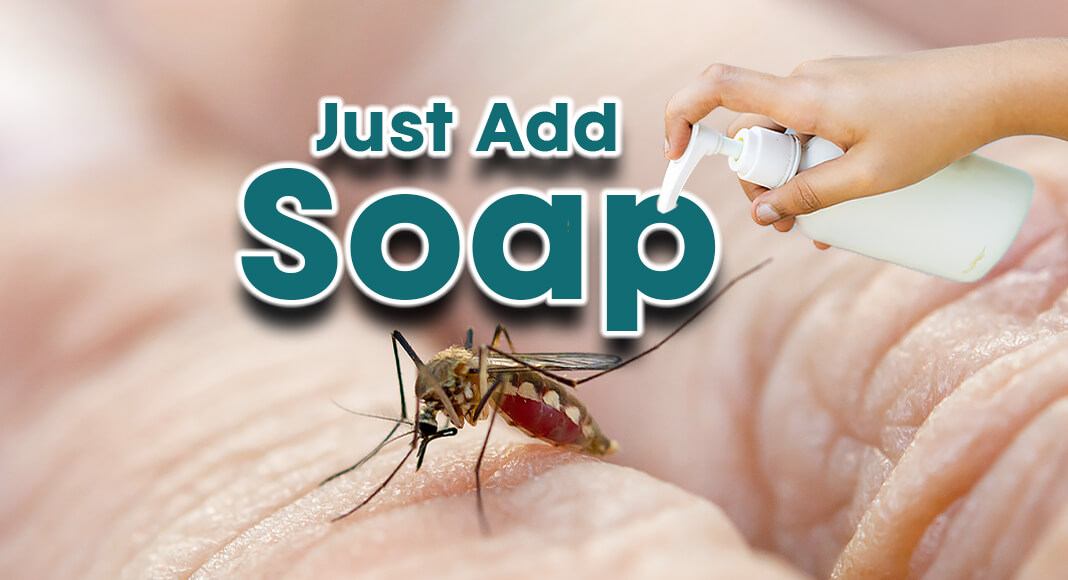
Newswise — EL PASO, Texas – Could the solution to the decades-long battle against malaria be as simple as soap? In a new study published in PLOS Neglected Tropical Diseases, scientists at The University of Texas at El Paso have made a compelling case for it.
The team has found that adding small quantities of liquid soap to some classes of pesticides can boost their potency by more than ten-fold.

The discovery is promising news as malaria-carrying mosquitoes display an increasing resistance to current insecticides, said Colince Kamdem, Ph.D., lead author of the study and assistant professor in UTEP’s Department of Biological Sciences.
“Over the past two decades, mosquitoes have become strongly resistant to most insecticides,” Kamdem said. “It’s a race now to develop alternative compounds with new modes of action.”
Both laboratory tests and field trials have shown that neonicotinoids, a special class of insecticide, are a promising alternative to target populations showing resistance to existing insecticides, said UTEP Research Assistant Professor Caroline Fouet, Ph.D., second author of the study. Neonicotinoids, however, do not kill some mosquito species unless their potency is boosted. In this case, Fouet said, soap is the boosting substance.
Malaria is a devastating mosquito-borne disease that is prevalent in sub-Saharan Africa, Asia and Latin America, causing fever, fatigue, headaches and chills; the disease can be fatal. In 2020, there were an estimated 241 million cases of malaria worldwide, according to the Centers for Disease Control, resulting in 627,000 deaths.
Prior to joining UTEP, Kamdem worked at Cameroon’s Centre for Research in Infectious Diseases (CRID); it was there that he first caught on to soap’s potency while conducting routine insecticide testing.
Current protocols from the World Health Organization (WHO) for testing mosquitoes’ susceptibility to some insecticides recommend adding a seed oil-based product to insecticide concoctions. Kamdem noticed when the compound was added, mosquito mortality increased from when the insecticide was used on its own.
“That compound belongs to the same class of substances as kitchen soap,” Kamdem said. “We thought, ‘Why don’t we test products that have same properties?’
He and his team selected three low-cost, linseed-oil based soaps that are prevalent in sub-Saharan Africa — Maître Savon de Marseille, Carolin Savon Noir and La Perdrix Savon — and added them to four different neonicotinoids, acetamiprid, clothianidin, imidacloprid and thiamethoxam.
The hunch paid off. In all cases, the insecticides drastically enhanced potency, the team wrote in the study. “All three brands of soap increase mortality from 30 percent to 100 percent compared to when the insecticides were used on their own,” said Ashu Fred, first author of the study and Ph.D. student at Cameroon’s University of Yaoundé 1.
The team also tested the addition of soap to a class of insecticides known as pyrethroids. In those cases, however, they saw no benefits.
The team hopes to conduct additional testing to establish exactly how much soap is needed to enhance insecticides.
“We would love to make a soap-insecticide formulation that can be used indoors in Africa and be healthy for users,” Kamdem said. “There are unknowns as to whether such a formulation will stick to materials like mosquito nets, but the challenge is both promising and very exciting.”
Additional authors on the study are doctoral student Marilene M. Ambadiang of CRID and the University of Yaoundé 1; and Professor Veronique Penlap-Beng, Ph.D., of the University of Yaoundé 1.
The project was supported by a grant from the National Institutes of Health.
About The University of Texas at El Paso
The University of Texas at El Paso is America’s leading Hispanic-serving university. Located at the westernmost tip of Texas, where three states and two countries converge along the Rio Grande, 84% of our 24,000 students are Hispanic, and more than half are the first in their families to go to college. UTEP offers 171 bachelor’s, master’s and doctoral degree programs at the only open-access, top-tier research university in America.


