







Mega Doctor News

by Mayo Clinic
Newswise – ROCHESTER, Minn.— “I should stop.” Have you ever said those words to yourself as you scrolled through one disheartening online post after another? This phenomenon is popularly known as doomscrolling. You may wonder: Why is it so difficult to stop doomscrolling once you start? More importantly, what can you do to break free from the negative spiral? Craig Sawchuk, Ph.D., a psychologist at Mayo Clinic in Rochester, offers insights.
“When you think of the word doom, it has an evocative emotional response,” Dr. Sawchuk explains. That lines up with the term’s origins in 2020.

During the early days of the COVID-19 pandemic, many of us were stuck at home, where we leaned heavily on our phones, computers and television sets to provide information and to entertain us. During these early days, there was a lot of uncertainty, which drove many of us to seek information continually. However, no amount of information quelled the uncertainty, keeping us stuck in a never-ending loop of searching, finding negative information and searching for more.
Now, years later, many people still struggle with doomscrolling. All behavior and emotions serve a function, Dr. Sawchuk says, and that includes doomscrolling. Often, it starts with a goal of understanding a situation and preparing yourself for it. However, this search for answers becomes obsessive and unproductive.
Doomscrolling is likely motivated by more than curiosity. According to Dr. Sawchuk, our brains are hardwired to orient us toward novelty and threat. Throughout human existence, this wiring helped keep humans alive. A brain that noticed threats — especially novel threats — was a brain that got you out of harm’s way before it was too late.
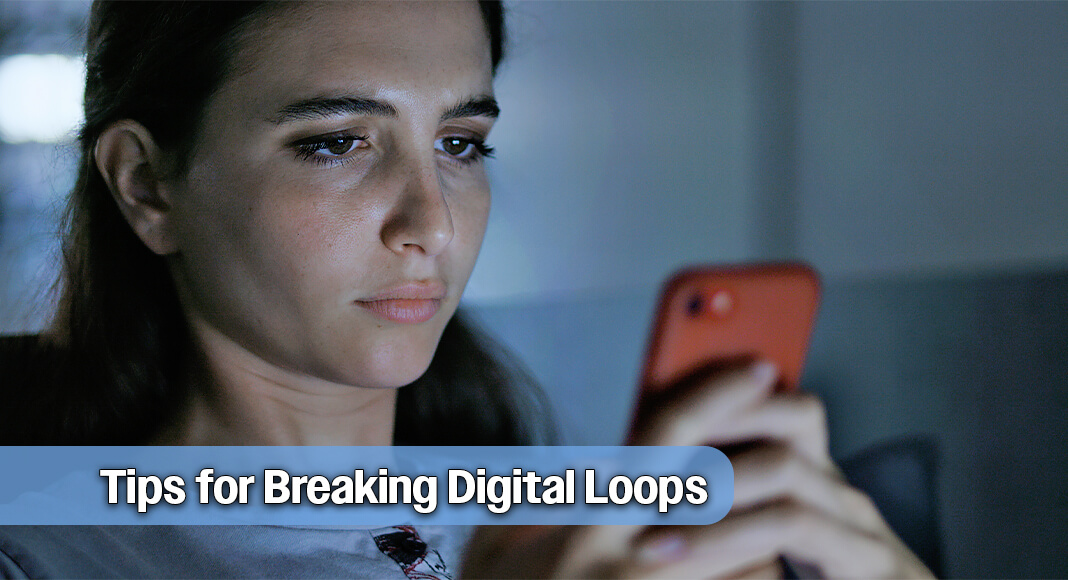
This protective tendency, however, can backfire when it comes to the internet. You might feel okay when you first pick up your phone. After several minutes of scrolling, however, you feel more anxious, angry, disheartened, disgusted or helpless. Once this negativity arises, it functions like a lens, causing you to pay even more attention to stories and posts that justify and accentuate your feelings, Dr. Sawchuk says.
Doomscrolling also may worsen mood in other ways:
Sleep procrastination. If you doomscroll in the evening, you may struggle to stop, consequently staying up long past your bedtime. This loss of sleep can affect your mood the following day.
“Sleep disruption doesn’t make us the nicest to be around. We’re less tolerant and more impatient the following day,” Dr. Sawchuk says.
Worsened social health. Time spent with friends and family tends to be restorative. When you doomscroll, you may spend so much time on your phone that there’s little left to spend with others.
Less exercise. Exercise, sunlight, and nature can all help buffer stress and support mood. However, doomscrolling tends to be a sedentary activity done indoors that wears us down.
To counter your brain’s bias to seek out the negative and novel, consider these questions:
Can you do anything about the day’s news? Does this information truly help you plan for the future? Or is it merely triggering negativity about something that you cannot influence?
How much information do you genuinely need to plan and make decisions? In most situations, some information is likely helpful, allowing you to weigh pros and cons and plan for the future. When most people doomscroll, however, they acquire much more information than they truly need to plan or make decisions, Dr. Sawchuk says. This can lead to indecision, a sense of helplessness or increased negativity for no beneficial reason.
How is time online affecting you? Do you tend to feel better than before you started? Or worse?
What are you missing out on because of your time spent scrolling? How does doomscrolling impact your sleep, relationships, work, mood and physical health?
Once you understand how doomscrolling affects your health and your life, consider adding some limits.
Check in with your mood. Every 5 to 10 minutes, tune out of your online feed and into your mood.
“If you feel worse, pay attention to that,” Dr. Sawchuk says. It doesn’t mean you have to stop scrolling right away. You might scroll another five or 10 minutes and do another check-in. If you feel even worse, that’s telling you something.
Set a time limit. Decide how much time you will spend online. For example, you might agree to limit your scrolling to 15 to 20 minutes twice daily and set a timer.
Replace scrolling with healthy activities. Spend more time socializing, exercising or sleeping.


