








Mega Doctor News
by Children’s Hospital Los Angeles
Newswise — In suburban neighborhoods and city streets across the U.S., electric bikes, or e-bikes, have seen a massive surge in popularity among children, adolescents, and adults.
While e-bikes may look similar to traditional bicycles, their internal electric motors enable them to reach high speeds of 28 miles per hour and in some cases more—comparable to the speed of a motorcycle. This can be convenient for travel and exciting for young riders, but can also lead to serious injuries if riders don’t follow the proper safety precautions.

Helen Arbogast, PhD, MPH, leads the Injury Prevention Program at Children’s Hospital Los Angeles. She has seen the number of e-bike-related injuries triple since last summer, with the largest number of crashes in kids ages 14 to 17 and increasing injuries among kids as young as 11 years old. She answers key questions about e-bike safety for families with kids or teens.
What are the most common e-bike injuries?
The most common injuries we’re seeing are the ones that are most jarring. They’re motorcycle-type injuries—concussions, fractures, internal traumas, traumatic brain injuries—that should not be the reality for young children.
The main reasons for these injuries are riding e-bikes at high speeds and riding in busy traffic. Many kids are not yet prepared to be riding e-bikes this fast in high-traffic areas, where accidents can easily occur. E-bikes are much heavier than traditional bicycles and are significantly harder for young riders to manage.
In June of 2025, we saw 10 kids with e-bike injuries at CHLA. In summer 2026, we’re seeing about one a day. At some hospitals in the South Bay, where e-bikes are especially common, doctors are seeing three to four times that number of injuries.
This is a growing problem, but there are many steps we can all take to address it.
At what age can kids ride e-bikes?
The Consumer Product Safety Commission- Opens in a new window advises that children under age 9 should not operate e-bikes, and children ages 9 through 12 should not operate any motorized product with a maximum speed higher than 10 miles per hour.
I always err on the side of safety, so I would recommend that no child below age 12 should be riding anything motorized. Some children are more mature and responsible at an earlier age than others, and parents know their kids best. But even the most responsible child under 16 does not have the skill set to traverse high-speed e-bikes around vehicles since they do not yet have driving experience and are not yet familiar with all road traffic safety rules.
Still, we know that e-bikes are common among middle schoolers and even elementary school-aged children. There’s a lot of peer pressure when kids have friends with e-bikes and they want one too. As a parent, you may have to make hard decisions about whether your child is ready for an e-bike.
How can kids ride e-bikes safely?
For families who choose to get e-bikes, there are a few important things to remember:
Start with a traditional bike. An e-bike should never be your child’s first bike. Your child should have lots of experience riding a traditional bicycle with adults and on their own before riding an e-bike.
Remember also that there’s a lot of peer pressure when kids have friends with e-bikes and they want one too, but as a parent, you may have to make hard decisions about whether your child is ready for an e-bike.
Learn the e-bike classification system. The 3-class system categorizes e-bikes by their speed and features, like whether they’re equipped with pedal assist technology only or have a throttle, like a motorcycle. It’s also helpful for parents to ride an e-bike themselves to better understand their weight and power, and to know which type would be best for their child.
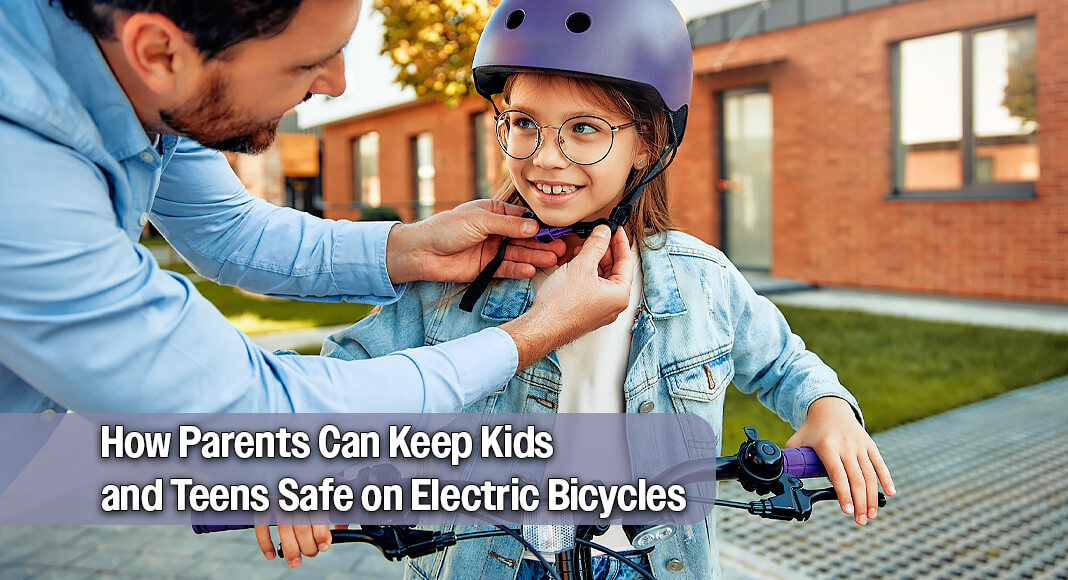
Choose a helmet made for e-bikes. The law requires all e-bike riders 17 or younger to wear a helmet. But most families with e-bikes allow their children to use traditional bicycle helmets, which are only crash-tested up to 14 miles per hour. These helmets cannot withstand the crash forces that a child would encounter on a high-speed e-bike.
Instead, children need a helmet with an NTA 8776 certification, a safety designation developed specifically for e-bike riders. I also highly recommend a helmet equipped with MIPS, or multi-directional impact protection system. These helmets are crash-tested for speeds up to 28 miles per hour and can help prevent traumatic brain injuries in high-speed crashes. This applies to tandem riders on e-bikes too, who might sit behind their friends on a bike. Everyone should wear an NTA 8776 helmet when riding an e-bike.
Make sure your child can be seen. If your child rides in the evenings or near traffic, equip their e-bike with the proper lights and reflectors to ensure they are visible.
Avoid distractions while riding. Many e-bike accidents involve distractions—such as from phones or passengers. . If your friend is sitting behind you on your e-bike and talking in your ear or trying to show you a video on their phone while you’re riding, that is a recipe for disaster.
Ride with your child. Riding together helps your child learn the rules of the road, how to judge speed and proximity of cars and pedestrians, and predict a driver’s move, which is an experience-based skill that takes time to develop.
Are there e-bike safety classes for kids?
Yes. CHLA’s Injury Prevention Program hosts e-bike safety events and bike rodeos at local schools, where kids can bring their bikes and learn safe riding practices. We also provide sample helmets and educational materials.
Families can also access online resources. Here in Southern California, cities like Huntington Beach, Manhattan Beach, and Redondo Beach, where we’re seeing the highest number of e-bike riders, are working with their local police departments to develop online safety trainings that teach young people about speed and road safety rules.
CHLA is also working with other trauma centers, health departments, and law enforcement to develop policies aimed at preventing e-bike accidents. For example, some high schools require students to complete an online safety course before they can park their e-bike on campus.
How can pedestrians avoid e-bike accidents?
Proximity and speed have everything to do with injury. If you’re encountering other people on e-bikes, move slowly or stay still to help prevent a collision. E-bikes are heavy and tricky to maneuver in tight spaces, so dense crowds are where collisions are more likely. It’s also important to be aware of what’s in your peripheral vision so you can see e-bikes approaching well in advance.
Avoiding distractions in areas with lots of motorized traffic is as important for pedestrians as it is e-bike riders. If you need to check a message on your phone, move to the edge of the street or sidewalk and stop, so you are not in the path of an e-bike or vehicle.
Awareness is the key to staying safe, and our team in Injury Prevention is doing all we can to make sure you have the right information to remain safe at all times.
Learn more about CHLA’s Injury Prevention Program.


