Mega Doctor News

by Empa, Swiss Federal Laboratories for Materials Science and Technology
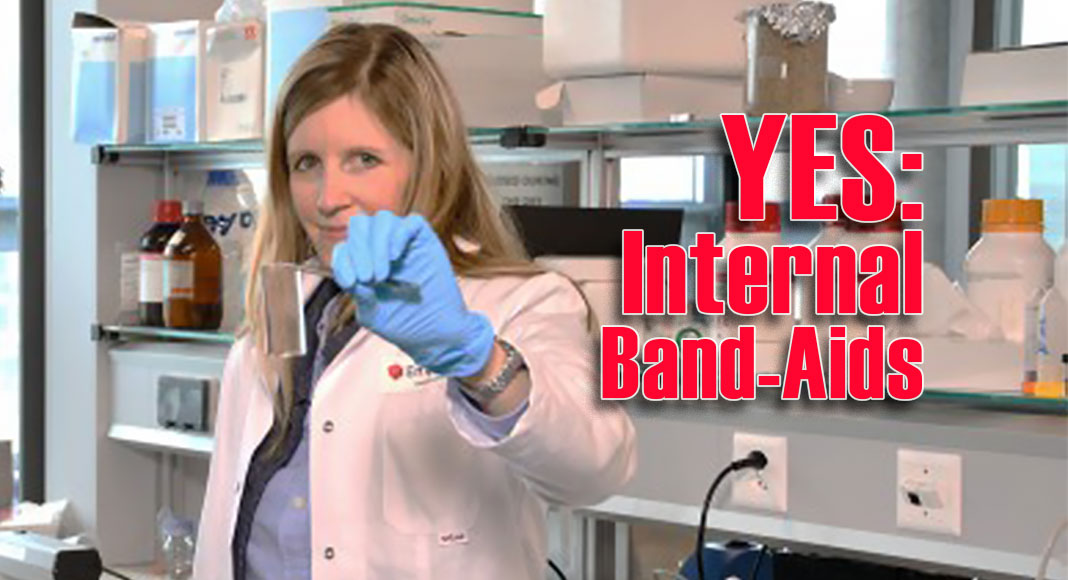
Newswise — A burst appendix or a life-threatening intestinal volvulus are emergencies that need to be treated by surgeons immediately. However, a life-saving operation, in which tissue from the digestive tract must be reattached, bears some risks. After all, everything that is transported through the gastrointestinal tract to the outside world in fact belongs there – and should under no circumstances end up inside the abdominal cavity. Highly acidic digestive juices and germ-laden food residues could trigger peritonitis or even a fatal sepsis. Needle and thread by themselves are not necessarily the perfect surgical tools for joining two pieces of intestine together, though – after all, you wouldn’t think of sewing up a leaky food pouch either, would you? Empa researchers have thus developed a patch that stably seals two sutured pieces of intestine and thus prevents dangerous leaks.
Dreaded complications
The idea of sealing sutured tissue with a plaster has already made its way to the operating rooms. But after the first of these products turned out to be poorly tolerated or even toxic, these plasters are currently made of biodegradable proteins. The problem is that clinical success is not always optimal and varies depending on the tissue, on which they are used. That’s because the protein patches are primarily intended to support the healing process. They dissolve too fast when in contact with digestive juices and don’t always hold tight. “Leaks after abdominal surgery are still one of the most feared complications today,” explains Empa researcher Inge Herrmann, who is also professor for nanoparticulate systems at ETH Zurich.
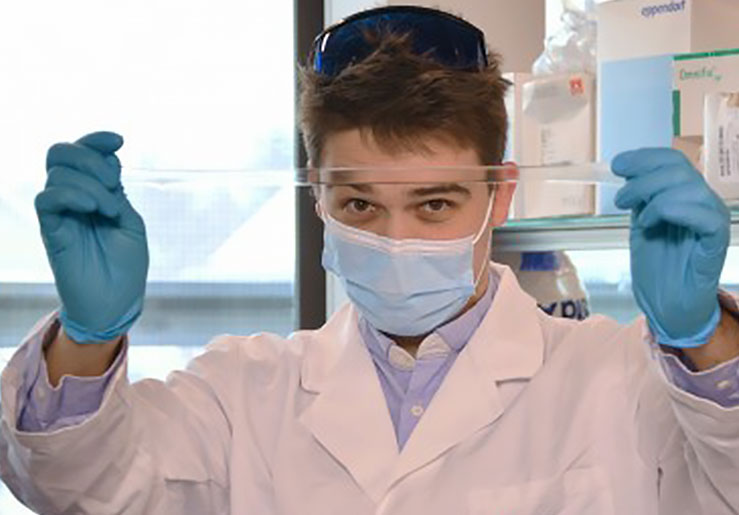
The team led by Herrmann and Alexandre Anthis from Empa’s Particles-Biology Interactions lab in St. Gallen therefore joined forces with Andrea Schlegel, a surgeon at Queen Elizabeth University Hospital in Birmingham, to search for a material that could reliably seal intestinal injuries and surgical wounds. They found a synthetic composite material consisting of four acrylic substances that, together, form a chemically stable hydrogel. What’s more, the patch actively cross-links with the intestinal tissue until no more fluid can pass through. The researchers have already successfully patented this novel technology. The quadriga of acrylic acid, methyl acylate, acrylamide and bis-acrylamide works in perfect synergy, as each component conveys a specific feature to the final product: a stable bond to the mucosa, the formation of networks, resistance to digestive juices and hydrophobicity.
Tailor-made patches
In lab experiments, the researchers showed that the polymer system met their expectations. “Adhesion is up to ten times higher than with conventional adhesive materials,” says Empa researcher Anthis. “Further analysis also showed that our hydrogel can withstand five times the maximum pressure load in the intestine.” And in the material’s design lies its tailored effect: The rubbery composite selectively reacts with digestive juices that might leak through intestinal wounds, expands and closes all the more tightly. The inexpensive, biocompatible super glue, which consists largely of water, could thus shorten hospital stays and save healthcare costs. Alexandre Anthis is thus already planning the next steps towards clinical application of the new wound plaster: “We are in the process of founding a start-up company to bring this innovative material to the market.”