







Mega Doctor News

The Skin Cancer Foundation
New York, NY – With summer ending and the busy back-to-school season in full gear, sun protection may slip down the list of health and wellness priorities. But harmful ultraviolet (UV) rays are present year-round, and one study notes that children sustain a significant amount of sun exposure at school. About 23 percent of lifetime UV exposure occurs before the age of 18, and this exposure can have far-reaching effects.
“Sun damage is cumulative, so sun exposure during childhood can contribute to skin cancer risk later in life,” says Deborah S. Sarnoff, MD, president of The Skin Cancer Foundation. “The best way to mitigate that risk is to educate young children on effective sun protection, instilling healthy habits that will last a lifetime. Children should understand that summer vacation is not the only time they’re exposed to the sun’s rays.”

The Skin Cancer Foundation offers the following recommendations for keeping children sun-safe during the school year.
- UV rays are most intense from 10 AM to 4 PM, and this is when students are usually outside for recess, physical education class and after-school sports. Check with the school to see if there are adequate places for students to seek shade during outdoor activities. Shade can be provided by gazebos and roof structures, awnings, shade sails, and natural shade, such as thickly leaved trees.
- Clothing is the single most effective form of sun protection for the body, so send kids to school in densely woven and bright- or dark-colored fabrics, which offer the best defense. The more skin you cover, the better, so choose long sleeves and long pants whenever possible.
- Send children to school with a wide-brimmed hat and UV-blocking sunglasses, to protect their face, neck and eyes. If they won’t wear a wide-brimmed hat, a baseball cap is better than nothing.
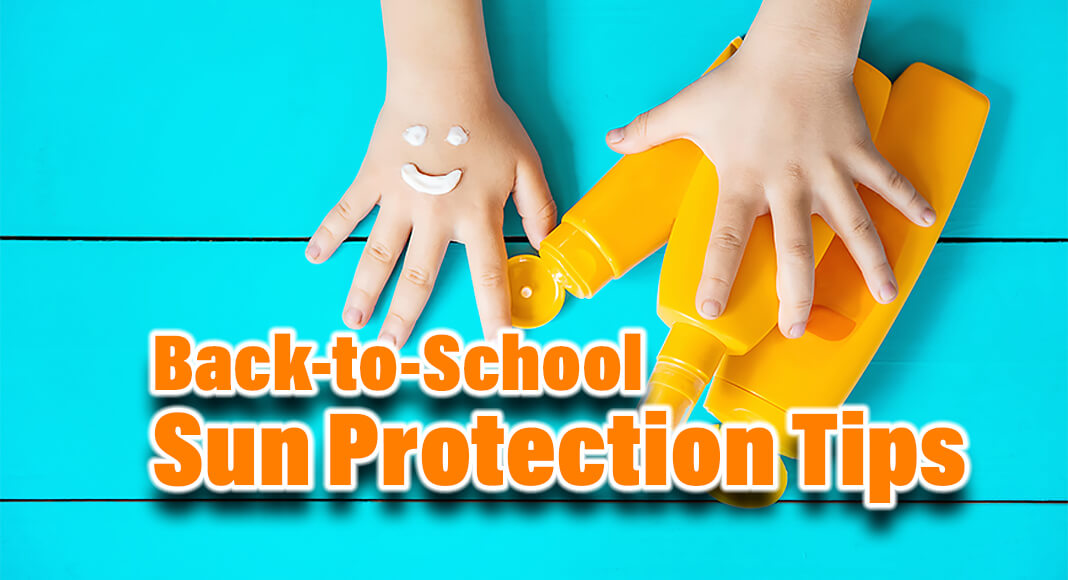
- Make sunscreen part of the morning routine: At least 30 minutes before children go outside, parents should apply a broad spectrum (UVA/UVB) sunscreen with an SPF 30 or higher to their skin. Older children should learn to apply sunscreen themselves and make it a routine habit. To remain effective, sunscreen should be reapplied every two hours or immediately after swimming or sweating. At a minimum, remind children to reapply sunscreen before after school sports and outdoor activities.
- One ounce of sunscreen (about the size of a golf ball) should be applied to the entire body. Remind children to cover those easy to miss spots, such as the back of ears and neck, as well as the tops of the feet and hands.
There’s a chance your child’s school does not allow students to use sunscreen or wear a hat outdoors during the school day without written permission from a physician. If that is the case, The Skin Cancer Foundation has created a sun protection permission form that parents and doctors can sign, allowing students to bring these items to school, apply and use as needed. The form is available at www.skincancer.org/schoolnote.
###
About The Skin Cancer Foundation
The Skin Cancer Foundation saves and improves lives by empowering people to take a proactive approach to daily sun protection and the early detection and treatment of skin cancer. The mission of the Foundation is to decrease the incidence of skin cancer through public and professional education and research. Since its inception in 1979, the Foundation has recommended following a complete sun protection regimen that includes seeking shade and covering up with clothing, including a wide-brimmed hat and UV-blocking sunglasses, in addition to daily sunscreen use. For more information, visit SkinCancer.org.


