Mega Doctor News
By Laura Williamson, American Heart Association News
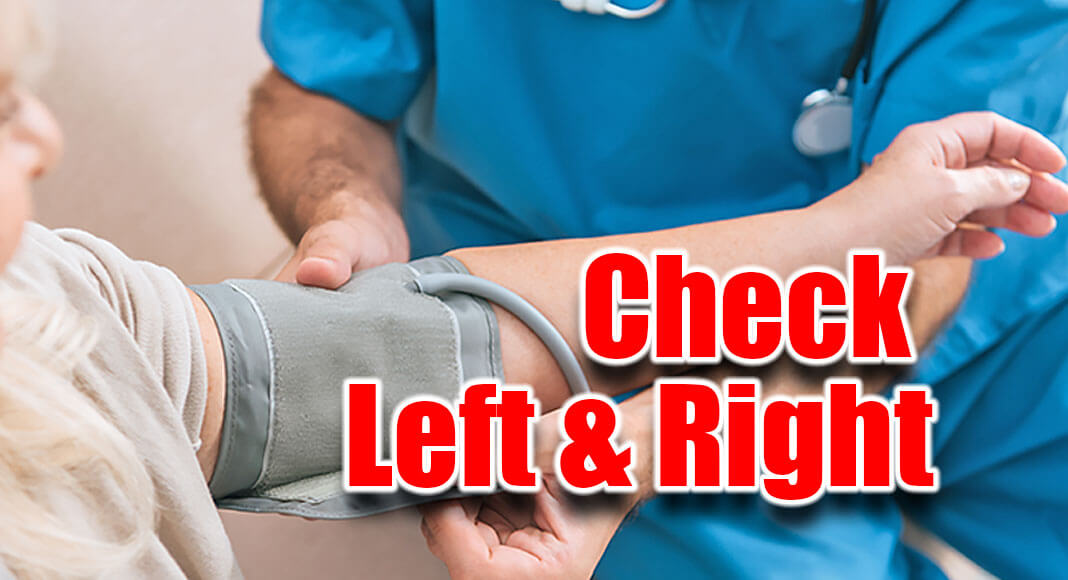
Taking blood pressure readings from both arms and using the higher reading would more accurately capture who has high blood pressure – and is at increased risk for cardiovascular disease and death – than relying on readings from a single arm, new research suggests.
While current recommendations call for using the higher arm reading, there was previously no evidence in the scientific literature to support the practice, which isn’t routinely followed, according to the study. The findings appeared this week in the American Heart Association journal Hypertension.

“If you are only doing one arm, you can’t know which is the higher-reading arm,” said lead study author Christopher Clark, a clinical senior lecturer in primary care at the University of Exeter Medical School in Devon, England. “And if you don’t catch high blood pressure, you can’t treat it. We can now support the adoption of using the higher reading from both arms.”
Nearly half of U.S. adults have high blood pressure, also known as hypertension. Blood pressure is considered high if the systolic reading – the top number – is 130 mmHg or more, or the diastolic reading – the bottom number – is 80 mmHg or more. High blood pressure is a risk factor for heart disease, heart attacks and strokes.
In a 2019 scientific statement detailing proper blood pressure measurement, the AHA recommended taking readings from both arms during an initial patient visit and using the arm with the higher reading for measurements at subsequent visits. The statement also called for making sure to use the proper cuff size based on the patient’s arm circumference, among other guidance.
In the new study, researchers analyzed medical data for 53,172 adults from 23 studies in countries around the world. Participants were an average of 60 years old.
They found using the lower arm’s reading, compared with the reading from the higher arm, resulted in 12% of people who had hypertension falling below thresholds for diagnosis or treatment of the condition.
Because hypertension also is used to help calculate a person’s risk for cardiovascular disease, missing a diagnosis of high blood pressure can have serious consequences, the authors noted.
Using the higher arm reading, compared with the lower one, researchers reclassified 3.5% of participants – or 645 more people – as at-risk for cardiovascular disease using the risk score developed by the AHA and American College of Cardiology. The researchers reclassified 4.6% of participants – or more than 1,000 extra people – as at-risk for coronary heart disease based on another model, the Framingham risk score, which is used to predict the risk of developing heart disease in people with no symptoms.
For both risk scores, using the higher arm readings better predicted cardiovascular illness.
According to the Centers for Disease Control and Prevention, high blood pressure was the primary or contributing cause of more than 670,000 deaths in the U.S. in 2020.
High or poorly controlled blood pressure is a major cause of premature death and cardiovascular events globally, “so we’re dealing with something that’s really very common here,” Clark said.
For people whose blood pressure is being monitored at home with an ambulatory device, the monitor should be attached to the arm with the highest reading, he said. And those who self-monitor should check both arms to see which arm is consistently higher and use that arm for routine measurements.
Taking blood pressure in both arms will take health care professionals more time, but it should be done to provide more accurate readings, said Dr. Shawna Nesbitt, a professor of internal medicine at UT Southwestern Medical Center in Dallas.
“And you should really measure more than once to get the most accurate reading,” said Nesbitt, who specializes in blood pressure disorders. Not doing so could mean measurements aren’t consistently accurate. “We may be allowing people to walk around with higher pressures than they should.”
The longer a person experiences uncontrolled high blood pressure, the higher their risk for heart attacks or strokes, Nesbitt said.
“This study is clinically relevant to what we do every single day,” she said. “Every hospital or clinic visit we have – even going to the dentist – somebody is measuring your blood pressure.”