Mega Doctor News

CHICAGO, Illinois – With disruptions in clinical care caused by the COVID-19 pandemic and increasing rates of sexually transmitted infections (STIs) and viral hepatitis across the U.S., the American Medical Association (AMA) today launched a new online toolkit to help physicians and other health care professionals increase routine screenings for HIV, STIs, viral hepatitis and latent tuberculosis (LTBI).
“Routine screening and early detection of HIV, STIs, viral hepatitis, and LTBI ensure patients receive the treatment they need, while at the same time lowering their risk of transmitting these infectious diseases to others. With input from our pilot sites, the improved toolkit will help increase screenings and prevent further spread, and improve public health,” said AMA President Jesse M. Ehrenfeld, M.D., M.P.H. “With patient access to preventive services interrupted during the COVID-19 pandemic, many individuals may not even be aware they have an infection and are at risk of contributing to new infections. Social inequities and stigma also continue to be barriers to screening. We are grateful to the pilot sites and subject matter experts who contributed to this resource to help improve routine screening.”
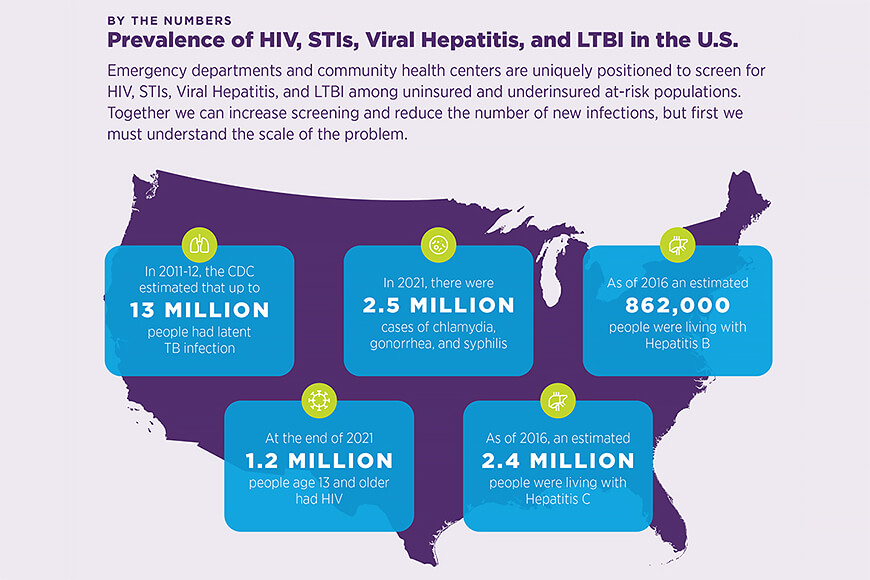
The new toolkit builds on the AMA’s work, with the support of the Centers for Disease Control and Prevention (CDC), over the past several years to understand key barriers and drivers for implementing routine screening in health care. The toolkit shares best practices and strategies for screening programs, specific to community health centers and emergency departments. In 2022, the AMA worked with community health center sites to test the quality improvement strategies in the toolkit. With feedback from the community health center pilot sites incorporated into the toolkit, the AMA, in late 2023, launched a similar pilot with emergency department sites, including:

- Harris Health Ben Taub Hospital, Houston, TX
- University of Colorado, Aurora, CO
- Mayo Clinic, Rochester, MN
- Valleywise Health, Phoenix, AZ
As the emergency department pilot comes to a close and the toolkit goes live, the AMA will be hosting a series of educational webinars to familiarize physicians and other members of the health care team with best practices and strategies for routine screening. The first session, “The Importance of Routinely Screening for HIV, STIs, Viral Hepatitis and LTBI,” will be held on March 19, 2024, at 9 a.m. CT.
The AMA has extensive policy supporting evidence-based preventive services, including screening for these infectious diseases. We recognize that routine universal screening protects not only individual patients, but the health of the public. The AMA is a Dissemination and Implementation partner of the U.S. Preventive Services Task Force and also supports the U.S. Department of Health and Human Services initiative focused on Ending the HIV Epidemic in the U.S.
This effort is supported by the CDC of the U.S. Department of Health and Human Services (HHS) as part of CDC-RFA-OT18-1802: Strengthening Public Health Systems and Services through National Partnerships to Improve and Protect the Nation’s Health with award totaling $999,696 with 100% funded by CDC/HHS. The contents are those of the author(s) and do not necessarily represent the official views of, nor an endorsement, by CDC/HHS, or the U.S. Government.
Information Source: AMA