








Mega Doctor News
Mega Doctor News
Moderna and Merck have reached a major clinical milestone after their investigational individualized cancer therapy, combined with Merck’s Keytruda, produced positive results in a Phase 3 study involving patients with high-risk melanoma.

Moderna CEO Stéphane Bancel discussed the results during an interview with FOX Business, saying the companies are moving quickly toward discussions with regulators while preparing detailed findings for presentation to the medical community.

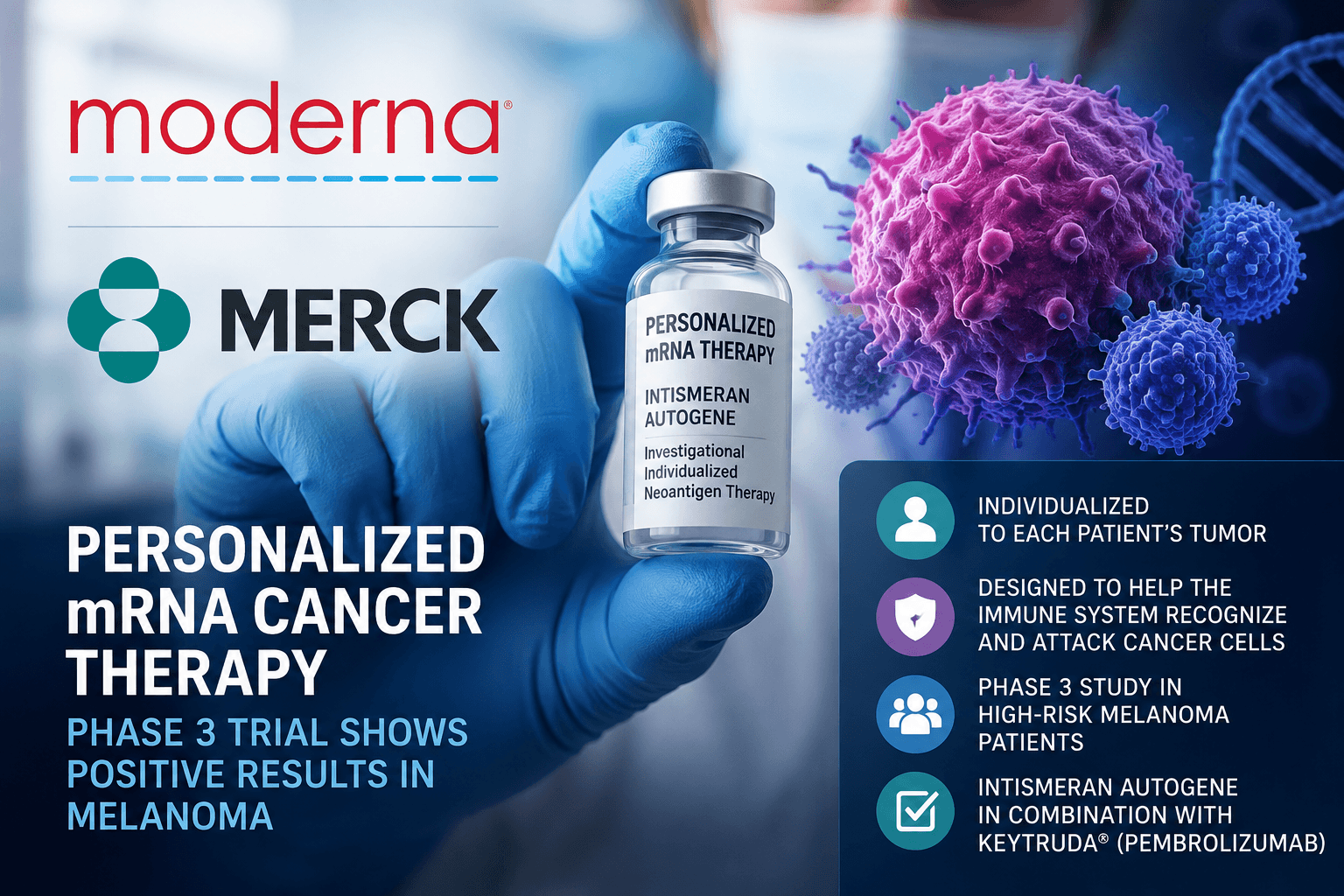
The investigational treatment, intismeran autogene, uses mRNA technology to create an individualized therapy based on a patient’s cancer characteristics. It is being studied with pembrolizumab, marketed by Merck as Keytruda, in patients whose melanoma has been surgically removed.
Moderna reported that the Phase 3 study demonstrated a clinically meaningful improvement compared with Keytruda alone in patients with completely resected Stage IIB-IV melanoma. The FDA has not approved the treatment.
Bancel said the companies expect to present detailed results at an oncology conference and submit them to a medical journal after completing their analysis.
The companies have already begun preparing for the regulatory process.
“Every day counts for patients,” Bancel said, explaining that teams began preparing portions of the FDA submission before receiving the Phase 3 results.
He said Moderna and Merck intend to file as quickly as possible and hope the treatment could potentially receive approval next year, subject to regulatory review.
The therapy is designed to help the immune system recognize characteristics unique to an individual patient’s cancer and generate an immune response against cancer cells.
Moderna and Merck are also studying intismeran across several other cancers. Moderna’s current pipeline includes studies involving lung, kidney and bladder cancers in addition to melanoma.
Bancel cautioned that clinical studies are still necessary to determine whether the approach will improve outcomes in those cancers and by how much.
The development also represents a significant expansion of Moderna’s mRNA platform beyond infectious disease vaccines.
Bancel said Moderna has sought from its beginning to apply the technology across multiple areas of medicine, including cancer, rare genetic diseases and autoimmune diseases.
“Last week was a big step forward. We became an oncology company,” Bancel said.
Manufacturing individualized medicine presents a different challenge because treatment must be produced specifically for each patient. Bancel said Moderna has developed a manufacturing process that can produce the limited number of doses required for an individual patient at a facility in Massachusetts.
He said pricing has not been established.
The cancer program comes as Moderna works to develop new sources of revenue following the decline in COVID-related sales. The company reported approximately $142 million in second-quarter 2026 revenue and a GAAP net loss of approximately $0.8 billion.
Moderna is also expanding its respiratory portfolio. In August, the FDA approved mFLUSIVA, Moderna’s mRNA influenza vaccine, for people 50 and older. It became the first FDA-approved mRNA-based influenza vaccine.
For cancer patients, another critical issue is how quickly an individualized treatment could be produced.
Asked about the time between identifying a patient’s tumor and producing the personalized therapy, Bancel said it should take “less than two months.”


