Mega Doctor News

By Selene Rodriguez
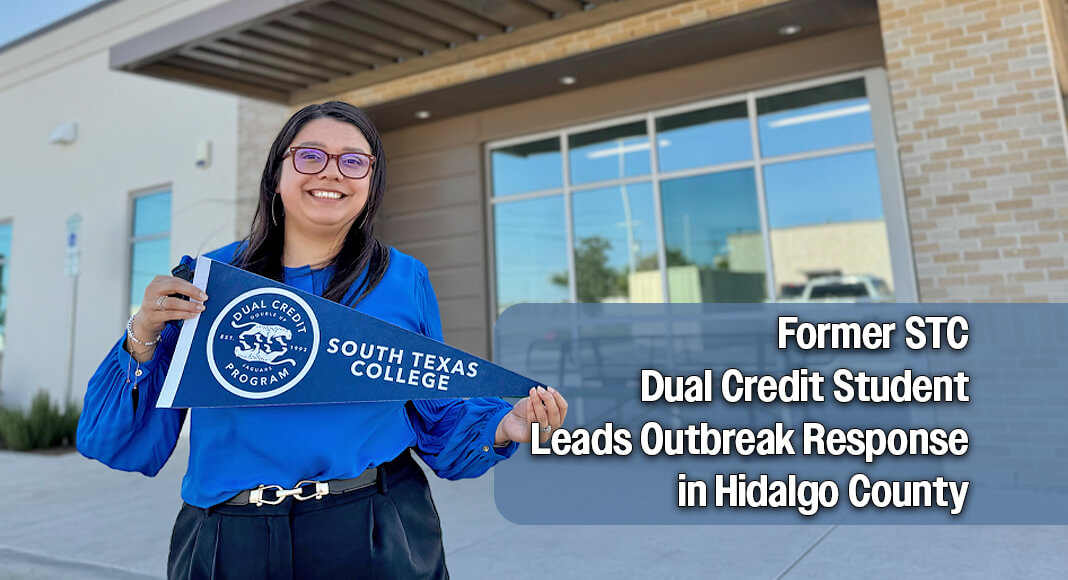
McALLEN, Texas – From investigating outbreaks and identifying health threats to educating the community, South Texas College alumna Amy Gonzalez has dedicated her career to serving others and making a meaningful difference in the community she calls home.
As lead epidemiologist for the Hidalgo County Health and Human Services Department, the 31-year-old oversees a team of public health professionals who track and investigate diseases, respond to outbreaks and work with hospitals, schools and other organizations to keep residents safe and informed.

“I was born and raised here in the Rio Grande Valley, so I love that the work I do protects the community that watched me grow,” she said. “In public health, a lot of what we do happens behind the scenes. I like to describe it as detective work. When there’s an outbreak or a new health concern, it’s our job to figure out where it’s coming from, where it’s going and how we stop it.”
A first-generation college graduate, Gonzalez knew early on that she wanted a career helping others. Aspiring to become a physician assistant, she joined STC’s Dual Enrollment Medical Science Academy (DEMSA) while attending Mercedes High School.
During the program, one of her faculty members encouraged her to apply for a U.S. Department of Agriculture-funded undergraduate research opportunity. Gonzalez was selected and spent two years conducting research at the Texas A&M University-Kingsville Citrus Center in Weslaco. Her research on Mexican key limes and a fungal pathogen eventually contributed to a published paper.
“Apart from saving my family money by allowing me to complete two years of college at no cost, STC’s Dual Credit program opened the door to great opportunities I don’t think I would have had otherwise,” she said. “Having faculty encourage me to keep trying and do more made it all feel a lot less scary. Moving forward, I had the confidence to take higher-level science courses and succeed.”

In 2013, Gonzalez graduated from STC with an associate degree in biology, just weeks before receiving her high school diploma. She later transferred to Baylor University before returning home to complete a bachelor’s degree in biology from the University of Texas Rio Grande Valley (UTRGV) in 2016.
In 2017, she accepted a part-time position with the Hidalgo County Health and Human Services Department as a Zika technician, helping educate residents about the mosquito-borne virus and its risks, particularly to pregnant women, not knowing the job would ultimately change the direction of her career.
“I started by helping educate women about Zika, which was a major health concern at the time,” she said. “There were pregnant women who were crying; they were scared. I knew I could give them information and try to answer their questions. That felt very rewarding to me, being able to be a shoulder for someone. That’s really when I realized that this is what I want to do. I want to be able to help someone.”
Over nearly a decade with the department, Gonzalez has worked her way up while helping respond to everything from the COVID-19 pandemic and disease outbreaks to emerging health concerns affecting the region.
Along the way, she earned a master’s degree in public health from the University of Alabama at Birmingham in 2020 before eventually becoming lead epidemiologist.
“When someone tests positive for certain diseases, that gets reported to us at the health department, and that’s when we start our investigation,” she said. “We talk to the patient or the family, ask questions and look for connections. For example, if there’s a party and everyone gets sick, we start asking, ‘What did they all eat?’ We go back and figure out what happened, where it came from and how we can stop it from spreading.”
For Gonzalez, however, protecting public health goes beyond responding when people get sick. Much of her role today focuses on preventing illness and making health information and services more accessible to residents.
“People often have questions like, ‘I heard about this parasite on the news. What is it?’ They can call the health department, and we can educate them about the disease and available resources,” she said. “I’ve fallen in love with this work because the more we educate people about public health, the more people we can help.”
Looking back at her roots, Gonzalez credits STC with giving her the confidence and opportunities that helped shape her life.
Although her career took a different direction than she originally imagined, she hopes her journey encourages other students to remain open to new opportunities and keep moving forward when their plans change.
“I’m incredibly grateful for the STC Dual Credit program because it helped expedite my career,” she said. “If I could give students any advice, it would be not to fear failing. Sometimes we look at people and think, ‘Wow, they have everything figured out.’ But I’ve failed a class and I’ve made mistakes, and that doesn’t define where we are. We can keep going and keep learning. If someone tells you no, someone else will tell you yes. Just keep trying and keep learning.”