
Mega Doctor News

Revolutionizing the field of surgery, robotic-assisted technology has redefined modern surgical care by merging innovative innovation with surgical expertise.
This minimally invasive approach enables physicians to perform complex procedures through small incisions, offering enhanced precision and control while minimizing trauma to the body.
For more than a decade, South Texas Health System (STHS) Edinburg, recognized by the Surgical Review Corporation (SRC) as a Center of Excellence in robotic, minimally invasive and hernia surgery, has delivered advanced surgical care designed to improve patient outcomes, offering procedures that reduce hospital stays, accelerate recovery and minimize risk.

Equipped with three da Vinci surgical systems, STHS Edinburg has expanded its capabilities beyond routine general surgery to perform more complex procedures involving the stomach, liver, pancreas, esophagus and colorectal system. These advanced platforms provide surgeons with enhanced visualization, improved access to internal anatomy and greater precision compared to traditional surgical methods.
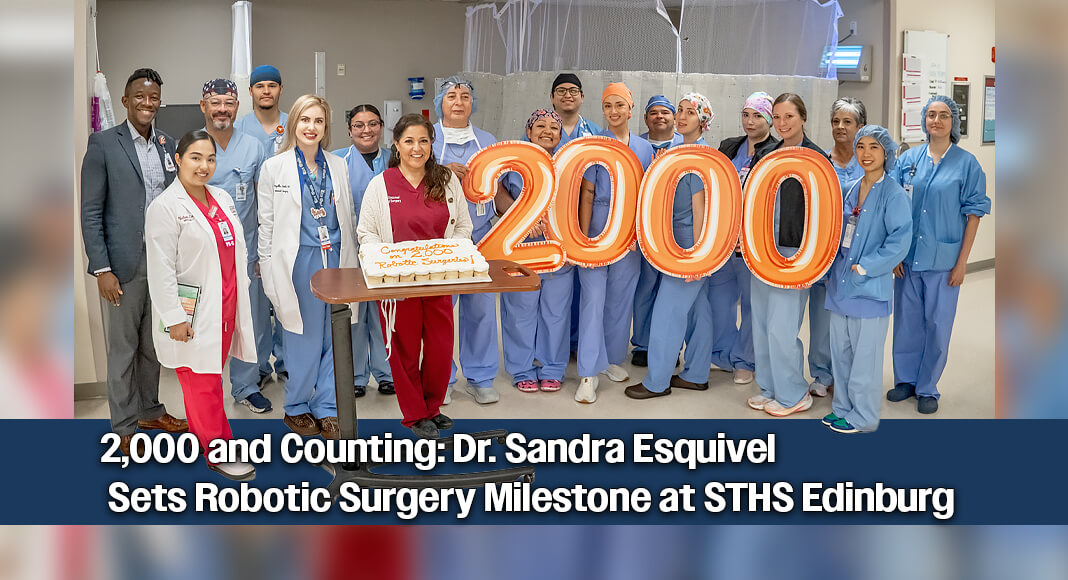
Recently, leaders and operating room staff at STHS Edinburg recognized STHS Clinics’ Sandra Esquivel, MD, FACS, an SRC-accredited Surgeon of Excellence, for achieving a significant milestone with the completion of her 2,000th robotic procedure, a colon resection performed on a patient with colon cancer.
“This is an incredible milestone, but more importantly, it reflects what advanced, minimally invasive care can mean for patients here in the Rio Grande Valley,” says Dr. Esquivel, a Weslaco native who recently received the Legendary McAllen Women award for her trailblazing 30-year career as a general and robotic surgeon. “My greatest reward is seeing patients recover faster, experience less pain and return to their lives with renewed hope for their health.”
Recognized as a leader in robotic-assisted surgery in the Rio Grande Valley, STHS Edinburg became the first facility south of San Antonio to implement the da Vinci Xi system in 2015. The program has since grown with a second system added in 2021 and further advanced with the integration of the advanced da Vinci 5 platform last year.
“The growth of our robotic surgery program at STHS Edinburg has had a meaningful impact on the communities we serve, giving thousands of patients access to advanced, minimally invasive care that allows them to heal faster and return to their daily lives sooner than with traditional surgery,” says Lance Ames, Chief Executive Officer, STHS Edinburg & STHS Children’s. “Physicians like Dr. Esquivel have been instrumental in elevating the program, and together with our team of skilled robotic surgeons and operating room staff, we remain committed to improving the health and well-being of residents across the four-county region.”
Learn more about the advanced robotic surgery program at STHS Edinburg by visiting STHSEdinburg.com.