
Mega Doctor News


There’s no doubt that advancements in surgical technology are changing lives, shifting care away from traditional open procedures toward less invasive, more precise techniques that promote faster healing and improved outcomes.
“Robotic and minimally invasive surgery allow patients to recover more quickly,” says Bob Saggi, MD, FACS, a general and robotic surgeon with South Texas Health System (STHS) Clinics. “These approaches not only reduce pain and shorten recovery times but also give patients greater confidence knowing they have access to advanced, highly precise care close to home.”
Today, minimally invasive and robotic-assisted procedures account for a growing share of surgeries performed in the United States, reflecting a broader shift toward innovation-driven, patient-centered care.

Nationwide, hospitals perform more than 2.6 million robotic-assisted procedures each year, according to the National Institutes of Health, representing approximately 22% of the U.S. surgical market. For highly precise procedures, such as prostatectomies for prostate cancer, robotic surgery now accounts for more than 80% of all cases.
“As surgical technology continues to evolve, we’re seeing steady growth in the use of robotic and minimally invasive approaches across a wide range of procedures,” says Dr. Saggi. “This shift is being driven not only by advancements in precision and technique, but also by greater awareness among both physicians and patients about the long-term benefits these technologies can offer.”
In the Rio Grande Valley, residents have access to nationally recognized surgical care at South Texas Health System Edinburg, where innovation, expertise and advanced technology are setting new standards in modern surgery.
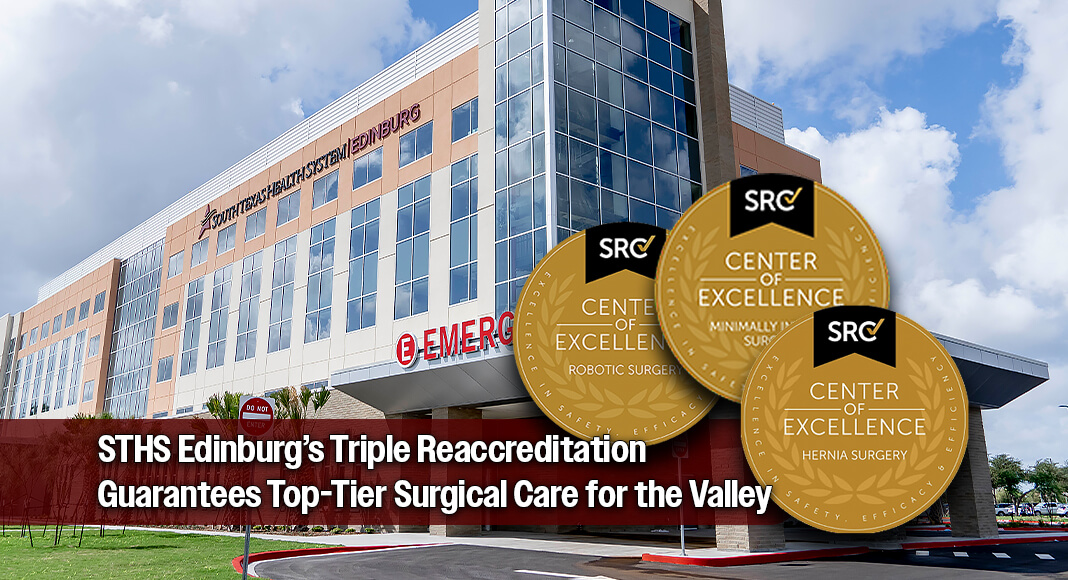
A Best Regional Hospital by U.S. News & World Report for four consecutive years and recognized as a 2026 Top Hospital by Forbes, the facility has recently earned a three-year reaccreditation as a Center of Excellence in minimally invasive, robotic and hernia surgery by the Surgical Review Corporation (SRC), a nonprofit patient safety organization dedicated to advancing and standardizing high-quality surgical care.
“Our reaccreditation as a Center of Excellence reinforces STHS Edinburg’s legacy of exceptional surgical care and should give our patients confidence that they’re receiving high-quality care in a facility known for its commitment to safety and clinical excellence,” says Lance Ames, Chief Executive Officer, STHS Edinburg & STHS Children’s. “For years, our surgical teams have consistently upheld the highest standards in patient care, and this reaccreditation demonstrates our ability to meet and exceed the rigorous benchmarks for safe, effective and evidence-based surgical practice.”
To maintain its designation, STHS Edinburg underwent a comprehensive three-year compliance inspection designed to verify its ongoing commitment to patient safety, continuous quality improvement and exacting standards in surgical care. The process evaluates a range of critical factors, including surgical volumes, advanced facility equipment, clinical pathways and standardized operating procedures. It also places a strong emphasis on patient education and continuous quality assessment to ensure consistent, high-quality outcomes.
In addition to STHS Edinburg’s reaccreditation as a Center of Excellence, the SRC also renewed its Surgeon of Excellence designation for Dr. Bob Saggi and STHS Clinics general and robotic surgeon Sandra Esquivel, MD, FACS, in minimally invasive, robotic and hernia surgery.
Additionally, Miguel Rodriguez, DO, a general and robotic surgeon with STHS Clinics, earned designation as a Surgeon of Excellence across all three programs, further highlighting the depth of surgical expertise available to patients in the Rio Grande Valley.
“Dr. Saggi, Dr. Esquivel and Dr. Rodriguez, along with our dedicated team of surgeons and operating room staff, have long made patient safety their top priority,” says Caren Ohliger, Director of Surgical Services, STHS Edinburg. “Earning this reaccreditation reflects that ongoing commitment to delivering the highest standards of care and reinforces our focus on putting patients first in everything we do.”
STHS Edinburg has significantly expanded its surgical capabilities since acquiring its first da Vinci Xi Surgical System in 2015 as part of its growing robotic surgery program. Today, the facility is home to three advanced robotic surgical systems, including the da Vinci V (DV5), demonstrating its continued investment in advanced technology and patient care.
That commitment recently resulted in a major milestone, as the hospital celebrated the completion of its 4,000th robotic-assisted surgery, further reinforcing its leadership in minimally invasive and robotic surgical innovation in the Rio Grande Valley.
For more information on the comprehensive surgical services available at STHS Edinburg, visit southtexashealthsystemedinburg.com or call (956) 388-6000.