

Mega Doctor News

Newswise — Patients suffering from shoulder pain and loss of motion due to osteoarthritis have often relied on shoulder replacement surgery to provide pain relief and restore function when nonoperative treatment has failed.
A new surgical technique, known as the stemless, rotator cuff intact anatomic total shoulder replacement, is changing the game for active individuals by prioritizing biology and minimizing trauma to the bone and rotator cuff. By preserving a patient’s natural bone with a stemless implant and placing the implant in a way that does not detach the tendons of the rotator cuff, surgeons are now able to restore motion and function faster, without the need for prolonged immobilization.

Kenneth Donohue, MD, Chief of Shoulder Reconstruction at Yale Medicine and Associate Professor of Orthopaedics & Rehabilitation, was the first orthopedic surgeon on the East Coast to perform a rotator cuff intact, stemless anatomic total shoulder replacement in March of 2026.
Understanding shoulder replacement
To appreciate this new technique, it is important to understand how a healthy shoulder functions.
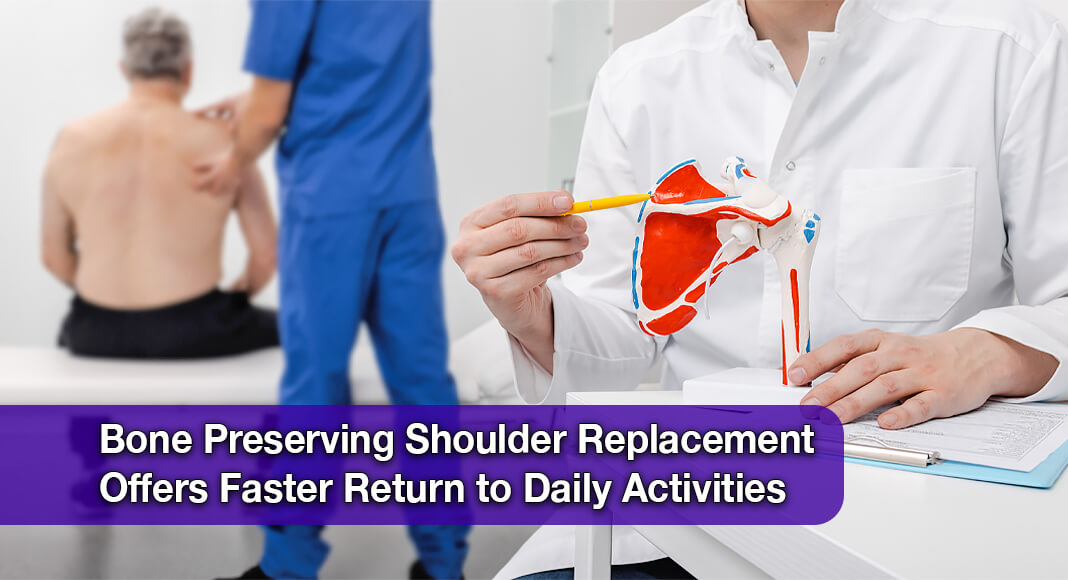
The normal shoulder consists of a “ball”, or uppermost portion of the humerus, that fits into a shallow “socket”, or glenoid. The joint is surrounded by the rotator cuff, a sleeve of four muscles and tendons that provide both the strength and stability to lift and rotate the arm. The rotator cuff is then surrounded by a much larger muscle called the deltoid, which assists with overhead motion and creates the contour of the shoulder.
In an anatomic total shoulder replacement, the goal is to mimic this original design. Traditionally, shoulder replacement is performed by detaching one of the rotator cuff tendons to access the joint and place implants. The detached tendon must then be repaired at the end of the procedure and heal properly for the procedure to be successful. This requires immobilization of the arm in a sling, which can lengthen recovery by several months.
An anatomic shoulder replacement is ideal for patients with osteoarthritis, a wear and tear condition where protective cartilage erodes, provided their rotator cuff is still strong and functional.
A second technique, known as a reverse shoulder replacement, flips the natural anatomy of the joint to restore movement when a standard replacement is not an option. During this procedure, a surgeon swaps the positions of the ball and socket joint, attaching the metal ball to the shoulder blade and the socket to the upper arm. This method is designed for patients with a severely damaged or non-functional rotator cuff.
By switching the mechanics of the joint, the shoulder no longer relies on those weakened rotator cuff tendons. Instead, it allows the larger deltoid muscle to take charge, providing the leverage needed to lift and rotate the arm effectively.
This new method, specifically designed for patients with a healthy rotator cuff, does not require cutting of the healthy rotator cuff tendon to replace the joint and uses a less invasive implant that preserves bone from the humerus.
“This new technology offers a less invasive way to perform an anatomic total shoulder replacement that does not require cutting or detaching the rotator cuff tendon.” Donohue says. “This is exciting because it offers the potential to significantly shorten recovery time following anatomic total shoulder replacement. After rotator cuff intact shoulder replacement, patients are allowed to begin moving the arm actively such as reaching overhead, immediately following surgery, rather than having to wait weeks or months.”
How stemless surgery works
In the past, the “stemmed” implants were necessary because early materials could not easily bond to bone. Today, advanced materials and smart designs have changed the surgeon’s toolkit.
During a stemless procedure, the surgeon does not drill or ream down the arm bone known as the humeral shaft. Instead, the arthritic cap of the humerus is removed, and a small, low-profile metal anchor is inserted onto the very top of the bone.
This anchor is made of a porous texture, meaning it is covered in microscopic holes. These holes act as a scaffold, encouraging the patient’s own bone to grow into the metal. This fusing of bone and metal creates a bond that provides excellent strength and durability without the need for a long stem going down the arm.
On the other side of the joint, the surgeon addresses the socket. The worn-out surface of the glenoid is smoothed and fitted with a high-density plastic liner. Once the new polished metal ball is attached to the anchor in the arm, it glides against this plastic. This eliminates painful bone-on-bone friction that patients can feel when attempting to perform simple tasks like reaching for an item on a shelf or participating in recreational activities.
Benefits for active patients
This procedure is a significant milestone for active patients or those with health conditions that make them especially dependent on their upper extremities.
By preserving the rotator cuff tendon when replacing the shoulder, patients are allowed to begin moving the arm immediately after surgery. “This is an absolute gamechanger for patients who suffer from arthritis on both sides or have other medical conditions that affect mobility of the opposite arm.” Donohue says. “These patients regain their mobility and independence much sooner than they would have with the traditional technique for performing anatomic shoulder replacement.”
Stemless designs provide additional advantages over traditional implants as well. By leaving the humeral canal untouched, the surgeon saves the amount, quality, and structural integrity of a patient’s existing bone. “Stemless implants can minimize stress shielding, which is a process where bone resorbs, or disappears, around a stemmed implant over time,” Donohue adds.
This matters because joint replacements have a lifespan. If a patient receives an implant in their 50s, they may eventually need a revision surgery 20 years later. Because the stemless method preserves so much natural bone, a future surgery is much simpler and safer to perform.
“By avoiding the long metal stem, we are being much less invasive to the bone,” Donohue explains. “We see less internal bleeding and a lower risk of bone fractures during the operation. More importantly, we are saving bone for the future, which gives our younger, active patients a much better long-term outlook.”
The combination of the rotator cuff intact surgical technique with a stemless implant during anatomic total shoulder replacement is made possible by advances in technology including patient-specific planning software, new surgical instrumentation, and advanced implant design. “This technology offers the best of both worlds – a less invasive implant combined with a less invasive technique,” Donohue continues.
By blending modern materials with a less is more surgical philosophy, stemless, rotator cuff intact shoulder replacement is helping patients return to their favorite activities with a shoulder that feels and functions remarkably like the original.
“Performing the first case of this kind on the East Coast was an exciting milestone for me, Yale New Haven Hospital, Saint Raphael Campus, and academic medicine as a whole,” Donohue notes. “For me, the most rewarding part of this surgery is truly tailoring the technique and implant choice to each patient’s specific anatomy and goals. The rotator cuff intact stemless anatomic total shoulder replacement is another new technique that can be used to help people return to the activities they love without the limitations of shoulder pain.”