
Texas Border Business
By Roberto Hugo González / Mega Doctor News
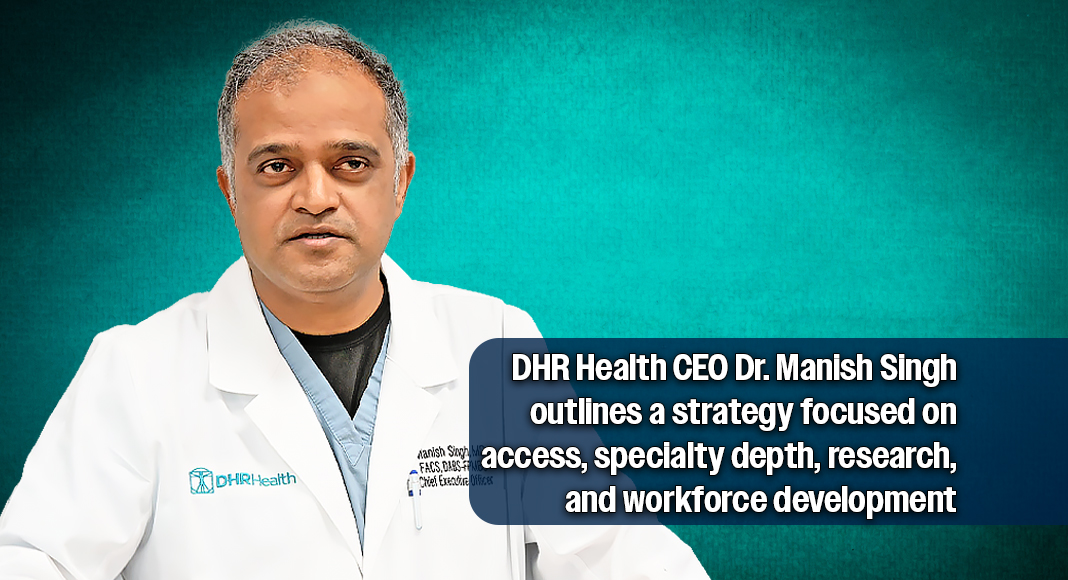
The Rio Grande Valley is growing, and its healthcare system is evolving with it. In an exclusive interview, Dr. Manish Singh, Chief Executive Officer of DHR Health, described a long-term strategy to expand advanced medical services in South Texas so patients no longer need to travel to distant metropolitan areas for specialized care. His remarks reflect an effort to build a comprehensive, patient-centered healthcare system capable of meeting the needs of one of the fastest-growing regions along the Texas-Mexico border.
The Rio Grande Valley region of South Texas, encompassing Starr, Hidalgo, Willacy, and Cameron counties, has experienced steady population growth over the past decade. According to U.S. Census Bureau Vintage 2024 estimates, the combined population of the four counties reached approximately 1,433,308 as of July 1, 2024, up from about 1,332,590 in 2014. The growth reflects regional trends driven by natural increase, international migration, and economic opportunities along the Texas-Mexico border, while projections from the Texas Demographic Center suggest continued moderate expansion through the mid-2020s. Dr. Singh said this growth directly affects healthcare demand. “The Rio Grande Valley is growing — and so are its healthcare needs,” he said.

Dr. Singh said the mission guiding DHR Health remains constant. “Our mission is to improve the health of the communities we serve through high-quality, accessible, patient-centered care,” he said. The organization’s responsibility, he explained, is to evolve with the region by strengthening specialty services, investing in infrastructure, maintaining cost-efficient care models, and focusing on long-term outcomes. The vision, he said, is “building a complete, innovative, patient-centered healthcare system that meets the full spectrum of needs in the Rio Grande Valley.”
Looking ahead, Dr. Singh said he hopes the system’s growth will eventually be recognized beyond the region. The founders of DHR Health believed Valley residents deserved the same level of care available in major metropolitan areas, a principle that continues to guide the organization. Today, services that once required travel outside the region are available locally, including comprehensive oncology programs, advanced cardiovascular services, women’s health programs, subspecialty surgical care, kidney transplant services, and modern facilities supported by integrated digital systems. Over the next decade, Dr. Singh said he hopes DHR Health will represent measurable quality outcomes, comprehensive specialty depth, and accountable healthcare delivery. “Ten years from now, I hope DHR Health represents measurable quality, comprehensive specialty depth, innovative care delivery grounded in accountability, and systems that can be replicated in other regions,” he said. Above all, he added, the system represents a commitment to “putting patients first and doing the right thing — every time.”
Balancing expansion with quality remains a central concern. Dr. Singh said planning begins with a fundamental question: “What does our community truly need?” If a service aligns with community needs and the organization’s mission, leaders assess readiness through clinical expertise, infrastructure, workforce alignment, financial sustainability, and quality oversight. “Quality is not an outcome of growth,” he said. “It is the foundation.”
One of the most significant developments discussed in the interview was the growth of DHR Health’s transplant programs. The system recently surpassed 100 kidney transplants in a single year. Dr. Singh said the milestone reflects the coordinated work of multiple disciplines. “Transplant medicine is complex and requires coordinated multidisciplinary effort,” he said, noting the need for surgical expertise, nephrology collaboration, intensive care capability, pharmacy oversight, regulatory compliance, and continuous quality monitoring. Providing transplant services locally improves access and continuity for families across the Rio Grande Valley.
On March 5, 2026, community leaders, healthcare professionals, and public officials gathered in Rio Grande City to dedicate the new DHR Health medical campus in Starr County, a project aimed at expanding healthcare access, strengthening physician training, and supporting economic growth. Marissa Castañeda, senior executive vice president at DHR Health, said the investment represents “more than just new buildings,” highlighting expanded care, physician training, and clinical research opportunities. The campus includes a multi-specialty clinic offering cardiology, oncology, and general surgery services so residents can receive care closer to home. DHR Health Chief Executive Officer Dr. Manish Singh said the expansion reflects the organization’s commitment to underserved areas, stating, “Our goal is simple: to continue expanding services so that this care can be provided right here in this community.” The campus also introduces a Family Medicine Residency Rural Track Program designed to train physicians locally and address rural doctor shortages while honoring longtime Valley physician Dr. Alberto “Beto” Gutierrez for more than five decades of service.
Kidney transplantation is now well established at DHR Health, while the system continues strengthening its liver transplant capabilities as part of its long-term strategy. Programs of this complexity require coordination across the entire health system, including surgical teams, hepatology and nephrology specialists, perioperative services, intensive care units, and pharmacy oversight. “High-acuity medicine requires teams working in unison, aligned toward the same goal,” Dr. Singh said.
Launching complex programs also requires transparent outcomes and consistent performance. “Complex programs require transparent outcomes, disciplined oversight, and sustained performance,” Dr. Singh said, adding that trust in healthcare institutions is built through measurable results and accountability.
According to Dr. Singh, expanding high-acuity services directly changes care for Valley patients. When specialized services are available locally, patients no longer need to travel outside the region for complex treatment. He cited oncology care, advanced surgical procedures, cardiovascular interventions, and high-acuity critical care support, including extracorporeal membrane oxygenation, or ECMO, as examples of capabilities now available locally. Access to these services allows families to remain together and helps preserve continuity of care. Dr. Singh also noted that the system maintains an “A” grade from the Leapfrog Group for patient safety, which he described as the highest recognition for quality and safety performance. “Safe, high-quality care is here,” he said.
Beyond transplant services, Dr. Singh said several specialties continue to strengthen healthcare in the Valley. Oncology programs and the Cancer Center are particularly significant because cancer care requires multidisciplinary coordination, advanced technology, and highly trained physicians. DHR Health also continues expanding services in cardiovascular medicine, neurology, gastroenterology, orthopedics, minimally invasive and robotic surgery, and women’s health programs, including a growing Breast Center of Excellence. Dr. Singh said comprehensive specialty depth defines strong health systems.
Technology also plays a role in the future of healthcare delivery. Dr. Singh said artificial intelligence is becoming part of modern healthcare infrastructure but must be used responsibly. AI can assist with data analysis, quality monitoring, documentation workflows, and pattern recognition. “AI enhances oversight and efficiency but does not replace physicians,” he said, emphasizing that governance and patient safety must guide the adoption of new technologies.
Research is another component strengthening healthcare in the Rio Grande Valley. Participation in clinical research helps improve the precision and relevance of treatment decisions. Because the region has a predominantly Hispanic population, local research can help ensure therapies are effective for the communities receiving them. “Our involvement in research within predominantly Hispanic populations helps ensure therapies are effective for the communities we serve,” Dr. Singh said.
Workforce development is also central to long-term healthcare growth. Dr. Singh said healthcare excellence depends on engaged professionals and strong training pathways. DHR Health supports leadership development programs, invests in career pathways, and strengthens graduate medical education programs to train physicians locally. Partnerships with institutions such as the University of Houston support these efforts. “Supporting our employees strengthens patient care,” he said.
DHR Health’s role extends beyond clinical services. Dr. Singh said healthcare systems must contribute to the social and economic stability of the communities they serve through workforce initiatives, volunteer efforts, and community partnerships. “Healthcare systems must strengthen the communities they serve,” he said.
Dr. Singh said his leadership philosophy reflects both his medical and executive responsibilities. Success, he said, is measured through outcomes and accountability. Whether in clinical practice or leadership, the standards remain consistent. “Put patients first. Support our teams. Strengthen the system responsibly. Do the right thing — every time,” he said.
As the Rio Grande Valley continues to grow, Dr. Singh believes healthcare must grow with it. His vision for DHR Health centers on building a comprehensive system capable of delivering advanced care locally, supported by technology, research, and workforce development. If successful, more patients in the Valley will be able to receive complex medical care close to home rather than traveling to larger metropolitan centers.
See related story: