Mega Doctor News

By Christina Elston / Cedars-Sinai
Newswise – LOS ANGELES – A new tool co-developed by investigators from Cedars-Sinai Health Sciences University can predict which of two available chemotherapy options for pancreatic cancer would be more effective for an individual patient.
If validated in further studies, the artificial intelligence-based platform could be used to improve treatment selection in virtually any cancer type. Results from a study of the platform’s effectiveness are published in the Journal of Clinical Oncology.

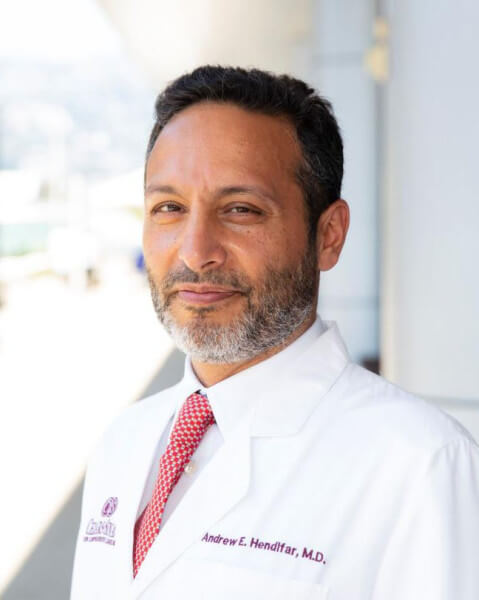
“Currently, we have no conclusive data to show which of the two approved chemotherapy regimens for patients with advanced pancreatic cancer is more effective,” said Andrew Hendifar, MD, medical director of Pancreatic Cancer at Cedars-Sinai Cancer and first author of the study. “So we start with one, do our best to quickly gauge the patient’s response, and switch if needed.”
The problem with this, Hendifar said, is that putting an ill patient on a chemotherapy regimen that isn’t working worsens their health rather than improving it. Biomarkers from blood or tissue can help predict treatment response and guide these decisions in other cancer types, but currently, no biomarkers exist for pancreatic cancer.

“This endeavor is an example of applying AI technology to an unmet clinical need, and offers tremendous translational potential,” said Robert Figlin, MD, interim director of Cedars-Sinai Cancer. “It aligns perfectly with our goal of personalizing cancer treatment for our patients and improving outcomes for all.”
To develop the tool, investigators used a platform called Computational Histology Artificial Intelligence, or CHAI. CHAI analyzes images of microscope slides containing samples of tumor tissue, which are stained to highlight minute details of the cells. Almost all patients have these samples taken when their tumors are biopsied.
The team analyzed tissue characteristics in samples from 25,000 pancreatic cancer patients who had received one chemotherapy regimen or the other. The platform’s AI capabilities made it possible to analyze more than 30,000 different features of the tissue samples. Investigators then matched tissue characteristics to treatment response to create the predictive tool.
When they tested the tool on data from a large clinical trial using the two pancreatic cancer treatment regimens, they found that it was able to accurately predict each patient’s response to the treatment received.
“Unlike most biomarker tests, where you need an extra sample of tissue or blood, this test requires only a scanned image of the patient’s existing biopsy slide,” Hendifar said. “You just send the image electronically and quickly receive a result with the treatment preference. And you don’t just learn which treatment is preferred. You learn how much more effective it is likely to be.”
The tool needs to be further validated in patients undergoing treatment before it is ready for clinical use, but Hendifar said that with that validation it could eventually be applied to other solid tumor types. It could even compare the potential benefit of different types of therapy, such as radiation therapy versus surgery.
“If the chance that a particular treatment will benefit a patient is 50-50, which is quite common in cancer therapy, then this may serve as a powerful tool to aid physician and patient decision-making,” Hendifar said. “And we can train the digital tool not just to choose between two available treatments, but to choose between multiple available treatments.”
Additional Cedars-Sinai authors include Brent K. Larson, DO; Vladimir Kazarov, MS; Natalie Moshayedi, BS; and Arsen Osipov, MD.
Other authors include Viswesh Krishna, BS; Vrishab Krishna, BS; Haochen Zhang, PhD; Katelyn Smith, BA; Kawther Abdilleh, PhD; Snehal Sonawane, MD; Akshay Neema, MS; Asit Tarsode, MS; Ekin Tiu, MS; Vivek Nimgaonkar, MD; Shawn Hutchinson, MSc; Daniela Bevacqua, BS; Sudheer Doss, PhD; Alejandra Alvarez, MS; Drew Watson, PhD, MBA; Waleed M. Abuzeid, MD; Barbara T. Grunwald, MD; Marcus Noel, MD; Rashmi Samdani, MD; Dove Keith, PhD; Rosalie C. Sears, PhD; Davendra Sohal, MD, MPH; Christos Fountzilas, MD; Grainne M. O’Kane, MD; Robert C. Grant, MD, PhD; Eric A. Collisson, MD; Lesli A. Kiedrowski, MS, MPH; Trevor J. Royce, MD, MS, MPH; Anirudh R. Joshi, MS; Aatur D. Singhi, MD, PhD; and Jennifer J. Knox, MD, MSc.
Funding: Supported in part by the Pancreatic Cancer Action Network (PanCAN – Know Your Tumor), the University Health Network, Toronto (COMPASS trial), and Valar Labs, Inc.