








Mega Doctor News
Since opening 30 years ago as one of the first cardiovascular hospitals in the United States, South Texas Health System (STHS) Heart has expanded its services to provide innovative solutions to help Rio Grande Valley residents maintain their heart health.
But the facility’s dedication to high quality, compassionate care extends beyond cardiology.
In June 2023, STHS Heart launched its robotic surgery program with the acquisition of a da Vinci Xi Robotic Surgical System, an innovative platform that enhances surgical precision and allows for minimally invasive procedures across various specialties.

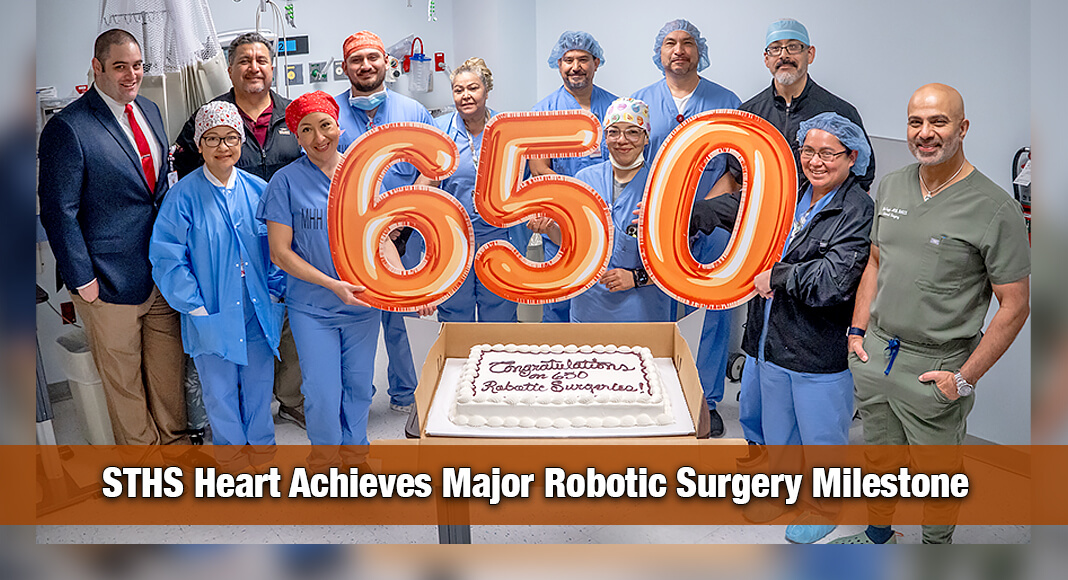
Now, about two and a half years later, STHS Heart is celebrating a special milestone… the completion of its 650throbotic-assisted surgery.
Performed by STHS Clinics physician Bob H. Saggi, MD, FACS, a Surgical Review Corporation-accredited Surgeon of Excellence, the milestone procedure was a cholecystectomy, a procedure to remove the gallbladder, performed on a 57-year-old female patient.
One of the most common procedures in the United States, with more than 1.2 million cholecystectomies performed annually, per the National Library of Medicine, a robotic-assisted cholecystectomy provides patients with several benefits over traditional laparoscopic surgery, including less scarring, reduced pain and faster recovery.
“It’s important to be able to provide advanced emergency and elective surgical care like robotic-assisted surgery that significantly enhances patient outcomes,” says Dr. Saggi. “In less than three years, STHS Heart has done a tremendous job to offer not just robotic surgery, but complex robotic surgery like pancreatic, esophageal and bariatric weight-loss procedures that have helped improve the overall patient experience. I’m honored to be the surgeon who performed this milestone procedure.”
A highly advanced, computer-assisted surgical system that enhances capabilities beyond a surgeon’s eyes and hands, the da Vinci Xi allows them to “see” inside the body and be more meticulous during surgery, resulting in less invasive procedures with a shorter recovery time.
The da Vinci Xi enables surgeons to operate on a patient via one or more small incisions, typically less than or equal to one centimeter long, as opposed to the large incisions that may be required in traditional surgery.
“Equipped with four thin robotic arms, which have a wider range of motion than the human hand, the system offers a magnified, 3D view of the surgical site and helps surgeons operate with precision, flexibility and control,” says Dr. Saggi.
The journey to the first 650 robotic surgeries began in the summer of 2023, when Dr. Ernesto Garza, MD, made history by performing the first procedure using the minimally invasive robotic system at STHS Heart.
Since then, surgeons at the facility have performed general surgeries like hernia repairs, cholecystectomies and colon surgeries, as well as bariatric procedures such as sleeve gastrectomies and gastric bypasses.
It’s all part of STHS Heart’s commitment to providing quality, compassionate surgical care with better patient outcomes and better outcomes.
“South Texas Health System Heart is dedicated to leveraging cutting-edge technology like the da Vinci Xi to ensure Rio Grande Valley residents have the best surgical care possible,” said Brenda Ivory, Chief Executive Officer, STHS Heart. “The facility is proud to offer our patients close-to-home advanced surgical options, including minimally invasive procedures, which offer precision, reduced trauma, faster recovery and improved patient outcomes. The continued growth of our robotic surgery program serves as a testament to our commitment to continue evolving to meet the healthcare needs of the communities we proudly serve.”
STHS Heart’s da Vinci Xi system is the third of its kind at South Texas Health System. In 2015, STHS Edinburg became the first medical facility south of San Antonio to use the da Vinci Xi system and later acquired its second da Vinci Xi in February 2021. Since then, STHS Edinburg and STHS McAllen have each acquired a da Vinci 5, one of the most advanced and integrated robotic surgical systems to date.
For more information about the minimally invasive surgical services available at STHS Heart, visit STHSHeart.com or call (956) 994-2000.


