Mega Doctor News
By Jackie Maupin, jacmaup@iu.edu / Indiana University
Newswise — INDIANAPOLIS — New research co-led by Indiana University School of Medicine scientists has exposed a vulnerability in acute myeloid leukemia by identifying the blood cancer’s reliance on a specific signaling pathway involved in the body’s inflammation response. Their preclinical evidence suggests that blocking this pathway with a new drug compound can weaken acute myeloid leukemia during critical stages, paving the way for more effective and targeted treatments for this hard-to-treat disease.
According to the National Cancer Institute, the five-year survival rate for AML is only 32.9%, and about 22,000 new cases were reported in 2025. Acute myeloid leukemia (AML) is known for being treatment-resistant and having a high relapse rate.
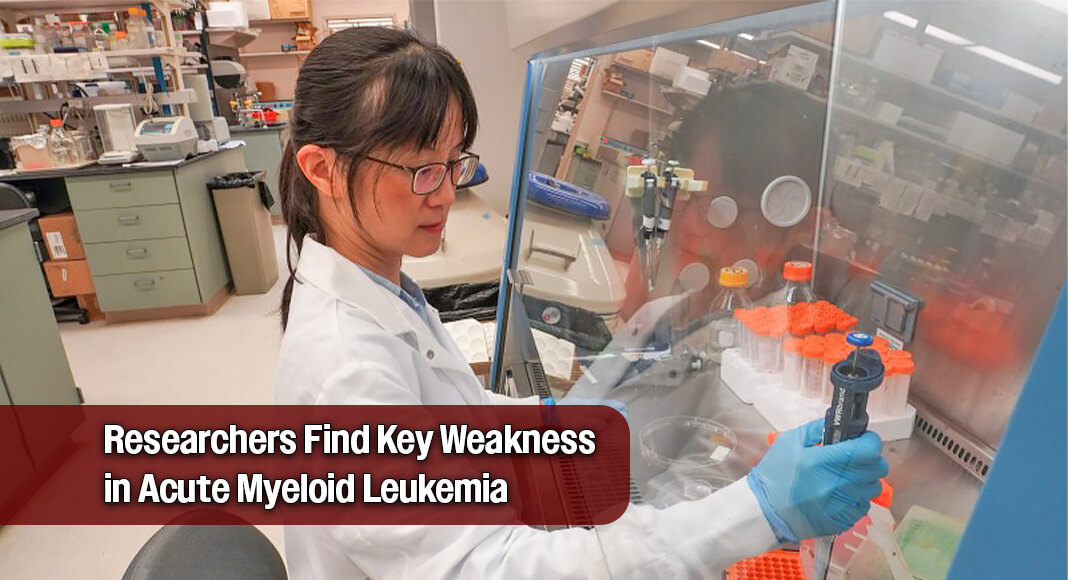
“AML is a challenging blood cancer because a small population of cells, known as leukemia stem cells, can survive chemotherapy and later regenerate the disease,” said Tzu-Chieh (Kate) Ho, PhD, assistant research professor of pediatrics at the IU School of Medicine and a lead author of the study. “Our research goal was to understand the critical mechanisms these leukemia stem cells rely on at both diagnosis and relapse, and to identify potential therapeutic targets.”
In the study published in Leukemia, the researchers examined leukemia stem cells from AML patients during their diagnosis and relapse. They discovered that an inflammatory signaling pathway involved in the body’s immune system response — known as Interleukin-1 (IL-1) signaling — is significantly elevated at both stages. When the team used genetic approaches to reduce this signal in human AML cells, the cells formed fewer colonies and showed a diminished ability to reestablish leukemia.
The researchers also developed a new drug-like compound, UR241-2, designed to block the key proteins found in the IL-1 signaling pathway. In preclinical models, the compound impaired leukemia stem cells while largely sparing healthy blood-forming cells and significantly reduced leukemia levels in the mice. Their findings suggest that targeting this pathway could strengthen current AML treatments like chemotherapy and reduce the risk of relapse.
“Our studies indicate that IL-1 signaling is not a random feature, but rather a fundamental survival mechanism that persists across different stages of AML and can be targeted,” said Reuben Kapur, PhD, director of the IU School of Medicine Herman B Wells Center for Pediatric Research and co-author of the study. “This opens up exciting possibilities for developing therapies that are more effective and more precise.”
UR241-2 is still in early preclinical development, but similar drugs are already being tested in clinical trials for other cancers and immune-related diseases, suggesting a promising path toward eventually evaluating this compound for AML.
“Future AML treatments may incorporate our strategy alongside standard chemotherapy as an approach to reduce relapse risk,” Ho said. “We hope these approaches will ultimately help improve treatment outcomes and long-term prognosis for patients with AML.”
Ho and Kapur are also researchers in the Wells Center’s Hematologic Malignancies and Stem Cell Biology Program and the IU Melvin and Bren Simon Comprehensive Cancer Center.
IU School of Medicine’s Baskar Ramdas, PhD, is a co-author on the study. Other authors include Mark W. LaMere, Hiroki Kawano, Daniel K. Byun, Elizabeth A. LaMere, Chunmo Chen, Laura M. Calvi, Jane L. Liesveld, Rakesh K. Singh and Michael W. Becker from the University of Rochester Medical Center; Yu-Chiao Chiu and Li-Ju Wang from the University of Pittsburgh School of Medicine; Jian Wang and Nikolay V. Dokholyan from Penn State College of Medicine; and Craig T. Jordan from the University of Colorado, Denver.
About the Indiana University School of Medicine
The IU School of Medicine is the largest medical school in the U.S. and is annually ranked among the top medical schools in the nation by U.S. News & World Report. The school offers high-quality medical education, access to leading medical research and rich campus life in nine Indiana cities, including rural and urban locations consistently recognized for livability. According to the Blue Ridge Institute for Medical Research, the IU School of Medicine ranks No. 13 in 2024 National Institutes of Health funding among all public medical schools in the country.