








Mega Doctor News
Newswise — Masks help protect the people wearing them from getting or spreading SARS-CoV-2, the virus that causes COVID-19, but now researchers from the National Institutes of Health have added evidence for yet another potential benefit for wearers: The humidity created inside the mask may help combat respiratory diseases such as COVID-19.
The study, led by researchers in the NIH’s National Institute of Diabetes and Digestive and Kidney Diseases (NIDDK), found that face masks substantially increase the humidity in the air that the mask-wearer breathes in. This higher level of humidity in inhaled air, the researchers suggest, could help explain why wearing masks has been linked to lower disease severity in people infected with SARS-CoV-2, because hydration of the respiratory tract is known to benefit the immune system. The study published in the Biophysical Journal.
“We found that face masks strongly increase the humidity in inhaled air and propose that the resulting hydration of the respiratory tract could be responsible for the documented finding that links lower COVID-19 disease severity to wearing a mask,” said the study’s lead author, Adriaan Bax, Ph.D., NIH Distinguished Investigator. “High levels of humidity have been shown to mitigate severity of the flu, and it may be applicable to severity of COVID-19 through a similar mechanism.”

High levels of humidity can limit the spread of a virus to the lungs by promoting mucociliary clearance (MCC), a defense mechanism that removes mucus, and potentially harmful particles within the mucus, from the lungs. High levels of humidity can also bolster the immune system by producing special proteins, called interferons, that fight against viruses, a process known as the interferon response. Low levels of humidity have been shown to impair both MCC and the interferon response, which may be one reason why people are likelier to get respiratory infections in cold weather.
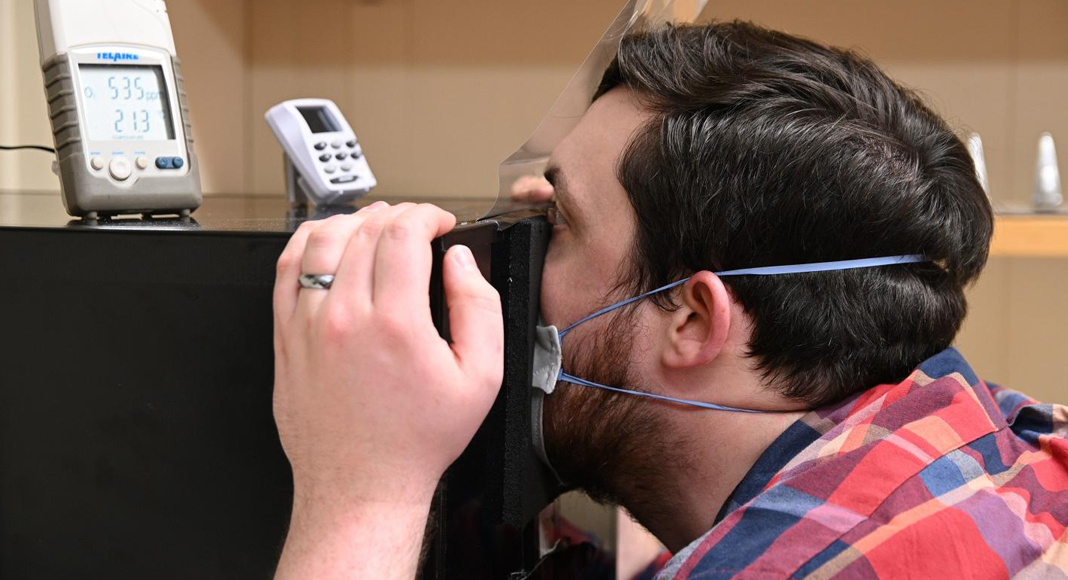
The study tested four common types of masks: an N95 mask, a three-ply disposable surgical mask, a two-ply cotton-polyester mask, and a heavy cotton mask. The researchers measured the level of humidity by having a volunteer breathe into a sealed steel box. When the person wore no mask, the water vapor of the exhaled breath filled the box, leading to a rapid increase in humidity inside the box.
When the person wore a mask, the buildup of humidity inside the box greatly decreased, due to most of the water vapor remaining in the mask, becoming condensed, and being re-inhaled. To ensure no leakage, the masks were tightly fitted against the volunteer’s face using high-density foam rubber. Measurements were taken at three different air temperatures, ranging from about 46 to 98 degrees Fahrenheit.
The results showed that all four masks increased the level of humidity of inhaled air, but to varying degrees. At lower temperatures, the humidifying effects of all masks greatly increased. At all temperatures, the thick cotton mask led to the most increased level of humidity.
“The increased level of humidity is something most mask-wearers probably felt without being able to recognize, and without realizing that this humidity might actually be good for them,” Bax said.
The researchers did not look at which masks are most effective against inhalation or transmission of the virus and defer to the CDC for guidance on choosing a mask. Earlier studies from Bax and his colleagues showed that any cloth mask can help block the thousands of saliva droplets that people release through simple speech? droplets that, if released, can remain in the air for many minutes. While the current study did not examine respiratory droplets, it does offer more evidence as to why masks are essential to battling COVID-19.
“Even as more people nationwide begin to get vaccinated, we must remain vigilant about doing our part to prevent the spread of the coronavirus that causes COVID-19,” said NIDDK Director Dr. Griffin P. Rodgers. “This research supports the importance of mask-wearing as a simple, yet effective, way to protect the people around us and to protect ourselves from respiratory infection, especially during these winter months when susceptibility to these viruses increases.”


