






Mega Doctor News

A new procedure offers long-term relief for patients struggling with severe high blood pressure that resists traditional drugs.
Affecting nearly 50% of U.S. adults, hypertension remains the leading contributor to death worldwide, according to the World Health Organization.
Yet among Americans who know they have high blood pressure, roughly 80% do not have it adequately controlled, according to the Centers for Disease Control and Prevention, putting them at increased risk for life-threatening cardiovascular events.

“High blood pressure is often called the ‘silent killer’ because many people don’t experience symptoms until serious damage has already occurred,” said Luis Padula, MD, FACC, an interventional cardiologist with South Texas Health System (STHS) Clinics. “When left uncontrolled, hypertension can significantly increase the risk of heart attack, stroke, heart failure, kidney disease and other potentially life-threatening conditions. That’s why it’s so important for patients to work closely with their healthcare providers to manage their blood pressure and explore all available treatment options when lifestyle changes and medications alone are not enough.”
Unfortunately, apparent treatment-resistant hypertension (aTRH) affects nearly 20% of the treated hypertensive population in the U.S., according to the American Heart Association.
Clinically defined as blood pressure that remains above 140/90 mmHg despite the concurrent use of three or more antihypertensive medications from different classes, including a diuretic, aTRH poses a significant threat to long-term health.
Compared to patients whose blood pressure is more easily controlled, individuals with aTRH face a substantially higher risk of target-organ damage, serious cardiovascular complications and premature death.
“Because the vascular system remains under continuous, high-pressure stress, resistant hypertension takes a compounding toll on the body over time,” said Dr. Luis Padula. “Studies indicate that patients with treatment-resistant hypertension face approximately a 50% greater risk of experiencing major adverse cardiovascular and renal events.”
But there’s good news for Rio Grande Valley residents living with resistant hypertension. STHS Heart has introduced new, minimally invasive technology to help control high blood pressure.
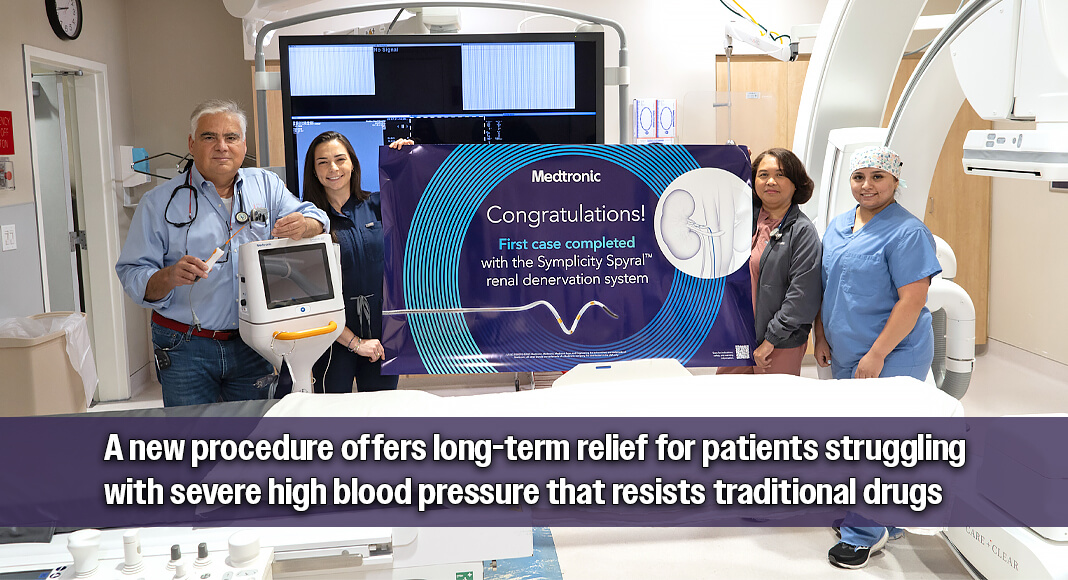
This summer, the facility treated its first patient with Symplicity Spyral™, a new renal denervation (RDN) system now offered for certain patients with high blood pressure. The elderly man has reported positive results following the procedure.
Approved by the U.S. Food and Drug Administration (FDA) in November 2023, the RDN system involves a minimally invasive procedure that targets nerves near the kidneys that can become overactive and cause high blood pressure.
The procedure, which is also known as the Symplicity blood pressure procedure, is approved for use as an adjunctive treatment in patients with high blood pressure when lifestyle changes and antihypertensive medications do not adequately control blood pressure.
“It’s no secret that the Valley faces a high incidence of hypertension, with many people struggling to effectively control their condition,” said Dr. Padula. “Innovative therapies like Symplicity Spyral™ provide a promising new option for eligible patients whose blood pressure remains uncontrolled despite medication and lifestyle modifications, helping reduce long-term risks and improve overall cardiovascular health.”
“The Symplicity blood pressure procedure can provide patients with a blood pressure-reduction benefit that is ‘always on’ and does not require a permanent implant,” said Brenda Ivory, Chief Executive Officer, STHS Heart. “For patients who have worked tirelessly to manage their blood pressure without achieving adequate control, this technology offers new hope and peace of mind. We are proud to bring this innovative treatment to the Valley and look forward to helping more patients reduce their risk of serious cardiovascular complications.”
Since introducing the technology, STHS Heart, one of the first freestanding cardiology and cardiovascular hospitals built in the United States, has successfully completed an additional four procedures using the Symplicity Spyral system, expanding treatment options for patients with difficult-to-control hypertension.
If you or someone you know has high blood pressure that remains uncontrolled despite lifestyle changes and medication, talk to your healthcare provider to learn whether the Symplicity blood pressure procedure may be an appropriate treatment option. Individuals without a primary care physician can visitdoctors.southtexashealthsystem.com to find one near them.
To learn more about the comprehensive cardiovascular services available at STHS Heart, including the Symplicity blood pressure procedure, visit the facility’s website at www.southtexashealthsystemheart.com.