



Mega Doctor News
By American College of Surgeons (ACS)
Newswise – CHICAGO – Quicker access to bleeding control interventions taught in the American College of Surgeons (ACS) Stop the Bleed program could have prevented the deaths of numerous homicide victims in Maryland, according to a first-of-its-kind analysis published in the Journal of the American College of Surgeons (JACS).
The analysis included data from more than 5,000 homicide victims in Maryland and showed that nearly half of the victims who died from gunshot or stabbing wounds sustained severe bleeding injuries affecting their arms or legs.

“We know that the skills taught in Stop the Bleed can save lives, but we have very little population-level data telling us how often injuries that are treatable with techniques learned in Stop the Bleed occur,” said Joseph V. Sakran, MD, MPH, MPA, FACS, senior author of the study and executive vice chair of surgery at Johns Hopkins Medicine in Baltimore, Maryland. “Maryland has a high burden of violent injury and a robust medical examiner system, providing us with a unique opportunity to study how many homicide victims sustained injuries that might have been survivable with rapid bleeding control.”
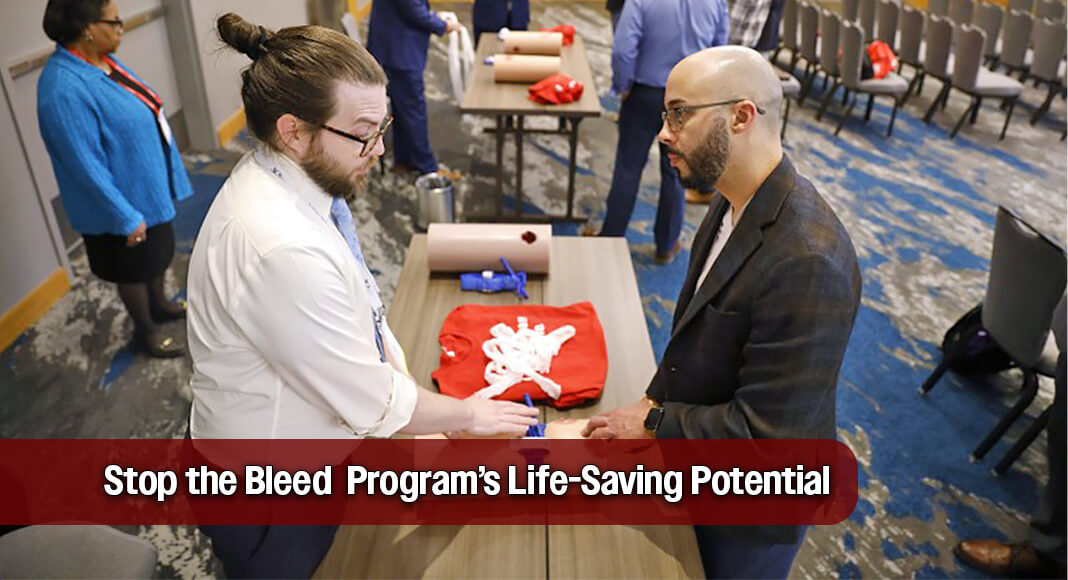
The ACS Stop the Bleed program teaches bystanders how to use three techniques for severe bleeding emergencies while waiting for first responders: applying pressure, packing the wound, and using a tourniquet. Since the program’s launch, more than 5 million people have been trained.
For the JACS study, researchers reviewed 5,765 autopsy reports from Maryland homicide victims killed by gunshot or stabbing wounds between 2005 and 2017. They categorized cases as isolated extremity injuries (arms or legs only) or non-isolated extremity injuries (involving other body parts, such as the head, neck, chest, or abdomen). They also reviewed reports for evidence of significant blood vessel damage, such as wounds to the femoral or brachial arteries.
Potentially preventable deaths were identified for victims who had isolated extremity injuries, which the researchers said represent the clearest scenarios where bystander intervention with bleeding control techniques is likely to be effective.
Study Results
The majority of homicides occurred due to gunshot wounds (84%), followed by stabbing wounds (16%), and combined mechanisms (<1%).
Nearly half of gunshot wound victims and a third of stabbing victims sustained multiple injuries that included their arms or legs. A smaller but meaningful fraction of those killed — about 1% of gunshot wound victims and 2% of stabbing wound victims — had isolated limb injuries that could have been survivable if bleeding control techniques had been applied at the scene. That translates into 72 potentially preventable deaths.
Gunshot victims with isolated limb wounds were 10 times more likely to have a significant vascular injury — an injury causing life-threatening bleeding — than those who sustained multiple injuries.
Victims were predominantly Black men under 30, underscoring the need for community outreach and violence prevention efforts reaching at-risk communities, the authors said.
“This research tells us that while isolated extremity wounds are relatively uncommon, they are high-yield opportunities for bystander hemorrhage control — and that’s the exact type of injuries that the ACS Stop the Bleed training targets,” Dr. Sakran said. “While 1% may sound small, in public health, every preventable death matters. Every one of these individuals was a brother, sister, family member, or friend, and we need to think about them in those terms, not just statistics.”
Dr. Sakran noted that because the study did not evaluate non-isolated injuries that may have been survivable with bleeding control, the number of potentially saved lives is likely higher. He added that while the results are specific to Maryland, which has a high density of Level 1 and 2 trauma centers, the findings highlight a critical gap between severe bleeding and first response that Stop the Bleed helps close across all communities. Future research will investigate the role of Stop the Bleed in preventing deaths from more complex, multi-site injuries.
“You don’t have to be a doctor to save a life; you just need to know what to do in the first few minutes of a bleeding injury before first responders arrive,” he said. “And those first few minutes often belong to the community, not the hospital.”
Coauthors are Samuel Okum, BA; Ambar Mehta, MD, MPH; Nicole Lunardi, MD, MSPH; James P. Byrne, MD, PhD; Elliott R. Haut, MD, PhD; and David Efron, MD.
This study is published as an article in press on the JACS website.
Citation: Okum S, Mehta A, Lunardi N, et al. Could We Have Stopped the Bleed? An Examination of 5765 Homicide Autopsies Across 13 Years. Journal of the American College of Surgeons, 2025. DOI: 10.1097/XCS.0000000000001695