Mega Doctor News
By Maryanne MacLeod
Newswise — Royal Oak, MI – The use of a tiny tool to pluck life-threatening blood clots out of arteries to the lungs resulted in a high patient survival rate, especially when compared to historical treatments such as blood thinners or surgery, according to the largest study to date of pulmonary embolism removal.

The FLASH (FlowTriever All-Comer Registry for Patient Safety and Hemodynamics) study results were published recently in EuroIntervention, the journal of the European Association of Percutaneous Coronary Interventions, with interim results published earlier in 2022 in Catheterization & Cardiovascular Interventions. The study reviewed the treatment of pulmonary embolism (PE) in 800 patients cared for at 50 hospitals in the United States between December 2018 and December 2021, including Corewell Health’s Beaumont Hospital, Royal Oak.
The study looked at the effectiveness of a minimally invasive device, called the FlowTriever System by Inari Medical, now available to PE patients at Corewell Health, using a catheter threaded through a vein in the groin to the right side of the heart and into the arteries leading to the lung. Doctors then use a large suction device at the end of the catheter to grab the clot. Vacuum suction pulls the clot out of the artery into the catheter and out of the body in a process called mechanical thrombectomy.
“When we looked at the effectiveness of this mechanical thrombectomy device compared to standard treatments such as systemic blood thinners, thrombolytics or open surgery, mortality risk dropped from a historic rate of 6.5% down to 0.8% …..” said one of two Corewell Health study investigators, Dr. Michael Savin, an interventional radiologist who treats patients at Corewell Health’s Beaumont Hospital, Royal Oak and Corewell Health’s Beaumont Hospital, Troy. “Additionally, the patients’ blood flow, cardiac function and shortness of breath improved rapidly. This treatment potentially decreases the risk of long-term disability.”
Each year, pulmonary embolism affects up to 900,000 people in the United States; with 10 to 30 percent of patients dying within one month of diagnosis, according to the American Lung Association.
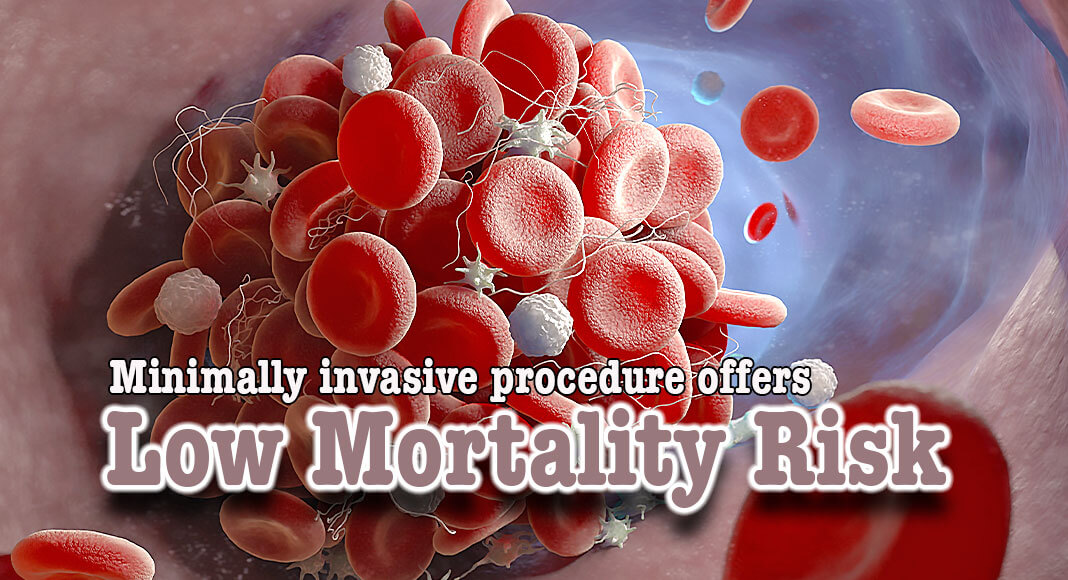
Pulmonary embolism occurs when blood clots, often formed in the legs, travel through the right side of the heart and become lodged in arteries of the lungs, cutting off blood flow. Risk factors for pulmonary embolism include obesity, immobilization due to surgery, cancer, smoking and COVID-19. Symptoms can include sudden shortness of breath, chest pain, lightheadedness and a cough. The condition can damage the lungs, affect heart function, injure major organs deprived of oxygen and ultimately lead to death.
Historically, doctors often used anti-coagulation and clot dissolving medications to thin the blood, prevent additional clots from forming and dissolve existing clots. However, these medications carry an increased risk of internal bleeding and brain hemorrhage.
Study investigator Dr. Herman-Simon Kado, an interventional cardiologist at Corewell Health’s Beaumont Hospital, Royal Oak, said use of a mechanical device provides an alternative for patients who cannot tolerate clot-dissolving medications that thin the blood. About a third of the FLASH patients (32.1%) could not be treated with these medications. The medications are not recommended for patients who are already taking anti-coagulation medication, often cardiac patients; are over 75 years old; who have blood pressure higher than 180/110; are pregnant; or have recently had surgery, among other factors.
“Mechanical thrombectomy increases our ability to treat patients for whom clot-dissolving medications are not an option,” Dr. Kado said. “And a minimally invasive option over open surgery results in less trauma to the patient, shorter hospital stays and faster recovery. This provides additional opportunity for positive outcomes for our patients.”
Corewell Health has been a leader nationally for the treatment of pulmonary embolism and a magnet hospital regionally for PE patient transfers. The Pulmonary Embolism Response Team (PERT) formed at Corewell Health’s Beaumont Hospital, Royal Oak, is now serving as a national model for how to treat PE patients.
Journal Link: EuroIntervention