




Mega Doctor News

Newswise — If something seems too good to be real, it probably isn’t.
Counterfeit medications often look exactly like the authentic ones, but they can endanger patients hoping to save money on prescription drugs. These fake medications can be ineffective or contaminated, according to Interpol, the world’s largest international police organization.
Two South Dakota State University researchers will develop methods to create a chemical profile that will help determine if a medication is authentic or not—and possibly even trace where the ingredients in illicit drugs come from—as part of the South Dakota Center for Understanding and Disrupting the Illicit Economy.


The center, which recently received a five-year, $3.9 million award from the South Dakota Research and Commercialization Council, aims to thwart criminal activity and illegal trade on the dark web and other networks. The multi-institutional state research group, which is led by the South Dakota School of Mines and Technology, also involves faculty from Dakota State University and the University of South Dakota.
Analyzing chemical fingerprints
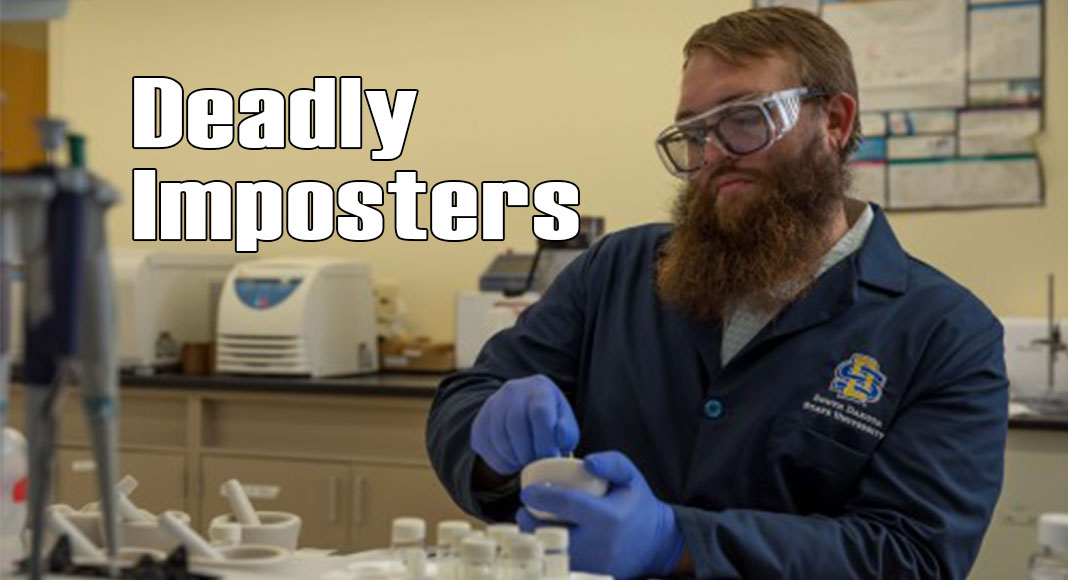
Professor Brian Logue of SDSU’s Department of Chemistry and Biochemistry and two doctoral students will develop techniques to determine the chemical composition of drugs from various manufacturers and come up with a chemical fingerprint. Logue has been collaborating with many of the researchers involved in the new center on projects related to security and anti-counterfeiting technologies for 15 years.
Associate professor Chris Saunders of SDSU’s Department of Mathematics and Statistics, who specializes in quantifying impression, pattern and trace evidence, will apply statistical methodologies to figure out whether a drug might or might not be counterfeit. “Dr. Saunders will take the chemical information and statistically analyze the data to group specific drugs from different manufacturers,” Logue said.
Saunders, who has worked with the FBI and the broader intelligence community, has extensive experience applying statistical modeling to forensic evidence. “Chris is a great addition to the research group,” Logue said. One doctoral student will work on the statistics portion of the project. The SDSU researchers will receive nearly $900,000 in funding through the center.
Spotting counterfeits
“Incidence of counterfeit drugs in the United States is rare relative to the large number of prescription drugs,” according to the Food and Drug Administration. However, when ingredients or the pills themselves come from sources outside the United States, counterfeit pharmaceuticals can reach American consumers.
Spotting counterfeit drugs is the first step to disrupting the distribution channels. “Pills that have no active ingredients are easy to identify,” Logue said. However, some counterfeiters simply repackage outdated pills that were supposed to have been destroyed or crush them and add a little of the active ingredient to get people hooked on buying the cheaper pills.
Logue and his team are developing methods to concentrate and extract the compounds, using different brands of aspirin for proof-of-concept testing. “First, we are going to analyze what’s out there legally and then look at what does not fit the profile,” Logue explained, noting that drugs that lower cholesterol and treat erectile dysfunction are among the most commonly counterfeited ones.
Initially, the SDSU researchers will focus on pharmaceuticals, but later the project will expand to controlled substances. To work with these, they will need to obtain a U.S. Drug Enforcement Authority license. “We have to make sure we have the proper security measures in place,” Logue said.
“If we can determine where the counterfeit chemicals are coming from, then we can work with other team members and experts to disrupt the supply chain and distribution network,” he concluded.