








Student Engineering Team Designs Device to Help Patients with Parkinson’s Disease

Translate to Spanish or other 102 languages!

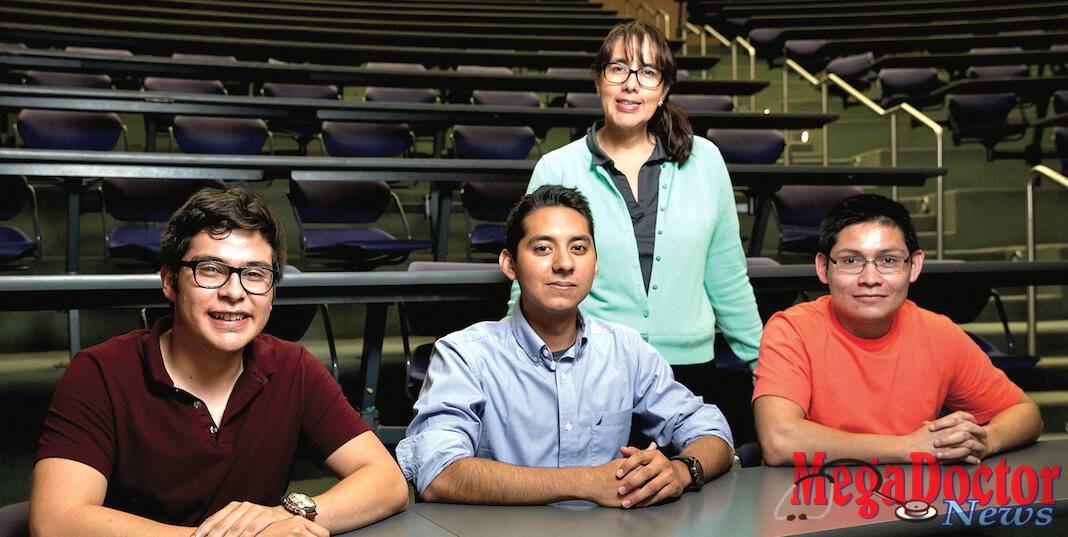
A team of four UTRGV mechanical engineering students have designed a prototype device that will help Parkinson’s disease victims right legibly again. The development of their Self-Stabilization Holder, a yearlong endeavor which became their senior design project, was overseen by Dr. Karen Lozano, professor of mechanical engineering (standing). This spring the device placed second in the Rafael Munguia UTRGV Business Plan Competition overseen by the Robert C. Vackar College of Business & Entrepreneurship. The students (left to right) are Carlos Hernandez, Misael Martinez, and Rodolfo Becerra. Team member Arnoldo Ventura, currently participating in an out-of-state internship, is not pictured. (UTRGV Photo by Paul Chouy)
A team of four UTRGV mechanical engineering students have designed a prototype device that will help Parkinson’s disease victims right legibly again. The development of their Self-Stabilization Holder, a yearlong endeavor which became their senior design project, was overseen by Dr. Karen Lozano, professor of mechanical engineering (standing). This spring the device placed second in the Rafael Munguia UTRGV Business Plan Competition overseen by the Robert C. Vackar College of Business & Entrepreneurship. The students (left to right) are Carlos Hernandez, Misael Martinez, and Rodolfo Becerra. Team member Arnoldo Ventura, currently participating in an out-of-state internship, is not pictured. (UTRGV Photo by Paul Chouy)

By Gail Fagan

- Advertisement -

Mega Doctor News

Rio Grande Valley, Texas – Putting pen to paper – it’s a motor skill most of us use every day. But what happens when hand tremors from Parkinson’s disease strip us of that ability? Something as simple as signing your name becomes a challenge – or an impossibility. To help find a solution, a team of UTRGV mechanical engineering students, guided by their professor, Dr. Karen Lozano, went to work on a design that could provide some relief.

The project came in response to a plea from local writer/columnist Chris Ardis, who wrote to Lozano asking for help in combating her mother’s deteriorating penmanship due to Parkinson’s disease. Lozano – a Julia Beecherl Endowed Professor in the UTRGV Department of Mechanical Engineering, and a Great Minds in STEM Engineer of the Year – and her students heeded the call.

- Advertisement -

“We are engineers – we use our scientific knowledge to develop technologies to benefit the community,” Lozano said. “That is our job.”

Lozano oversaw and mentored the team, made up of Rodolfo Becerra, Carlos Hernandez and Misael Martinez – all spring 2017 honors graduates who earned bachelor’s degrees in mechanical engineering and are now graduate students in the mechanical engineering master’s program – and Arnoldo Ventura, an undergraduate mechanical engineering student. All four are graduates of Valley View High School in Pharr, Texas.

TEAMWORK

Although the students had worked together in various university classes, they said they struggled, at first, with each one wanting to do a bit of everything in the project. “Once we each identified our strengths and weaknesses, we moved at a faster pace,” Martinez said. Becerra was in charge of computer coding, a new skill they all had to acquire. Martinez took on the assembly process and electrical work.

- Advertisement -

Ventura, who was in an internship out of state in the project’s later stages, was in charge of the senior design presentation and timelines. Hernandez handled the architectural and 3-D printing work. “In addition, the team learned the importance of balancing what a customer or client wants with what they really need, all within the engineering scope of efficiency and functionality,” Martinez said.

The team earned an “A” on their senior design project, which included a presentation of their goals and objectives, market research, comparable products, first and final design details, product cost and analysis, software requirements, analysis of safety features and environmental issues, and data collection and analysis.


- Advertisement -
- Advertisement -

- Advertisement -

More Articles

DHR Health Continues to Lead the Way in Treatment of Alzheimer’s Disease for the RGV

Two years after DHR Health announced it was the first hospital south of San Antonio to successfully administer Leqembi, an FDA-approved intravenous treatment for early Alzheimer’s disease, DHR Health continues to expand access to advanced Alzheimer’s care for patients in the Rio Grande Valley being now the only facility doing amyloid PET Scans, a diagnostic test to accurately diagnose Alzheimer’s disease. DHR Health also offers Kisunla, another FDA-approved intravenous treatment for early symptomatic Alzheimer’s disease.

The Genetic Armor Defeating Colorectal Cancer

A team of scientists from the Barbara Ann Karmanos Cancer Institute, Wayne State University, and institutions across the U.S., have published a landmark paper on the role of TGFBR1*6A, a naturally occurring genetic mutation in the TGFBR1 gene found in approximately 14 percent of the general population. Image for illustration purposes

Why CKM Syndrome Requires a Coordinated Care Point Person

When the term “cardiovascular-kidney-metabolic syndrome” was created in 2023 to define how heart disease, kidney disease, obesity and diabetes are connected, one goal was to help health professionals understand the benefits of working together.

How Long is Too Long to Fall Asleep?

How long does it take you to fall asleep? Sleep experts call this sleep latency, and they say there’s a typical range for how long it takes most people to drift off.
- Advertisement -
