Mega Doctor News

By Selene Rodriguez
South Texas College Emergency Medical Services (EMS) faculty are strengthening emergency childbirth training for the Rio Grande Valley after recently obtaining a specialized obstetrics certification at the Texas EMS Educators Summit.
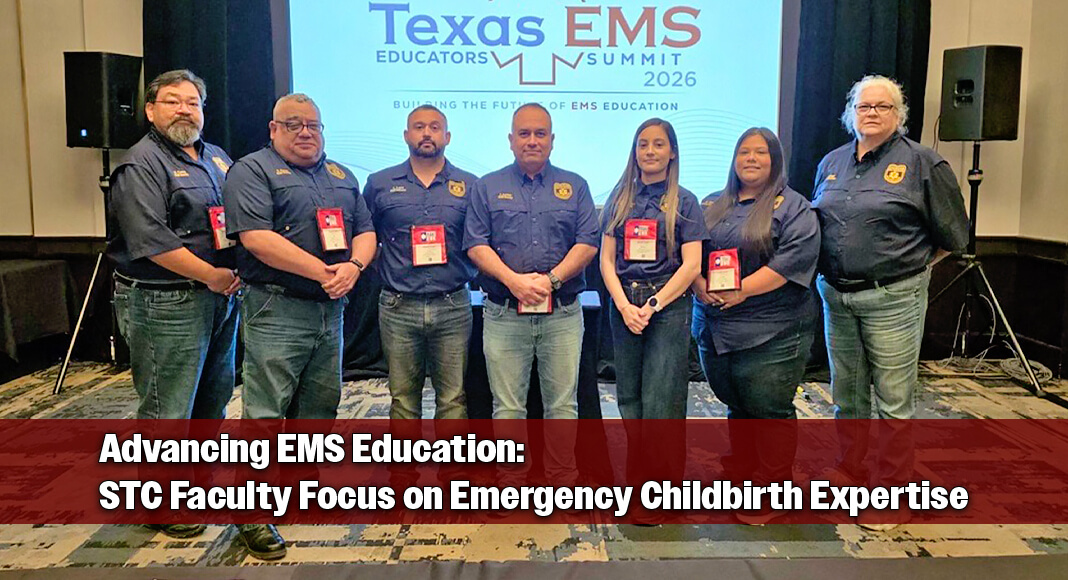
Seven faculty and staff members participated in the statewide professional development conference in San Antonio, completing the Obstetric Life Support (OBLS) course, a specialized certification that prepares first responders for childbirth-related emergencies through hands-on training and real-world simulations.

“Faculty are now able to bring more knowledge into the classroom and lab, giving students the critical skills they may need when facing an obstetrics emergency in the field,” said STC EMS Program Chair Carlos Tello. “These situations may not happen every day, but when they do, providers have to be ready.”
Led by an obstetrics physician, the course combined online instruction with immersive simulations focused on emergency childbirth, postpartum complications and pregnancy-related medical emergencies.
STC faculty practiced responding to high-pressure scenarios, while learning updated techniques and communication skills designed to help first responders act quickly in critical situations.
“This is one of those subjects where, because it doesn’t happen often, people don’t always refresh on it,” EMS faculty member Edgar Flores said. “But when it does happen, it has a big impact. It’s important for us as faculty to stay updated so we can pass that knowledge on to our students and better prepare the next generation of emergency medical technicians (EMTs) and paramedics for the field.”
Flores, who has worked in EMS for 13 years, said emergency childbirth calls are uncommon, as most patients are able to make it to the hospital before delivery.
Throughout his career, he has assisted in four deliveries, experiences that occurred years apart and often under unpredictable circumstances.
“We teach our students to be ready for anything,” Flores said. “We don’t see these situations very often, but when they do happen, you must know what to do, there’s no time to hesitate.”
Obstetrics and emergency childbirth response are taught at every level of the EMS program, including EMT (EMT) Basic, Advanced EMT and Paramedic, helping ensure students are prepared to respond to unpredictable medical emergencies that, although uncommon, can still happen in the field.
For STC Lab Assistant Karina Heredia, a certified EMT, the training expanded her understanding of medications, emergency maneuvers and the decision-making process first responders face during high-pressure situations.
Heredia said the course also helped her better understand medications commonly used in emergency scenarios, including their purpose and dosage, knowledge she said will strengthen both her own preparation and the instruction students receive.
“Part of my job is helping prepare scenarios for students to practice, so I was grateful for the opportunity to learn alongside faculty and better understand these situations,” she said. “As an EMT, it helped me become more prepared and gave me a better understanding of what our students may face in the field.”
Heredia added that the experience challenged participants to think critically in fast-paced situations, reinforcing the intensity of the emergency scenarios STC faculty often ask students to complete in class.
“They really made us think and second-guess if we were right about what we were doing,” she said. “It was challenging, but incredibly eye opening.”
According to Tello, the certification reflects the program’s continued commitment to strengthening instruction. Faculty who participated in the training are expected to incorporate the updated techniques and lessons into classroom instruction and hands-on labs across all levels of the EMS program.
“We are preparing the next generation of EMS professionals to care for us, our families and our communities, so we want them to be as prepared as possible,” Tello said. “Our students are our first priority, and when the unexpected happens, we want them to have the knowledge, confidence and training to respond.”
For more information on STC’s EMS program, visit southtexascollege.edu/academics/ems/ visit or call 956-872-3027.